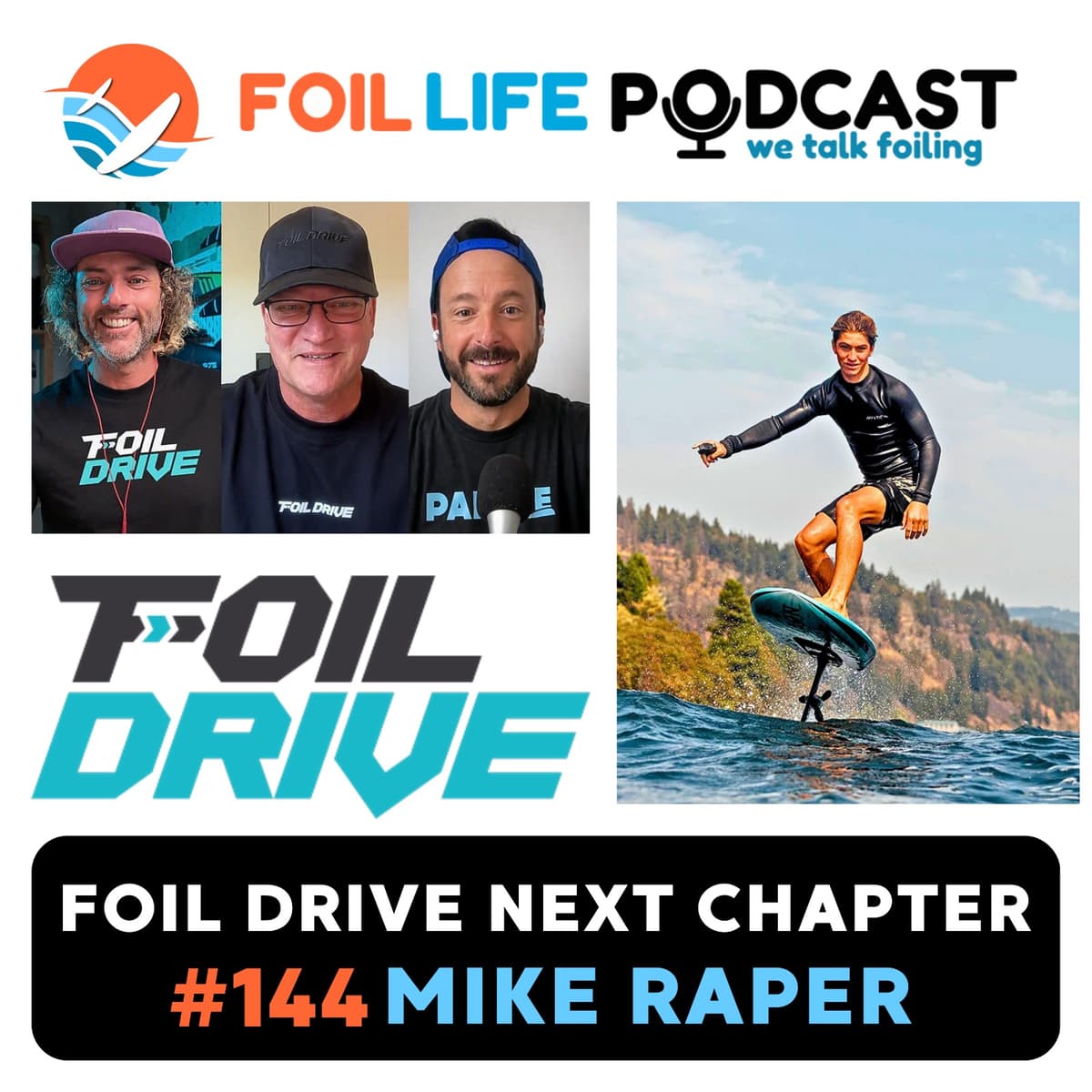
Foil Life Podcast · Episode #144
Some people stay in the lane they built. Mike Raper stepped out of his.
After years at the centre of wind sports, a health scare, and a stretch of time with family and forecast maps, he is now Global Brand Director at Foil Drive. On Episode #144 of the Foil Life Podcast, Luc Moore sat down with Mike and Nico Hopp (Hoppline) to talk about that shift, the product, the camps, and why assist keeps pulling more people onto foil.
It is not a product dump.
It is three people who already live on the water talking about access.
A break that was not just a holiday
Mike called the last stretch lucky.
He had been working hard for a long time. Then he had space. Time with family. Time to reset. Time to look at the industry from outside it.
Health was part of that. A brain hemorrhage a few years ago was, in his words, life-changing. It put a simple question on every morning.
What are we doing today?
The practical answer was swell and wind. New Zealand and Australia. Raglan to Ahipara. The east coast. Adelaide. Pacific swell. Roaring Forties. A few thousand kilometres of map and a few days or a few weeks wherever it was on.
About half to sixty percent of it was foil drive or tow foil. On the bigger days he was not fighting oversized wings. He was on a 35-liter board at 93–94 kg, on 680 to 800 wings, pumping faster off the trigger than on it once he was up.
It is not prone.
It is getting closer.
The industry context sits beside that story, not on top of it. When North consolidated brand, product and development into Europe and closed the New Zealand brand-and-design office, Mike’s Chief Brand Officer role ended with that team. His own statement at the time was clear: it was a structural move, not a performance call. He stayed on in a consulting capacity through the handover. The months on the water came after that chapter closed. Then he looked at where growth was actually coming from.
“I would have quite happily been unemployed for the rest of my life,” he told Luc.
He also said he had to go back to work at some stage.
Foil assist was what he saw.
People first. Then the product.
The attraction was Paul Martin, Ben Jamieson, and the crew around them.
Nico said the same thing from a six o’clock morning in Europe.
“It’s still surfers for surfers.”
Events run twelve hours. Then someone checks the forecast. Then the argument is whether to pack down first or go for a session.
Paul did not start from market share. He had a bung shoulder and a paddle he could no longer trust. He wanted a solution. Then he and Ben chased millimetres and milligrams: weight, thrust, runtime, drag.
Mike has only been on the inside a few weeks. What surprised him was not a secret prototype. It was the level of knowledge across the business — manufacturing, service, product.

Passion starts it.
Experience is what he thinks will keep Foil Drive ahead when other assist brands arrive.
They pointed to two films on the Foil Drive channel. The company story. And Gerry Lopez at 77, using foil drive to reach breaks nobody else is on.
Assist as another way in
A couple of years ago, a lot of people poo-pooed it.
Some purists still do.
Mike has watched sports arrive before. Windsurfing. Early kiting. SUP. Wing. Foiling’s different disciplines. From that seat, one of the easiest ways onto foil now is assist that bolts onto gear people already own.
Weights change. Boards change. Conditions change. Fusion, used for teaching, can run like a lightweight e-foil for ninety minutes or two hours depending on the rider.
Luc’s first session was Ecuador in May. About half an hour to get up, mostly because the demo board was slippery. Then it clicked.
Mike’s advice for riders who already foil is short.
One or two sessions on flat water.
Then chase lumps.
Waist-high is a different kind of fun to double overhead.
Not far off.
What camps do that demos cannot
Nico spent the summer under a heat dome. Little wind. Rivers like a warm bath. Fish dying. He escaped north to the Baltic and ran foil-drive camps instead.
One of them was supposed to be wing and wind with Winger of the Sea and Racer of the Sea. Twenty-five women. No wind. It became foil drive, more or less around the clock.
Beginners who had never foiled were flying.
Riders stuck on a jibe progressed because they could repeat the move.
Most demos are twenty or thirty minutes. This was days. Mike compared it to a ski week versus a single day on the hill.
The first session, Nico said, is the trigger.
How much you push. When.
After that the curve steepens.
Free demos still happen through Instagram and the Foil Drive site. The camp format is what he and Mike both want more of. Ryan, Ozzy, Josh in Hood River. Time on the water with people who can actually teach.
Fusion, Max, Slim — and a two-second pod
Nico lined the three systems up behind him.
Fusion is the long-runtime, high-power unit. He is racing e-foil events on it. His setup is around 11 kg. Many dedicated e-foils on the small end are still 20–25 kg. On a straight they can be a touch faster. In a tight turn he is catching up. Second in the runner-up section at Lake Garda.
Max is the all-rounder.
Slim is light and high-performance. Twenty, maybe twenty-five minutes of battery depending on foil and rider weight. If you only need fifteen or twenty seconds to get up, that is a lot of get-ups. Downwinders who stay on foil most of the time often do not need Max. Nico thinks Slim is still underrated.
The small part that changed his week is the Mini Pod.
Toolless. A flap. On and off the mast in a couple of seconds.
He used to leave the old universal adapter on for a twenty-minute family pump session because unscrewing it was not worth it. Now he tells his wife he will be a minute, pulls the motor, jumps on a tiny board, and goes pumping.
Robert at Ecuador Foil — die-hard prone, lightest setup possible — has been putting in more time because of the weight drop.
That is how you bring in people who previously wanted nothing to do with assist.
Faster off the trigger
Mike sees open-ocean downwinding as the high-performance growth line. A global downwind foil race circuit already has six or seven events on the board.
Nico named La Salle de Saint-Tropez, the Corsair Festival, mixed starts at Lake Garda. Power-wingers, paddlers and foil-assist riders leaving together.
The cheat argument does not survive a race.
“You’re actually faster if you let go of the trigger and get high up on the mast.”
He chased Dominic from Foil Drive Europe. The goal was to beat him once so he would not get fired. He could not cheat his way there. After the race he wanted another one.
On trigger to get out. Five or six seconds to get on foil. Then pump. Smaller wings. Smaller boards. Thinner masts. Mini Pod on a 73.
Pros at demos do not want the 105-liter midlength. They want Nico’s 14-liter board and a 770 Armstrong. They come back and ask if they can keep it.
Foil Drive is not taking winging or prone away.
It is another tool in the quiver.
Nico’s first unit has about 200 sessions on it, mostly freshwater. Still looks right. Rinse. A little lubrication. Modular parts. In Germany, Max and Slim units are showing up second-hand as people step to Fusion. Friends who would not buy new are buying used and getting in.
Paul’s brief on durability was simple.
This has to work.
What the job is now
Mike’s role is brand. Look, feel, how products get explained. Product management reports in. The three numbers he keeps coming back to are power and thrust, runtime, and weight. Beginners need runtime. Pros can live with less. Communicating that is the work.
He is also sitting with other foil brands so Foil Drive integrates cleanly with their masts and boards. After years on one side of the wind-sports table, he is working with companies he used to compete against. Some have already said they cannot wait. Others will take time.
AWSI was next. Nico was skipping it for a Fusion race in Nice. Luc was heading back to a coaching session in the lagoon off Blue Bay.
The through-line of the episode is not that assist replaces anything.
It is that more people can get on foil, more often, on smaller gear, in more conditions.
Listen to the full episode
Hear Mike Raper and Nico Hopp in their own words on Foil Life Podcast Episode #144.
Listen at foillifepodcast.com
Foil Drive · Gerry Lopez | Driven by Foil Drive