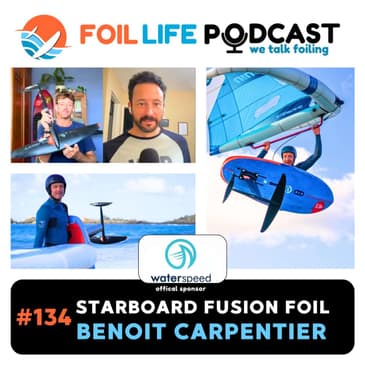


Episode Highlights:
- The story behind Benoit’s first signature foil: the Fusion
- How camber, profile, and span deliver massive low-end + high performance
- Fusion vs Glider 3: when to choose each
- New upcoming Team foils tech: less drag, more rigidity, adjustable length & angle
- Tips for riders of all levels: from beginners to advanced wave and freestyle
- The magic of testing with family and pushing prototypes in real conditions
Whether you’re looking for your next foil, love hearing about product development, or simply want inspiration from a passionate waterman, this episode is packed with practical insights and genuine stoke for the future of foiling.
🎧 Tune in for an inside look at Starboard’s latest foils and what’s coming next in 2026.
Brought to you by Waterspeed App the ultimate app for tracking, analyzing, and competing in wing, wind, kite, and foiling. Download now and join the community! 🌊✈️
[00:00:00] Hey everyone, welcome back to the show. On this episode we sit down with Benoit Carpentier of Starboard to chat about his brand new signature series foil called the Fusion. Now this foil looks super fun to ride. As you've seen in some of our reels he's taking into waves, he's doing a little bit of freestyle, some free riding with it. So we do hope that you enjoy this episode.
[00:00:24] Next I'd like to say a big thank you to our team. We have Frank, Stefan and Pam. Thank you very much guys for your continued work into 2026. Next, WaterSpeed is the official app of the Foil Life community. It's the app water sports athletes use to track their performance on the water. Connect your Garmin, Coros, Apple Watch, Vaccaros and it starts logging everything. Speed, tag, jives, foiling time, live tracking, VMG and polar charts.
[00:00:53] It's the kind of data that actually tells you whether you're getting faster and better or just feels like you are. It works across 30 plus water sports including downwind, wing foiling, sailing, windsurfing and it turns every session into something you can learn from. This is what performance tracking looks like when it's actually built for the water. So before you listen to this episode with Benoit, make sure to go over to WaterSpeed and download it. It's available on iOS and Android.
[00:01:23] Lastly, a big thank you to our sponsors for the 2026 season. We want to thank WaterSpeed, North Foils, Mystic and OnKiteboarding. Make sure to visit foillifepodcast.com forward slash sponsors to learn more about them. Now I hope you enjoy the show. Welcome to Foil Life. Whether you wing, kite, parowing, downwind, pump or e-foil, thanks for being here. All right, Ben. Thanks for coming on.
[00:01:52] Yeah. Thanks for having me. We're going to talk about some pretty cool foils and you've had your hands in developing this. First of all, how cool is that to be able to take part in the revolution and the evolution of a sport that we all love so much? How does that make you feel? Yeah, it's amazing to be a part of the journey. Foiling has been evolving the last few years and now it's been taking a big part into our water sports world.
[00:02:22] And so to be able to work on foils and be involved in the process with starboard foil the last few years has been amazing. And to have the trust to be signing my first foil actually that just came out this year, the fusion has been pretty amazing. And just from hearing the feedbacks from everyone that have been testing it since then, it's just been super amazing.
[00:02:50] And yeah, stuck to be a part of the journey. When did you start with starboard? I started with starboard with the SUP surfing. So I was basically from the, I've been doing from 15 years ago, water sport at high level. So following a stand up paddling competition and longboarding competition in the past. And I was on Nash, the first three years of my career.
[00:03:17] And after I got called by Sven Rasmussen, the boss of starboard group. And it's been a journey now for 12 years and starboard foiling, starboard foils have been coming up with the, well, whenever like GoFoil started. I think starboard was one of the first as well to make a foil ever with GoFoil. I think they were in the same time or even before.
[00:03:46] And so I got lucky enough to be traveling and to be joining some good friend, an Australian like James Casey. I was staying a lot with him doing a stand up paddling competition. And so I had the chance to, to try foiling as well, like super early in Hawaii. And from there, I got lucky with Starboard to get a foil and start on my journey.
[00:04:12] Because all those years of experience tying into a little bit of, we're going to talk about where the idea came from for your, your kind of the model that you're putting out. But all of those years of experience working with all the people that you worked with, how do you think that helped when it came to you designing something or you giving your input into something and say, hey, like, I want these features. I want this. And this is what it's going to do for me. Yeah, exactly.
[00:04:37] I think it's all about the, yeah, all the knowledge in the water and the fields that have been gaining the last 15, 20 years in the water. And that came into this idea of the foil of my design, you know? And yeah, I feel like it's all about experience, all about fields and all about what you want to draw in the ocean.
[00:05:00] And from there, you just, that's the magic of being able to create something that you, that take all the highlights that you want and what you want to do in the water. And what I want to do in the water is basically to ride waves and be as progressive and efficient and have the most ton of fun I can have. So this is what I put in my foil. So that is your new fusion model. So that's exactly what it's designed to do.
[00:05:27] Where did you draw inspiration from to kind of tap into this? Yeah, well, so it took me a bit of time before designing my first foil. And basically I've been doing a following a lot of the GWA, doing the first ever wing foil wave event in Cape Verde in 2019. Was it? No, I think it was 2021 maybe or something like this. You got a freight train.
[00:05:56] Sorry, you wrote that freight train. Freight train. It's like, yeah, yes. You know, you mean that Punta Preta? Yeah, crazy. Yeah, exactly. Yeah, yeah. So yeah, I got lucky to be there the three years we got the event. And so the first year I got second, riding one of the Starboard foils. That was the glider 2 at that point.
[00:06:22] I know Zane Schradzer at that time as well got third behind me. So that was pretty cool to see the foil going at some high level, I would say with Starboard. So that was pretty exciting. And then after I think the excitement just got bigger and bigger and from each and every year it evolved like crazy.
[00:06:42] And at some point after one year, two years competing, I was like to be able to follow the journey with this guy pushing the limits. Now I need to work on something closely with the chest door and Starboard foil to be able to actually follow these guys and be where I want on the wave.
[00:07:04] So this is where the idea of the fusion came and after four prototypes, we nailed it. So yeah, stoked. So do you have one that we can see and you can walk us through the different aspects? Sure. There it is. There is the fusion. So with my little signature here, thanks to Chess. I'm putting this in there. So basically, this is a medium aspect foil.
[00:07:33] So it's really comparable to the MA from Armstrong a little bit. That's pretty much the same outline, not exactly. It has a bit more curve into it. The Armstrong is a bit more flat. But basically, the magic of it is the span actually and pretty much the profile and the camber makes the wing so much forgiving.
[00:08:01] It's crazy how much low hand and in the same time top speed you can have in this foil. So basically, from the profile we have and the camber, it gives that super low hand comfortable takeoff and stall speed. But in the same time, still the thickness and the profile here gives you like super high performances and top speed.
[00:08:28] And as well with the thin tips, actually with the area, the span that is 68 cm for the 625. So it jumps from 4 cm every time after it gets bigger and bigger. Basically, you still have a lot of glam too. So it happens to be for all round condition and stuff.
[00:08:53] It happens to be a foil that works in high wind, low wind. And for someone like me that I'm 73 kg, I can pop it up in pretty much nothing, which is great. And then after for freestyling, it works great as well. It's super nice and easy. And yeah, just for waves, I've been having some great feedbacks about it.
[00:09:18] So I'm just stoked to see some other people as well are getting in the move and really liking it. So yeah, it's pretty exciting. I actually have a 525 coming now with Tuesday. Oh, really? We have it in 525. So 525, I'm going to get the first sample, I think, in the next week or the week after, because actually it's crazy how much low hand I have in some huge waves.
[00:09:43] It's getting tricky to keep the foil in the water and stuff because it won't lift a lot. So this is why now I'm creating a 525 even for like a lighter person, lighter people, because it's that easy to get it up on foil. So I'm actually making a smaller, smaller model. And yeah, we also have 525, 625, 725, 825 and 925. And right now we are going to work on the bigger size as well.
[00:10:13] As the bigger size right now are a pick from actually the old E-type model and wave model that we have in the past. But for beginners, pretty much, it's really stable. This is what I'm using as well for my school. I have a school here in Brittany, France. Oh, awesome. So it's pretty cool to get the people up on flights easily and nice and safe. So with the bigger size of the Fusion.
[00:10:42] So it's great to see people evolving from a beginner to more advanced, but still with a super, a lot of ease in the foil. So that's what I wanted for that foil as well. Now, looking at that camber and improving that low end, because that's something that a lot of brands have been talking that they're working on. You're in essence, what you're allowing people to do is go with a smaller foil and gain that benefit of riding something smaller,
[00:11:10] but with more of that low end. And so that's quite interesting. So how did you come into that concept? And how much did you want to add versus because there's so many variables, right? Yeah, exactly. You don't want too much low end as well. You don't want too much camera as well, because then after it drags a lot and you don't go so fast. So it's all about the calibration and to put exactly what you need.
[00:11:35] And the idea came from being looking at so many brands and testing stuff. To be honest, especially with that KT, as we were talking about it like earlier, I think with Kane, that's been one of the standouts into foiling development and stuff since a few years, we have seen it. With now the new mask that he made, we are inspired by all these guys for sure.
[00:11:59] And so the camber definitely on that wing came like from the inspiration with all the other guys doing it as well. And it's all about the balance, as I say, and I feel like we found it pretty nicely. And it's crazy how people actually can jump on a small foil. And what you will notice when you jump on a small foil, sometimes, well, it's easier at the end. You know, once you fly,
[00:12:28] it is easier. Everything is so much easier. You go, you have a bit more glide, a bit faster, you know, a bit more speed and speed is the key, you know, to be able to, to be stable and to be able to, yeah, just have fun, you know, it's all about speed. What matches best with this front wing? You designed some new stabs as well, correct? Yes. So right now I have the BC stab. So same, I made a front wing.
[00:12:58] I was like, I'm going to make a stab that works with it perfectly. So basically this is what I made. So it is pretty flat, super flat, very thin. Um, so, uh, with not a lot of cords in the tips, uh, still a bit of cold here to have a lot of lift and control and still have, um, bit of, um, span to be able to glide nicely as we are reducing the,
[00:13:28] uh, the span of the wing of the front wing. So my idea was to still get a lot of stability, really a bit of stabilization from the back and glide because we're losing some from here. So, um, yeah, it's pretty amazing. Um, uh, with the, as well, the, the shorts, uh, span here in the tips, it's really maneuverable and the flats, uh, flat profile. So, yeah, this is the one I've been using with this fusion,
[00:13:57] but not only, it's been crazy how efficient it is for the older model. Um, so for example, uh, in the back as well, the glider free that has been involved as well, a little bit into the, the, the testing of it. Then you show it to you. let's see this thing. For those new to starboard foils, we're looking at this as more of a kind of downwind. Yeah. So we have the starboard range. We have the low medium aspects.
[00:14:27] And that is the fusion. Then we have the high aspects. That is the glider. Three. We are at version three. Okay. That is, uh, all round, uh, for, for downwind, uh, someone that want a bit more glide, uh, and still like ease of use for aspect. And then after we have the glider pro that is a high aspects. High performance, but definitely less low hand and stuff.
[00:14:54] So it's more for advanced people that want to go fast and glide. And we have after the MF, that is, uh, one of the foil, uh, just designed for downwind. So super high performance and just gliding. You don't want to turn. You just want to go straight and go as fast as you want in the bumps. So four different foils. Cool. All right. I'll let you continue on this one. Yeah. So, um, yeah. So that one, uh,
[00:15:24] we were talking about the style. This is the BC stab. So I'm using it. I'm loving it with all the other wings. So the MF, uh, with also for downwind, as it's really flat, it glides a lot, which is great. So for that one, as you can tell. Yeah. Big difference in length right there for those on audio. Exactly. Yeah. Much shorter. Okay. Yeah. Yeah. Much shorter. So we have, um, two different size of fuselage. Uh, we have a 60 and we have a 66.
[00:15:54] So a bit more control, uh, the shoulder one shoulder fuse is going to be more for wave orientated or for, um, um, toe foiling if you want, or like pretty much, or, um, freestyle. I'm using it as well for freestyle to have a lot of pop. So that's the two difference. Mm hmm. Regarding the stud. And then after, if we talk about the front wing, so if we compare the fusion and, Oh,
[00:16:24] you got a lot of difference there. Yeah. Yeah. So the fusion, exactly. Yeah. So the glider three is definitely more flatter and the fusion definitely has a bit more curve, but the profile is a bit different. That one is a bit thicker in the fusion because one of the main thing I want as well is to be able to do some big slide of the lip and without my, without my fall, just like, like not engaging, you know, on the surface of the water.
[00:16:52] So one of the biggest goal for me as well was to be able to do this crazy dark slide. So that's why the profile on that one comparing to that one. So fusion compared to the glider two, glider three. Uh, is the profile. So the profile on that one, glider three is definitely thinner than the other one to give a bit more speed performance. I would say, uh, yes, but still as well as the other one,
[00:17:23] we find this camera. Hmm. So same kind of peak, a bit less camber because it has more span. So you actually get the low end from the span and the span and, um, and yeah, you have this extra with the camber. So you don't need that much camber. Uh, because it's so slow you down at some point. And so that was the goal behind it. And, uh, yeah, it's basically super efficient. Uh, that seven 50.
[00:17:50] I'm using it for light wing winging or surfing. Super easy. I can pump around. I can get up and nothing. Uh, it's crazy how efficient it is. And, uh, it's interesting because I have all my family riding with me, uh, lucky enough to have the water just in front of me to be able to look at it and keep an eye on it. If there are some bumps. And, um, so all my family is riding, uh, starboard for, for the last few years.
[00:18:19] And it's been great to have them as a test tester as well. And so it's been crazy to see, uh, with this new shape, how they can all go. So it's just lower in size. It's, it's crazy. And so get more excited about foiling, um, because of that new, new profile. So that's the wind they using the most. Uh, just because it's for all around stuff. It's super nice and easy and comfortable. And for light winding, um, it's super efficient. So, you know,
[00:18:49] you're not going to get stuck in the water when you go in game, you know, you're going to be easy, nice and easy to get up. And for, at the point where they are, where they are looking for doing tags and jibes and have the nice glide, why the wind foiling, uh, they definitely have been more glide and forgiveness, coming from the fusion. So that's the go to, um, and yeah. So the glider would be, would be that like looking at both of those,
[00:19:17] even the models that you designed for the fusion, what would be your ideal rider for that foil? Yeah. So basically, uh, fusion is going to be for freestyle. It's going to be for wave, uh, orientated, um, can be as well in the biggest size, if you want something that is super like aggressive, uh, if you want to be after, uh, more into a free ride, uh, winging, surf foiling,
[00:19:47] pump foiling, surf foiling, and pumping forever. Uh, that's going to be the glider free, uh, that got pretty much everything out of it. Um, then intermediate advanced, they can kind of all handle the fusion. It's designed in such a way, like you were saying that. Yeah. Okay. So there's no problem. So glider free and fusion are easy, easy to get up and super easy.
[00:20:16] Just a bit more surf for surfy feeling and, being able to slide and stuff. If you like trying to evolve a little bit and do this kind of approach. Um, so the fusion is going to be the one. If you want to be more about cruising, doing the downwinder, upwind, downwind, and, uh, just fump around, be super easy, uh, and glide. Uh, that's more going to be about the glider, glider free. Okay. Yeah.
[00:20:42] What else did you guys have coming out in the 2026 range that you would like people to, to know about that are just like, we're just starting to see a little bit of information out there about what you guys are coming out with. Um, yeah. So basically, uh, from 2026, that's going to be, that's going to be eat for the ranch, but we have some exciting stuff as, uh, with starboard. It's always been about innovation. And so that's the great part about it to be about of this kind of brand is that,
[00:21:12] you know, that they always going to pop with something new and something that you're going to be, I don't know how we can make it better. And every time they're like popping up something. And this is the most craziest part of our starboard. And every time I'm going to deal a meeting and stuff, I arrive and I'm like mind blown by the evolution every time. So that's one of the big thing. And for the next year, I got lucky enough to bring back a few prototypes because of sick. Yeah. Yeah.
[00:21:42] Because, uh, so every year I'm lucky enough to go to Thailand where they're based and to do the photo shoot in Bali. We have a cool event like for SUP, uh, longboarding in Bali every year. So every start of the year in March, April, um, around, uh, yeah, Asia. And so every time I bring a lot of toy back from there. And so just before coming back here, I was in the restaurant, but just done. I knew this was this, this new fuselage coming out.
[00:22:12] That is, if you compare to the other one, definitely fear. Okay. And so I was like, Oh, can I take it? And he was like, he took it back just from his car and just like, give it to me. And I had the chance to test it actually downwinding, because this is the one you haven't seen. This is the NF. So as you can see, it's a super high aspect. Uh, and so basically we are looking for something that has even less drag. Um,
[00:22:40] because the reality with the, um, with the UCS connection, the other one, it's thicker. So it drags a bit more, but it's the strongest on the market and the more, um, rigid. So after doing a lot of tests with starboard, we found out that this is just like, in terms of rigidity with the four bolts, you have four bolts on the fuse, latch connection to the mast. If you see here,
[00:23:07] you can see maybe the difference in terms of thickness. I don't know if you can see, uh, not easy. A little bit, but basically, so this is the strongest. So we wanted something to be a bit more high performance. So this kind of come as the team series. So there's going to be, that's going to be a model block here. I still have a bit of bolts, two bolts here, but it's going to be no bolts, uh, when we're going to be ready, 100% with it.
[00:23:36] It's only going to be four bolts. Okay. Uh, from the mass, so you can still still switch and be easy to, to travel with. And so, um, this comes as, uh, with the Titan, uh, not titanium. Uh, I lost it. Uh, as he, as he, sorry. Stanless, yes. Yeah. So this is a metal.
[00:24:07] This is metal to have the, the most rigidity and strength and, uh, durability as we can in the fuse. Cause since we are, uh, definitely thinner, uh, less volume and stuff, this is not as strong. So we're looking for the stiff, stiffest thing as possible. So that's why it's using, uh, metal now. And, um, it's been just like mind blowing out efficient. It is, uh, for my downlander. Um, this is a six 40 foil. Without any camera.
[00:24:37] That one is designed to just go fast and to glide, to glide, to glide any bumps. You will feel it and you will glide. Um, and I've been just mind blown by how easy I can still get it up. Um, because of the less drag, I can feel directly the less drag when I'm pumping my foil. And this is pretty crazy to think about that. Just, just pumping the foil up.
[00:25:03] I can reduce even the size of my phone wing because I have less drag. And so more efficiency getting up paddling. Um, so this is pretty crazy. And once you have on the foil, it's, uh, just so much more efficient. So, um, yeah, this is one of the great highlights about it. Uh, uh, one of the exciting thing coming. So where do you, now that you're more into that foil development kind of world,
[00:25:31] where do you see the refinements coming in the years to come? Obviously drag, we're trying to reduce, everybody's wanting to take off faster, get more speed and have less drag. In essence, those are kind of our three and maneuverability, right? Yeah. Yeah. So basically when you do that, uh, you can lose a lot of, uh, rigidity and strength. So this is where, uh, it is all, I think for every brand.
[00:26:02] And since we have these fuselage with four bolts, uh, that gives a lot of advantage into this development now. Um, because yeah, our mast are super stiff, uh, from all the tests we did in the market. So that's amazing. Uh, and then after having this fuselage system, uh, we're going to be able to work on that and still keep that rigidity and, uh, strengths. Um,
[00:26:31] so it was great to, uh, that chest came out with this idea of, um, introducing this UCS, um, system two years, one year ago, we've been working on it one, two years now. Um, but, uh, yeah, at first when he came with this idea, I was like, I wasn't the same. It wasn't the only one, but like, this is way too many bolts, uh, like comparing to all the brand and stuff. This is too much. Uh, uh,
[00:27:00] but at the end from the strengths I get and just the durability of the products. And now with this idea that comes here and gives a lot of, uh, perspective of evolution, uh, I'm pretty, that was a smart move to me. Um, if we look at the fuselage right now as well, the good thing about it. So for sure you have many bolts. So for, for the connection, then after you have one, two here, one, two, three in the front.
[00:27:30] So you can see as well that there are many different, um, hole. So that gives you the avail, the, the possibility as well to add like a shin right here and to adjust the lengths of your fuselage in the front and in the back. So that's another highlight that is pretty cool. Actually you can, uh, you can have a few CM if you want a bit more stability, if you want something a bit more loose, you can always adapt. So, um,
[00:27:59] as well as I'm she here until, yeah, I have some shim so I can as well play with the angle of my follow. So basically it comes with the zero degree. So any customer that buy the full and that wants something that works straight away perfectly, they just put the foil that don't use this, but if you want to, you have the opportunity as well to adjust this. So that's one more point that is, uh, really interesting. Coming from your perspective,
[00:28:30] what does that extra length, like, do you need to be a certain level to be able to enjoy that? Or do you think an average rider at home could tweak that and say, Oh, that does make my turning or this or that, that much better. Yeah. I feel like you can feel it's definitely, yes, it's actually crazy from, uh, how picky are, is foiling, how you can feel things. But, uh, especially with the front, the front and the back, you can feel like pretty much directly that you have a bit more stability
[00:28:59] or a bit more maneuverability. So it's, uh, it's, it's interesting, you know, if you are, uh, super excited on foiling, this is one of the cool thing, you know, to be able to switch back and be on. Whoa. Okay. Something different than try to steal. Yeah. So I feel like this is a great thing about it as well. Anything else you want to add about your model? Um, maybe materials, how it was built, any of that kind of thing that people might want to know at home? I'm just super stoked. And, uh,
[00:29:28] thanks to all for putting the, uh, into the loop because, uh, I'm having a lot of fun. Yeah, I can imagine it. It's, and it is really fun to know that your foils would be out there, have helping people have a great time on the water. And all those years of experience that you've put in and all the different conditions that you've ridden in have gone into designing this kind of thing. So congratulations. It's quite the feat. Yeah. Thank you very much. You're welcome. Oh, Hey Ben, thanks for coming on to introduce this, this line. We're excited to try them. We're excited to see them.
[00:29:59] And, uh, I'm sure we'll be talking to you guys soon and I'll see you in, they'll be at AWSI. So I'll get to test them there at the latest. Oh yeah. Cool. Well enjoy. Thanks for having me and, uh, see you guys in the water. Hey guys, thanks for tuning into this episode. We really do hope you enjoyed it. If you can do us a favor as it helps our show grow, make sure to like comment and subscribe to our Instagram, Tik Tok and YouTube channels. They're all the same at foil life podcast. Thanks a lot for doing that.
[00:30:29] And we'll see you in the next one. Bye.