
Episode Highlights:
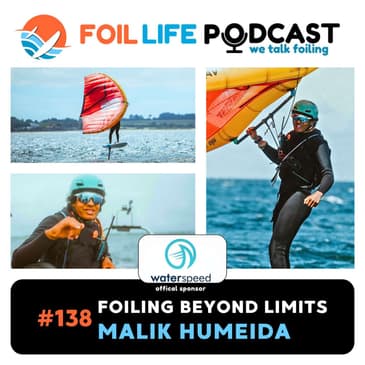
- Malik Humeida’s Guinness World Record: 375 km wingfoiled in 12 hours
- Plans to connect with Jean Legal for his upcoming 24-hour Windsor Foil night challenge
- The mindset and preparation behind massive endurance wingfoiling efforts
- Recovery after record attempts and balancing training with real life
- The emotional payoff of achieving a long-held goal and inspiring the foiling community
- Future ambitions and what’s next for this driven wingfoiler
A fun, motivating, and high-energy conversation full of stoke, respect for big achievements, and ideas for the next generation of foiling challenges.
Follow Malik Humeida on Instagram @malik_humeida for more on his record-breaking journeys and upcoming adventures.
Brought to you by Waterspeed App — the ultimate app for tracking, analyzing, and competing in wing, wind, kite, and foiling. Download now and join the community!
[00:00:00] Hey everyone, welcome back to the show. I apologize for the background noise but I'm currently in Paris Airport on my way to Mauritius to work with Jean de Valbert, the owner of the WeGlide Foiling Kite School. If you're looking for an amazing place to come and learn how to foil this winter, make sure to look up Mauritius, check out the kite school and send us a DM at the podcast to come and learn with us.
[00:00:22] Now, on this episode we talk with Malik Humeida about his world record wingfoil accomplishment. Malik wingfoiled 375km in 12 Hours. We talked to him about his preparations, how it felt during the feat and how it felt afterwards. We want to congratulate Malik for this because it is going to be a Guinness Book of World Record. Congratulations my friend, those things are very hard to beat.
[00:00:47] So we do hope that you enjoy this episode. Next, we want to say a big thank you to our team. We have Frank, Stefan and Pam. Thank you for your hard work behind the scenes that makes this show possible. Next, WaterSpeed App is the official app of the Foil Life community. It's the app that water sports athletes use to track their performance on the water. Connect your Garmin, Coros, Apple Watch or Vakaros and it starts logging everything. Speed, tax, job, foiling time, life tracking, VMG and even polar charts.
[00:01:16] This is the kind of data that actually tells you whether you're getting faster or just feels like you are. Follow Kylie Debelef, she had some pretty cool reels out today all about this stuff. So it works across 30 water sports, including downwind, wingfoil, sailing and windsurfing and it turns every session into something you can learn from. This is what performance tracking actually looks like if it's built for the water. So before you listen to this amazing episode, we ask you to go download Water Speed now.
[00:01:46] It's available on iOS and Android. Lastly, we want to say a big thank you to our sponsors for the 2026 season. We want to thank North Foils Mystic on kiteboarding and water speed. If you want to learn more about them, visit foillifepodcast.com forward slash sponsors to learn more. Now, I hope you enjoy the show. Welcome to Foil Life Podcast by SFT. Whether you wing, kite, parowing, downwind, pump or e-foil, thanks for being here.
[00:02:15] Hey Malik, thanks for joining me on the show, man. Hey Luc, thanks for having me. Frank reached out, I think it was a couple weeks ago, because he had found your story. And this world record that you guys just did is insane. We want to learn a little bit more about that today. Yeah. And find out about how that felt like. Yeah, I'll start to tell you some details about it. Yeah, man. Where did the idea come from? Well, I have to think about it. So it's a bit of a long story.
[00:02:45] When I was younger, when I was a child, I used to do a lot of windsurfing. And on my local spot, there's a lighthouse far out on the sea, like, let's say eight kilometers. And you know, when you're younger and you push yourself with your friends, you want to see who can jump the highest or go the furthest. So we had the idea for a long time to go out to this lighthouse and just ride around it to see how it looks like.
[00:03:14] And then all of a sudden, I started competing in wing foiling. And when my level improved, these eight kilometers have not been a challenge anymore. So I searched for that project, which is a bit bigger. And yeah, then we slowly, slowly the idea of the world record came. And then it took me a long time to realize it. But now we did it.
[00:03:42] And what was the actual world record? Let's look for the actual kilometers, because it was 380 kilometers in 12 hours and 34 minutes. That's what I achieved according to my GPS tracker. And the official Guinness World Record was set by Dimitris Apelagakis, the Greek guy, who did, let's say a downwind between, I think it was Athene and Crete.
[00:04:10] And it was around 295 kilometers nominal distance. And that's something most people don't understand. If you apply for a Guinness World Record, you have a huge rule book and things you have to follow. So how you say the calculated distance is the direct distance between two fixed points. It can be length points. Exactly.
[00:04:37] So what I did is I wrote these 380 kilometers between two bouillies. But, you know, you go up and down on the foil and you might also not be on that line between the bouillies. So that distance is not counting for the Guinness World Record. And the nominal distance I actually said, according to Guinness World Record guidelines, is I think around 350 kilometers.
[00:05:07] So there's a bit of a small difference. Oh, I see what you're saying. Okay. That doesn't take away from what you guys achieved at all. Um, cause I can't imagine winging for, for 12 hours. How did that, how did you train for that? Apart from just giving it for longer periods of time.
[00:05:29] Yeah, I think if you, if you see this project, you only see the results, but for sure, there was a lot of training going into this. Um, I've been training specifically for it for around, uh, yeah, half a year or maybe a bit more since winter. And I also did two long distance practice attempts.
[00:05:55] So, uh, I was training, uh, in the beginning of this year between March and April for a month on Frequentura. And there I did, uh, yeah, alone. I rode for six hours and just to see how far I can go, how I, how I have to manage my hydration and nutrition. And there I reached 200 kilometers in under six hours. So that was the first time where, where I actually realized, okay, what you're dreaming of would become reality.
[00:06:24] And then I did something a lot more stupid. Uh, after my training month in Frequentura, I came back to Germany and there's a huge temperature difference. So I came from, let's say 25, 30 degrees to five degrees in Northern Germany and freezing water.
[00:06:47] So I came straight back here and decided to go in offshore conditions and really stormy winds, uh, for seven hours. And I had to use gloves. I had to use a hood because it was so cold. And luckily, uh, nothing broke. Otherwise I might, would have not, uh, got back to shore in time. So, and that's also another training session I did.
[00:07:10] You don't think of the safety implications for offshore if you're so used to warm water and what the difference is when you're sailing in cold water, right? Yeah, exactly. So, uh, I did carry the GPS tracker, but, um, it didn't send the information to my, to my safety team when I did it alone, because there were some issues with the, with the signal in my bag.
[00:07:36] And that's how things can go really fast running in, in these long distance kind of trainings. So I would recommend everybody to not do it alone and, and just make sure that there's a specific level of safety insurance because, uh, yeah, you always want to go back and come after your session, no matter how long it was. And it's not worth to risk anything. No, that's true. That's absolutely true. How far apart were your buoys?
[00:08:03] So, uh, on the world record attempt was, uh, 10 points or four kilometers. Um, and it was around two and a half kilometers offshore. So we ensure that we have flat water, but, uh, also, yeah, not too bumpy water. That's why we did it so close to the land. And so you were able to achieve the Guinness book then because you had mentioned that, that there was some technicality issues around it. Yeah.
[00:08:32] So they, to, to make an unofficial record, an official one, uh, you need to send in a lot of information to Guinness world record. In order for them to verify your attempt. Mm-hmm . And in my case, I needed a witness team of four witnesses who worked in shifts and documented my, my lab time around these buoys and also the video evidence.
[00:08:59] And then, yeah, you also have to use several GPS tracking methods. And as soon as you send it there, it can take up to 12 weeks until they give you the go and say, give you the information that you now hold the official record. So we are still in this, uh, verification process. Oh, interesting. All right. Just to make sure, cause obviously their criteria has to be pretty strict, right? Exactly.
[00:09:26] I mean, in sports records are really important and, um, I can fully understand that they set up these, these hard, hard guidelines. And yeah, it was also a big part in the preparation to make sure everything is according to the guidelines and we can make it official then. Now, what were the conditions like on the day that you were doing it? Where did you do it? How cold was it?
[00:09:55] And how much wind and swell did you have? So, um, it was the temperature rose, um, during the day for sure. Uh, we started maybe in around 12 degrees Celsius air and then it rose up to 15 degrees and the water was also around 12 degrees.
[00:10:16] So, um, maybe better to imagine I used five, four, uh, wetsuits and, um, that was the setup for, for the temperature. And the wind also changed a lot. So, um, as you cannot change your course, as you have to go in between these booyahs, um, wind, wind shifts from the wind directions are really crucial.
[00:10:41] So, uh, we started from a wind angle, which was a bit too steep for the course. And then it turned around more to Western direction during the day. And, um, with that direction change, the wind increased from around 10 knots to 27 and I had to stay on the big wind. So it was quite a challenge. Cause you're, you're not allowed to change the equipment unless it breaks, right? Exactly. That's the point. Whoa.
[00:11:07] And I mean, I, I have sponsors, but it's also not worth it to break the wing on purpose in order to, I just stick to my six five. You were in a six five and like 25 knots or something. On a really big racing wing with a big wingspan, but it was good to manage. Yeah. So what was your board and foil setup?
[00:11:31] I had an 80 liter mid length boards to make sure that I can start in light winds and as well as in strong winds. And then I used my to banga V3, which is a 530 square centimeters from, from the surface. And my wing was a value X race. Uh, there are usually racing when you see in wing for racing. And value wings are pretty good.
[00:11:58] I only had the opportunity to try them once, but I liked them. Our buddy owns a school in Greece, Kyriakos. And he brought down his wings cause he was teaching. And they were great. Actually they were light, they're strong, stable, and he loves them. So it was cool to see that you guys are, and we like Philip over there. He's a nice guy. Yeah. You for sure have a, have a big advantage with the, uh, double surface profile.
[00:12:23] And I think the, the fact that everybody in way for racing is using now these specific race wings, which would save. So for people who did not try them yet, uh, you just have a way better angle. Um, on, on up and downwind, uh, riding. And it also creates less drag, which means that the wing is more stable. It brings a lot of advantages for racing, but it's also pretty specific thing in wing for them. A couple of years ago, they were just starting to work on them.
[00:12:51] So it's crazy to see how far that's evolved. And, and that is the main staple. If your window was 12 hours, um, like, did you take breaks? Did you bring food? What about hydration?
[00:13:04] So yeah, that's the biggest challenge because I think there are a lot of strong riders, but if you have to ride continues for 12 hours and, and you, you fuck up your hydration or your, your calorie intake, uh, you're physically not able to do it. And to ensure that I used a camel bag on my shoulders with, I think a two liter water, water bottle in it.
[00:13:33] And then we refilled it after six hours. And additional to that, I had energy gels in pockets on my chest. And then I ate every, every hour, one or two gels and made sure that I get the, the calories I burn in this. Good as possible. But I can tell you if you only eat gels for 12 hours, uh, you're fucking hungry. Yeah. I imagine.
[00:14:03] I imagine. And did you take any breaks? What's that looks like? Do the feet go numb? Does your body go numb for that length of time? So my idea was to do breaks every two hours. Um, but I did not needed those two hour breaks physically. So I decided to do like two and a half hours of riding and then a bit of a longer break.
[00:14:29] And it was the hardest part when doing long distance is your, your mental game. So you're just getting really tired from seeing the same thing. It's a really monotone, uh, sport because there are snow that say like this, you have a really low dopamine level. And I think, uh, people are used to scroll on their phones and have these dopamine highs. And this is something where you really have to focus on that thing for 12 hours.
[00:14:58] And in this break, uh, you can, uh, re reset your brain and get back into that focus mode. Mm-hmm. And how long was your mass just to avoid problems? Yeah. That's also a pretty important thing on these race points. We have, uh, around 110 centimeters of mass length. And then I had an adapter adding maybe five centimeters more.
[00:15:25] So it just allows you to go to fly over bumps on the water and not crash from every small wave. And keep your, your board speed a little bit more stable and your board stable rather than going above and below bumps. Right? Exactly. You can fly straight, straight over them. Fascinating. It's a huge advantage for sure. So how do you deal with that? Cause my friend and I, we biked across Canada in 2008.
[00:15:55] It was like 6,000 kilometers over two months. And I'm telling you 12 hours of biking, which is comparable to what you did for 12 hours was mentally exhausting and difficult. And it's probably is the hardest thing I had ever done physically in my life. Just being able to focus on cause your brain just wants it to be done in some capacity because it is, it's the same thing. You're just pedaling. So did you listen to music or is it just something that you would just look around or try to enjoy the moment?
[00:16:26] So, uh, first of all, huge respect for that, that bike ride. It also seems like an insane finish. And, um, 6,000 kilometers in 57 days. Yeah. It was crazy. That's a huge distance. How did you manage to keep your legs working? I mean, being on the bike is also, uh, the force of pedaling on the bike. It's also destroying your leg, isn't it?
[00:16:55] Yeah. We, um, it, my buddy invites me out to have a drink one night and at a restaurant and he's like, Hey, I have this idea. I'd like to bike across the country. And I'm like, okay. You said, you want to come? I said, all right, I guess I got nothing to do. So I took a three month hiatus off work. Um, and then. We trained one day, we trained 65 kilometers and we both fell asleep for the rest of the afternoon. Cause we had never biked that long before. So we just jumped into it cold.
[00:17:26] We landed in BC. We had no idea what we were doing. We did like 70 K the first day, 140 the next day. And then my knee, it was mainly knees because you got to track properly. Cause if you track off and your, your, your kneecap moves over because your legs are tight, but it took us about 4,500 kilometers. So almost the whole way across to break the psychology and for our body to fall into routine.
[00:17:53] Once we hit that 4,500, I could have biked for years. Yeah. For me, it was similar. As soon as you got the first six hours in, um, you realize that it's, that it's realistic and then you are really focused on the goal. So maybe it was the same for you. Oh yeah. I hear what you're saying. Was it, did it seem the first while, did that seem like a mental hurdle that you don't know if you're going to make it and that kind of thing?
[00:18:21] Cause you don't, cause 12 hours is a long time on the water, right? Is it something that you ever think, I don't know if I'm going fast enough or I don't know if I'm going to hit the record because I don't know. There's so many, I don't knows in your head when you start something like that. Yeah. For me, what helped me a lot is that I had a really supportive, I had a lot of supportive people around me who actually believed in it.
[00:18:46] And to be honest, I was a bit, let's not say scared, but I, I was concerned, concerned telling people, okay, I'm going to break the world record in wing following. Especially for people who are not in the sport and don't know my abilities on the water.
[00:19:05] But every close friend or every family member I introduced into that project actually told me that it's possible and that helped me get my mind to it. Nice. And on the water, what helped me is that I did not thought about the whole 12 hours. I just only thought my goal is to reach the next fuya and that's what I did for 12 hours. And that's how it fixed my mind. Nice.
[00:19:35] And then I had smaller achievements and they added up to those 375 kilometers. Nice. That's a really good way. We had to do something similar. Uh, cause if not, you're, you're here at like our number one and then you're like, I want to be at our number 10 now. But if you do that, you're going to, you're going to be in pain the whole time. So short little things I found are really beneficial. So it's cool that you found the same thing.
[00:20:03] My, my issue was, or I think everybody's issue in enduring sports is that you, your mind cannot comprehend what 12 hours means. Or yes. You don't have any, any relation to it. You don't know what it means to, to do the same for 12 hours. So it's not helping you to think like this. The only way to do this is to break it into short, um, short, uh, distances to achieve and achieve and achieve.
[00:20:30] How did you feel once you accomplished it? So when I was preparing for it, I, I imagined that I will be out of mind screaming around, jumping around. Um, but, uh, the, the physical fatigue is so high after this, that you're just sitting there.
[00:20:55] You look, you know, these cameras and you look to your, to the face of your family and, um, yeah, you, you celebrate it, but in a more relaxed way than I imagined it for myself. But for me mentally, it was a huge relief to, to just get, get this project actually done and not to have to start over and over again, because the conditions are not good or you're, you're physically not ready for it.
[00:21:21] So, uh, it was, uh, feeling of relief to, to achieve it. That's fair. Hey, congratulations for that. That's a huge, thank you so much. What kind of safety gear and how many safety people were around you the whole time? So, uh, we had three boats ensuring only my safety, um, which followed me, uh, one boat always followed me during the record attempt.
[00:21:48] And then we had witnesses on that boat, um, who made sure that I actually follow the guidelines and that I'm not riding the boat for 12 hours, but that I'm actually wing falling. So that was, um, one thing we did. And then we had, uh, um, uh, micro microphones to stay in contact in case I want to do a break or I'm getting too tired or having cramps. And, uh, that's how we entered safety.
[00:22:18] And on top of that, I also had this specific impact vest, which I can pull similar to the big wave surfing vest. And then it inflates. So in case I'm seriously injured, I could have pulled that and keep floating on the surface. Okay. And what kind of speeds were you hitting? So, uh, far below my top speed in winged falling.
[00:22:43] Um, I managed to ride around, uh, 30 kilometers as a pace or 30 kilometers per hour. And my top speed was around 22 knots. So, um, it's not, you cannot compare it to course racing where you managed to go above 32 knots. So, and it's more about maintaining that, uh, high pace for 12 hours. Did you say 42 knots?
[00:23:13] Is there? No, no, no, not 42 knots. I'm not there yet, but, um, I, I myself, um, have a top speed around, uh, 32 knots, uh, which is equal. So I, I think it's above 60 kilometers per hour. 60. And during that record. Wow, man, that's fast. Yeah, it is. You, you should try the race for it. They're amazing. I hit 50 kilometers an hour windsurf racing once.
[00:23:43] If I was in Bonaire with Tati Franz at their center and it was my first time on slalom gear. And I think I hit 50 to 52 or something. And that, that's getting quick. Was it on the foil or on the fin? On the fin. Yeah. On the fin. Yeah. He's doing, he's doing 30 knots windsurf foiling and it is crazy to see that. Yeah. Yeah. Especially in windsurfing. I mean, I used to do it before the catapults are way more radical than in wind foiling.
[00:24:12] Right now we are also using the harnesses, but in the windsurfing being directly connected to the board, instead the crashes are way, way harder on the impact. Are you riding strapless or strap for this kind of a long durance event? Yeah. No, it was really important to keep staying in the straps because the race voids are really reactive.
[00:24:40] So if there's seaweed or if you touch the surface of the water, they are, you can crash really fast. But what I did when getting tired is that I went out of the back foot strap to move my leg a bit around and prevent it from cramping. But your front foot stayed in the whole time. Yeah. Most, yeah. Cramping is a legit concern for that length of a time. You're not moving a ton, right?
[00:25:09] When you're, when you're foiling, you're fairly stationary. Yeah. The force, especially as we had these long reaches of 10 kilometers, the force goes mostly to one side of the body for like 20 minutes straight. And what I felt when riding is that my, my calves and the upper back started to tighten a bit.
[00:25:35] And, and yeah, then I had to eat salt tablets to, to prevent the cramps a bit and not stay in a too monotone position in these foot straps. How much of a good meal did you have after this thing was over? Did you take a six hour nap after? You must've been tired. Yeah. I woke up and then we did the interviews directly in the morning, but then I ate a lot of food.
[00:26:05] So I think the 80, 48 hours after this, the whole 48 hours, I was only eating sugar. So yeah. Ice cream, cake, everything. Nice. All right. Who are your sponsors that help make this dream a reality for you? So material wise, I'm sponsored by VAYU and I'm using VAYU wings and boards in my racing, in my training, in my competition.
[00:26:32] Besides that, I, another big sponsor was Wave Up Y. They do surf clothing and ponchos and they support me since a really long time now. And then, yeah, another big sponsor of mine is Races First. It's basically my sports management and we're now building, trying to build a team in wing fighting to, air tech more professionally on the world tour.
[00:26:58] So, um, these are the main sponsors who supported this project. Yeah. Let's quickly go into Races First. Can you explain that for people who haven't heard about it? Yeah, sure. So, uh, yeah, the idea behind this is basically that we, we build a team of committed athletes who wants to get better. But as everybody knows in water sports, there's not so much money right now. So many athletes have to fund the world tour or any other events by themselves.
[00:27:26] And the idea behind Races First is that we, that we find sponsors as a team and not as an individual athlete. If you imagine that we have five professional wing foilers, five professional snowboarders and so on from a lot of different sports disciplines,
[00:27:46] it will be way easier to approach a big sponsors and it will be also beneficial to train together, live together and do this kind of stuff. So, um, everybody who wants to get into competitions in any sports, uh, make sure to check that out. Interesting. So that is racers first dash agency.com. Yes, that is the website and it's empowering the next generation of sporting talent.
[00:28:13] So that's pretty cool. Actually. I'd never heard of that before. Yeah, for me as a student, it's, uh, for sure hard to, to manage both. You have really high expenses in sport and in my eyes, this should not, uh, determine who is winning at the end. It's cannot be about money. It should be about performance. And, um, with Races First, I have the opportunity now to compete, uh, properly.
[00:28:42] Yeah, that's, that's exciting actually. Yeah. We're going to add the link to, uh, to the episode later. And even it would be fun to have them on the show as well, just to talk about it. So maybe we can talk to you about that afterwards. But, uh, congratulations again, to be able to set a goal, set it, like have a dream like that, work hard at it and accomplish it in today's world where everybody just wants to be on their phones. Congratulations. That's super exciting.
[00:29:11] Thank you so much. What's next for you? So for me, I mean, everybody who competes in racing and wing foiling now, uh, might dream about, uh, the Olympics. So there are some discussions going on now that, um, um, in falling is getting in Olympic discipline. And if that is happening, it would be my, my goal for sure.
[00:29:38] I think that's the highest level of competition you can achieve as an athlete, but long distance projects. I would love to run around an island just for myself, maybe with some friends. Uh, maybe it's going to be Lanzarote on the Canary islands. We will see. So I will keep you updated in that. I just wanted to say thanks, Malik, for taking the time to join us on the show today and congratulations again. That's an crazy feat.
[00:30:06] And we're going to follow you cause I'm curious to see what you're going to come up with next. Thank you so much. Yeah. It was a pleasure to talk with you about it. So, uh, looking forward to the episodes. And I wanted to connect you with our friend Jean Legale, who is in France and he was going to do this 24 hour Windsor foil challenge. So it'd be super cool to connect you guys and see what his thoughts are because he wanted to do it with flashlights on his boom.
[00:30:33] I am looking forward to have a talk with him and see how he, how he's preparing for events like this. All right, my friend, I hope you enjoy the rest of your day. What's on the agenda for you? So for today I already did my training. So I will do a bit of recovery and meet some friends and start good into the weekends. And what is that? You have a Guinness, you have a Guinness, that tag? Uh, yeah. Guinness world record.
[00:31:02] Ponsor t-shirts. That's awesome, man. Well, Hey, keep up the good work and congratulations for achieving a dream and anybody who's ever worked hard on something, you know, how you feel after. So congratulations. Thank you so much. All right, guys. Bye everybody. Hey everyone. Thanks for tuning into this episode. We do hope that you enjoyed it. We would love it if you could subscribe to our Instagram, YouTube and TikTok channels to help our show grow. We're constantly putting out some great content there.
[00:31:31] So that would be awesome if you could support us in this way. If you have any questions, comments, if you would like to hear a particular guest, or if there's a cool company that you want us to talk to, send us a DM and we will do our best to organize a chat. Thanks again for tuning in. We hope you have a nice day. Get out on the water and we'll see you in the next one. Bye.