
Episode Highlights:
The origins of Paddle Imua and how it transformed fundraising for Camp Imua
The breathtaking Maliko downwind run — scenery, conditions, and why it’s one of the world’s best
The foiling revolution: faster times, global participation, and new disciplines (wing foil, para-wing, sub-foil, etc.)
Camp Imua’s life-changing experiences for children with special needs and the incredible counselors who make it possible
Safety upgrades, finish-line logistics, and making the event welcoming for everyone
Training tips for first-timers, the welcoming local pro scene, and how to prepare for the Maliko run
Volunteer opportunities, virtual participation, donations, and ways to support the cause even if you can’t make it to Maui
The future of the event and the power of community, inclusivity, and giving back through watersports
A heartfelt, uplifting conversation about how one race can unite the global foiling community, create lasting memories on the water, and directly change lives for children with special needs.
Mark your calendars — Paddle Imua 2026 is happening very soon! Register, volunteer, or donate at www.discoverimua.com.
Follow @discoverimua (or search Imua Family Services) on social media.
Brought to you by Waterspeed App — the ultimate app for tracking, analyzing, and competing in wing, wind, kite, and foiling. Download now and join the community!
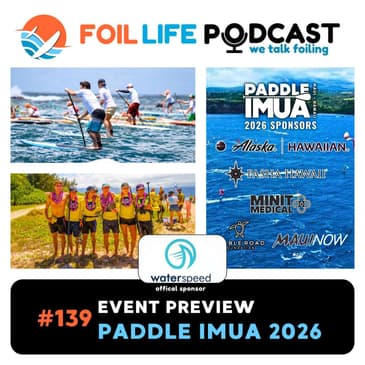
[00:00:00] Hey everyone, welcome back to the show. On this episode we sit down with Darris Hurst, the Events and Programs Coordinator at Imua Family Services on Maui, Hawaii to introduce Camp Imua and the upcoming Paddle Imua Downward Race taking place July 12th.
[00:00:17] Darris shares the inspiring story behind Paddle Imua now in its 15th year which started as a creative fundraising solution and has evolved into one of the world's most unique and inclusive Danwin Foiling events. We do hope that you enjoy this episode. Next we want to say a big thank you to our team, we have Frank, Stefan and Pam. Thank you for your hard work behind the scenes that makes this show possible.
[00:00:42] Next, WaterSpeed is the official app of the Foil Life community. It is the app that water sports athletes use to track their performance on the water. Connect your Garmin, Coros, Apple Watch or Vaccaros and it starts logging everything. Speed, tax, jives, foiling time, live tracking, VMG and even polar charts. This is the kind of data that actually tells you whether you are getting faster or just feels like you are.
[00:01:08] It works across 30 plus water sports including downwind, wingfoil and sailing and even windsurfing and it turns every session into something you can learn from. This is what performance tracking actually looks like when it's built for the water. So, if you are taking part in Paddle Imua Downward Race, make sure to download WaterSpeed and before you listen to this episode, make sure to go download WaterSpeed now. It's available on iOS and Android.
[00:01:37] Lastly, we want to give a big thank you to our sponsors for this season. We have North Foils, Mystic and OnKiteboarding. Make sure to visit foillifepodcast.com forward slash sponsors to learn more about them. Now I hope you enjoy the show. Welcome to Foil Life. Whether you wing, kite, parowing, downwind, pump or efoil, thanks for being here. Alright, Darris, thanks for joining us on the show, man. Hey, yeah. Pleasure to be here.
[00:02:04] Last year was the first year I got the opportunity to go to Paddle to Moor and it was amazing to see people from all over the world and all skill levels, all age levels. And it was such a beautiful and fantastic time out there. I thought it would be amazing to get you on, chat more about it. Excellent. Yeah. Paddle in Moor has been around for, this will be our 15th year this year. So we're kind of stoked to have that anniversary coming up. Seems like it's an anniversary year for everything that we do here at Imua Family Services.
[00:02:34] So why not just throw Paddle into the mix? But yeah, about 15 years ago we decided to create this event out of the need for fundraising for Campy Moor. It's a special needs summer camp, overnight, recreational. And it was really kind of struggling financially. And at that point in time, SUP was huge.
[00:03:01] People were going out paddling every weekend and really just kind of taking in what it was that Maui had to offer. And this downwind Maliko run from Maliko to what, I mean, was the harbor. It was super popular. And it immediately changed the way that we were able to fundraise for Campy Moor. And so over the years, it just kind of like things changed a little bit.
[00:03:29] SUP wasn't as popular anymore. And we were kind of wondering what was going to happen, you know? And then, boom, foiling hit. The evolution of the sports. I guess it really started with kiting and then just kind of progressed. And it's really, really cool to watch the progression of water sports and how it's grown. These wind-powered, like, runs now.
[00:03:56] It used to be an hour, hour and a half, two hours, three if you were, like, on the recreational side of it. Now foilers are coming in in under 20 minutes. And they're ripping. And it is just so amazing to watch these foils, not just one or two, but as a pack, cruise in and do this run. It's pretty epic, man. Yeah, it was. I think it was the last one out of the channel last year because I didn't hear the bell.
[00:04:23] But just to take off at the back of the pack and slowly pass people along the way. And, yeah, it was such a fantastic experience. And everybody was so friendly at the bottom when you kind of met up. And it was a really well-run event. And what were, do you have any highlights for some of the early days of people who happened to not be there? But there must have been some moments that stood out.
[00:04:46] You know, it's really what was cool about it is bringing people together, bringing the ocean community together, especially in those early years, to do something that's more than just a race. You know, there were lots of downwinders, organized runs on this course every year. There'd be six, seven, eight, ten of them. And they eventually all died out.
[00:05:11] And what we were missing when that happened was that camaraderie, that ability for us to get together and like have this moment. And so that's probably what you were feeling is that we're the last one now. People go and do this run recreationally or casually with their buddies or whatnot. But there's not an organized Maliko run race anymore except for us.
[00:05:35] The cool part is, is that we just happened to be uniquely positioned when the foil thing came along that, I mean, we were there. We were able to pick up that slack.
[00:05:46] So I think that just throughout the years, getting people together and doing this amazing, one of the most beautiful runs in the world, you know, and to have it be consistent, consistent weather, consistent wind, and just really kind of everything just aligns to make it amazing every year.
[00:06:08] So I would say that getting people together, like you said, the finish line and hanging out, we developed an Ohana festival at the end of it. So it's not just the run. You get music and entertainment, you get food, you get to hang out. And then, of course, we have one of the biggest lucky draw events on all of the island with over about $15,000 worth of gear and just amazing stuff from around Maui.
[00:06:36] So putting that all together, it's a lot of work, but it's so worth it at the end. Let's talk a little bit about Camp Imua because a lot of people that I talk to that go to this event, that's one of the reasons that they're willing to support and willing to take part because it's such a special thing that we get to do. Yeah, you know, it's unique to have this run, this race benefit something.
[00:07:02] A lot of the other races back in the day, they were just race to race, you know. So Camp Amua is really, it's one of the most special things that I've ever experienced. To be able to take these children and put them in an environment where there is a sleepover camp where they can come and thrive. I mean, we do some crazy events. We do helicopters. We do glow dance parties.
[00:07:31] We do ice cream socials, talent shows, beach days. We bring professional athletes and other organizations out to teach them how to get out on the water on a board. We do horseback or I mean, you name it, we do it. We pack five days full of just the most amazing activities for these kids. And the reason why it's so important is a lot of these kids, they don't get to do these things naturally, you know. They may have never spent a night away from their parents.
[00:08:00] They don't have a best friend to go do a sleepover with. Some of them are nonverbal and so they need constant care and somebody to look after them. So what Camp IMOA does is it provides that opportunity for these children in a way that you wouldn't be able to get anywhere else. Maybe in the world. It's really it's crazy this camp and how amazing it truly is. And what Paddle Imua does is it fully supports that.
[00:08:28] The fundraising aspects of what we used to do back 15, 20 years ago. It's a funny our committee head, Sam Campbell, she described it as ringing the bell at Safeway. And it's she said it's just not compelling. It's not compelling fundraising. You go there and you're basically asking for money and you're doing it one location and you're supposed to be a bunch of adults that are professional.
[00:08:57] And it just didn't kind of work to fund camp. And so when our CEO, Dean Wong, got together with Sam and a few other people, they had this idea to make this happen. And in the first year, they made three to five times as much money in a one day event that also created stoke.
[00:09:21] It created an environment where these special needs children could come and interact with these athletes and give them lay at the finish line. And like it really kind of embodied the whole idea of what camp is, which is inclusivity. At Camp Imua, we take high school and college age counselors and we pair them two to one with a camper so that this camper has somebody to help guide them through their day or their hour or their week. And then also gives them somebody to look up to.
[00:09:51] And it's really a beautiful thing when you watch these high school age kids, 16, 17, 18. When I was that age, I didn't give a rip, man. I really didn't. And I wasn't thinking the way that these kids are thinking now. And they actually become role models and leaders and they learn how to have empathy and they take that out into the world with them wherever they go.
[00:10:13] It is just truly amazing to see the full circle of what that actually means for our communities going further. Yeah, that's amazing. Thanks for sharing that. Now, you mentioned quickly that this Maliko run is like world famous. For those who happen to have not heard of it, what makes that run so special? You know, it's really cool to first and foremost.
[00:10:43] It depends on how you run it. It was more of a 10 mile run, which is a really good number. And now it's down to eight because the foils, when Foil and they came along, they don't allow the foils to come into the harbor because you guys are ripping so fast that you're crossing shipping lanes. And so the foils can't go there. So when we moved it to Kanaha Beach Park, it actually made a lot more sense for the event and for the safety of everything.
[00:11:14] But doing the run from Maliko, it's up the North Shore. You go through Paia, which is just a really killer, kitschy surf town. You go past Ho'okipa. That's where all the turtles go. It's also a local surfer destination beach. Big waves there, especially in the winter. You go almost all the way up to where Jaws is, where they do the big wave surfing. And then you get to come and leave the Maliko Bay. It's really protected.
[00:11:43] And you get out in the wind line and just boom, you go and you come back through and you pass all of that amazing stuff. And your background, your background is Haleakala, a volcano on one side that goes up 10,000 feet. And then you're looking as you're looking towards your destination. You're looking at the West Maui Mountains and all of Kahului. And you're actually coming into town. Meanwhile, you got the airport there. Things flying over.
[00:12:12] If you do it on the weekend, you might have a cruise ship. It's just literally everything that Maui has to offer, including the water sports and all of the scenery. And, I mean, I was just watching a video of Ridge doing this run, Ridge Lanny, the other day. And he's cruising. He's going 20-some-odd miles an hour. He's like, oh, turtle, there he is. Like, it's just phenomenal, man. How does it fit into the Koa Triple Crown?
[00:12:38] Because it's obviously the first race and then you have all these other cool kind of races that are taking people that are – this race I would say that anybody can do it. But then there's some others that are a little bit more advanced. But how is it cool to be able to kind of start this one and gather everybody and then see where people are lining up, let's say, for Maui to Molokai or Maui to Oahu or stuff like that? Exactly, yeah.
[00:13:03] Yeah, it's been a really, really neat and interesting relationship with Koa Kai. When they came around three years ago, it was called Koa Kai Triple Crown and it was based on three events, i.e. Triple Crown. Now what we've found out is that Koa Kai actually kind of means Triple Crown in a sense. So they dropped that off and the Koa Kai series is becoming a little bit more inclusive as far as the islands go.
[00:13:31] So Padale Mua and I believe it's called the Webfoot on Oahu are qualifier events. You have to do one of those two events. You have to prove that you're going to be here on island and ready to go. And then from there, your times will count for the M to M, the Maui to Molokai. And then the M to O, which is the big one. It's the big channel crossing. It's the big boy race. You do that one and then you get points as you cruise through.
[00:14:00] And that culminates into the podium finish or the winners for the Koa Kai series. So it really what's neat about the qualifier events, the early events like ours, Padale Mua, is that it is totally inclusive. Anybody can do it.
[00:14:19] The run is a difficult run, but if you've got some experience and you've trained a little bit and you know the waters and the winds off that side of the island, you're going to be able to complete it. It may take you a couple hours, but it's so worth it. When you get to the M to M and the M to O there, I mean, you're dealing with channel crossings and support boats and like just the cost of it.
[00:14:46] So it's definitely, yeah, it's really nice to watch a build. And that's what I kind of see as we look at the community that comes in to do our race. It's always grown. It's always been more diverse. It's more diverse this year than ever.
[00:15:03] We've got 10, 11 year old kids on supports coming down and then we've got world class athletes that are doing this race in a fraction of the time and watching everybody come together at the finish line and all that stoke and all of that ability to just like be together. That's what really makes our event special.
[00:15:27] And then lending that to the Koakai and some of the other events that happen afterwards that we just, we start the stoke and we line them up and then they get to come in and knock them down. It's a beautiful relationship. How do, let's say volunteers or people who work the event, how does that all tie in together? Because you probably have a pretty decent team putting all this together on race day. Yeah, of course. It takes a village. It really does.
[00:15:55] The one thing that's really nice is that Imua Family Services is a nonprofit and we do have a group of volunteers that come into a lot of our different events. But Paddle Imua is kind of a different animal. It's a two location event. You've got your starting and then you've got your finish and you've got to get everything set up in the morning for both of those sides.
[00:16:19] And then, of course, the larger part of the event, the more hours spent is at Ohana Fest at Kanaha Beach Park. So you've got a lot of different things that need to happen. The biggest one, besides like the setup and all of that, which we manage pretty efficiently, is just the board marshals.
[00:16:37] Just getting 25 water stable people, usually younger, that are more active, that aren't doing the race to help bring in all these watercraft and secure them as competitors are coming and crossing the finish line. It takes about 25 of those to make this race happen.
[00:16:58] And I would say that our volunteers were looking each year between 50 and 75 volunteers that make this happen from beach cleanups to the board marshals to the finish line marshals to set up food distribution, you name it. And that's part of what makes this event so cool is that there are people from the community participating and they're not out on the water.
[00:17:23] And they bring the stoke just as much as the athletes do, as much as the campers at the finish line do. So just everybody coming together as Maui does every time is what makes the event so special for sure. Now, how many different foil disciplines do you guys have running on that day? Because there's quite a there's quite a few.
[00:17:44] Yeah, actually, we have it's funny when I put the registration together every year and I'm looking at the list going like, oh, my gosh, we have like 10 or 12 different versions of water sports that we do. So as far as the foils go, we have the subfoil, the wing foil, parowing. That's been huge in the last two years. It's probably our biggest division as far as growth is concerned. I'm not sure exactly why.
[00:18:13] Maybe the ease ability of getting a kite out there really quickly and being able to pull it back in and turn it on and off and you're not carrying it the whole time. You got a little sling to throw in it, maybe that. But I mean, once you're on a foil, man, you're cruising. But I would say we definitely have like five different divisions, men and women divided off. So it's it's really the most popular this year. Oh, no. Wing foil for sure. No. Wing foil. Really?
[00:18:45] Parowing is I just feel like it's like it's the next little piece of the evolution of the sport. So it's still kind of young, but it's booming. It's like compared to last year, we have three times as many people doing that division, which is really, really neat. And really with the foiling, what I've seen is. The foiling brought the world to Maui.
[00:19:10] We used to have a bunch of sup and OCs and surf skis and even kiting when it first happened. And like it just all the different divisions. But then once the foiling revolution happened and that part of the sport became so much more active and faster. And it's kind of like the adrenaline rush of it. You know, we started seeing competitors come from all over the world.
[00:19:34] Europe, Asia, Australia, New Zealand, French Polynesia, South America. I mean, literally like all across the world. And they're all coming here for this Maliko run, this event, Padale Mua. And the coolest part about bringing the world to Maui to do this event is that they come thinking they're doing a race, which they are. But they leave knowing that they're supporting children of special needs here on Maui.
[00:20:03] And that to me, for us to be able to tell that story to the world, is the biggest and most important thing that we can do. So we're just really blessed and lucky to be able to do that. Yes. And just to see how much the race has grown is fantastic because it just helps get the name of the camp and everything out even further. Let me see. Yeah, because Dave West and then, yeah, like my buddy there, Dave and them, they flew in from Australia just for five or six days.
[00:20:32] We were talking about this before. But, yeah, just come in, do a couple races, enjoy the scene, and then be able to head back home. What for 2026, is there anything that you've seen that's different or big or any kind of things that you guys are looking forward to this year? Because it's happening on the 12th, right, if I'm not mistaken? Yeah, we're only a few days away now. It's go time. It's getting close. Yeah. Yeah, no, we're really excited.
[00:21:00] I think that this year what we're looking at is really trying to make things as safe as possible for our competitors. We've made a few little tweaks to the start line as far as the timing of things and seated starts. We've we actually dialed in the finish line last year. So the finish line is going to be the exact same. It's always been difficult to kind of navigate. Hey, these foilers are coming in. They're staying on foil.
[00:21:29] Do we make them come off foil? Do they have to swim into the finish line? And last year what we did is we actually had a upwind buoy that people had to come out and around and it slowed them down enough where it's like if you're a full pro and you know what you're doing, you're going to be able to pump all the way up to the finish line and finish quickly. But what it does is it slows them down so that they're not just running the corner coming straight in, which is dangerous for multiple reasons.
[00:21:59] One, the reef there is a lot shallower. And then number two, that cove, you've got people literally there as beachgoers hanging out when you've got oils coming ripping in. It's a safety factor.
[00:22:11] So we've really buffed up the infrastructure of the event with our safety team and we've really had conversations with the foiling community specifically about what that looks like and how we can, number one, keep it fun, keep it competitive, keep it amazing, but also keep it safe for everyone that's involved. And I feel like we've kind of, we've really, it's come to this point where we now know exactly how to do that and everybody's stoked.
[00:22:40] If you got, is somebody listening in is thinking about going and it's their first time, what do you recommend them or how do you recommend them to prepare for something like this? Because me, I'm an intermediate foiler. The technicality of it, I didn't have a problem. The stuff we ride in the Great Lakes in the fall was more challenging, which was, it prepared me really nicely for this. But is there anything out there that you would say to people who are thinking about it for the first time?
[00:23:09] Well, first I'd say, just do it. Come on down. It's very doable. Is it challenging? Yes. Are you going to be better off for doing it? Of course. But what I would say is, hooey up a little bit, get with some friends and actually make a mini run.
[00:23:28] Do a portion of it from like Maliko to, well, you can't really pull out at Ho'okipa, but you could go a little bit further down towards Paia. Do a mini run. Sure, I think the guys are coming in then. Yeah, there's that spot. Yeah. That's above Ho'okipa for sure. And then there's a couple spots down below by Paia. And then you can also do the run from Paia all the way into Kanaha as well.
[00:23:58] And so you could break it into a couple of different pieces as you're doing your training runs. That way you're not dedicating so much time to doing a run and then shuttling and the back and forth and the logistics. And then the other thing I'd say is that, man, these pros that come here, that live here, that are doing the sport, they are so welcoming. They just want to share their sport and their love for the water and the ocean.
[00:24:26] I can't tell you how many times my son's been out there in the lineup surfing and Kai Lenny's there being like, yo, what's up, bro? And kind of taking them under their wing. You know, Kai does it. Ridge does it. Otis does it. Yeah. You've got Jesse Richmond. I mean, there's just so many. Cody Kerba. I could go on and on and on about these local pros. And I'll be damned if just one day you're out there and you're not riding right alongside them.
[00:24:55] And that's really, that's just part of it. You know, that's part of being on Maui and being part of a club. Something that you do that not a whole lot of other people do. And I would also say that there's a huge demographic age wise. That's true. Foil has really opened up. It's like I know 10, 12, 13 year old kids that are learning how to do it.
[00:25:21] And I also know 60, 70 year old men and women, grandmas and grandpas that are out there to to ripping. And I'm watching the videos going like, damn, that is really, really cool to see that. So there's no lack of people to go out and share this experience with, to train with, to kind of get out and experience this in a way that you wouldn't ordinarily think was possible. So it's better with friends.
[00:25:50] That's for sure. Yeah, it always is. Are you going to take part in the race this year? Are you going to be busy doing other stuff? I am busy. This is my busy season between Camp Imua, which happened the second week of June, and then coming exactly one month later to do Paddle Imua. I am so busy. This is my life right now is just these two events.
[00:26:14] So as much as I would love to get out on the water and train and be ready and all of that, my purpose is to make sure that all of everybody else gets taken care of and has a great time. And that brings me just the most satisfaction you could ever imagine. Yeah, that's fair. To wrap up, how was camp this year? Oh, camp was amazing. Camp is always, always amazing. And really what's different about it each year isn't the activities or the way that we do things. It's the people.
[00:26:42] It's the kids from the campers to the counselors and even up through the leadership team and the staff. And what we've had this year and even the last two years is an amazing group of teenagers that come in to support these special needs children. I've never seen anything like it. They step up in a way that I didn't think was possible.
[00:27:07] They actually take it on themselves to be able to be that caretaker and in a way that is so meaningful. And then this year we actually had for the first time ever a 100% returning leadership team. Really? So that support for the counselors, we were able to bring back all seven of last year's leadership team. And I mean, between all of us, there's hundreds of years of experience, it seems like.
[00:27:37] Our camp director's been there for 15 years. Mykai Kadman, who is actually going to be doing the race in OC1 this weekend, he's an adult leader. He's been coming to camp since he was a kid. I mean, he's got 25 years of experience just himself. And so what's happening is that we're getting counselors that are coming back year after year. They're having this amazing experience. And I got an email today from a parent. It was like, hey, we're planning a senior trip next year for our son.
[00:28:05] But what he's telling us is that he can't leave until he comes back and does camp. And that's what I'm saying. And that's what's amazing about camp. And what's happening is that everybody's coming together year after year after year. And that's what's making it so much better and so much more amazing is the experience. Once you get a taste of it, you just you want to go back. You don't want it to end. You want you want summertime camp, but then you also want falltime camp.
[00:28:33] And so that's going to be my goal this year is actually finding ways, creative ways that we can come together as a community to get back together, kind of get the band back together, if you will. So maybe rock climbing days at the rock gym or some of our special events, really making an effort to invite our counselors and our campers back to participate in some of the other things that we do throughout the year.
[00:28:58] I think it's really important to just build that up as much as we possibly can. Yeah, no, it is. And especially just give them opportunities that they otherwise wouldn't have. So 100%. That's amazing. Yeah. Yeah. Now, how can people, let's say, that can't make the event get involved? Are they able to donate some money? Is there any donation of time? Any of that kind of stuff? Yep, 100%.
[00:29:24] If you're not doing the race or you're off island, there's a few different ways. Like this year, I allowed a few people to come in and do the race virtually. So they can't make it to Maui. They're doing whatever they're doing, but they want to participate. They want to get a swag bag. They want to have their stuff from Maui, but they also want to go out and document what they're doing on their own lake or river or whatever it is. So we highly encourage that. You just have to reach out.
[00:29:52] You can register and then shoot off an email that says, hey, I'm not going to be there. I'm doing the race virtually. And I'm putting together swag bags this week. So I'll have them in the mail before the event happens. Fingers crossed they'll get there in time, but I'm going to try and make an effort to do that. As far as donations go, yes, we are a nonprofit. We accept donations on all of our event pages. You can go to the registration page through our website, discoverymua.com. Click on events.
[00:30:22] You're going to see paddle. You're going to go there. You'll see places where you can donate. You can go to the registration page and donate right there, or you can go to other locations as well on our website. Yeah. You got support right at the top as well. Yep, totally. So you can register right there on the top. If you scroll down towards the bottom, you can find photos and videos from previous years. You can also find a link to volunteer.
[00:30:49] So, excuse me. Yeah, we kind of want everybody to be involved. The whole idea with this is that this event is an inclusive event. So it doesn't matter who you are. It doesn't matter what you do.
[00:31:05] As long as you come in and you're a part of the event and you're a part of that experience for all of these people, whether they're from Japan and coming here the first time and experience Aloha for the first time, or whether they're a seasoned veteran professional athlete that they're stoked to be there and maybe get on the podium. But at the end of the day, that's not what it's about.
[00:31:28] At the end of the day, it's to get your lay from your camper at that finish line and know that you did the best that you possibly could and that you're providing that child with a summer experience they wouldn't get anywhere else in the world. That's true. That's true, man. Well, hey, congratulations and thanks a lot for putting in all the work and dedication and time to make something like this real because we know that events are taxing. They take a lot of man hours and they're stressful.
[00:31:57] And so congratulations, especially like looking at the safety last year, like all the little pieces of equipment and all the people out there with you to make sure that everybody comes in because one of our friend's moms was behind us. And I think she wasn't able to finish, but she got in because of safety people. And so there's all these different pieces that tie into it that you guys have to think about.
[00:32:18] So thanks a lot on behalf of the entire Foiling community for putting this on, for not only giving us a place that we can come and hang out, but also giving us something meaningful to be able to donate and to work towards. Awesome. We appreciate all y'all. And yeah, we're stoked. We're five days away from this event and it's going to be the best one yet. It always is. Awesome. Hey, thanks, Darius. Thanks for coming on chatting with me. Thanks for taking the time. Yeah, I appreciate you. Aloha. All right. Bye, everybody.
[00:32:47] Hey, everyone. Thanks so much for tuning into this episode. We do hope you enjoyed it. And if you're going to Maui, have a blast and make sure to grab some good food while you're at it. That place has some amazing restaurants. We'd love it if you could take this opportunity to subscribe to our Instagram, YouTube and TikTok channels to help our show grow. We are constantly putting out some great content. So that would be amazing if you could do that for us. If you have any questions, comments, or if you would like to hear a particular guest,
[00:33:15] or if there is a cool company you just wanted us to talk to, send us a DM and we will do our best to organize it. Thanks again for tuning in. We hope you have a nice day. See you next time.