
Episode Highlights:
Alex’s watersports journey: from windsurfing/kitesurfing veteran (since 1995) to hooked on wing foiling in Cabo Verde 2020
Life at Club North Viana: sail repairs, teaching programs, sunset sessions, and the versatile bay conditions with piers, wind swells, and seasonal waves
Favorite setups: 2.9–3.5m wings, SF (530/680), MA foils, Swell Pro 45 & MIDI 60 boards
Teaching tips: front foot strap benefits, mast position for beginners, stabilizer importance, and safe progression
Memorable sessions: riding big waves during Storm Erin in strong wind
Winter destination: relaxed wave riding and lighter winds in São Miguel do Gostoso, Brazil
Equipment philosophy: testing different foils/stabilizers, going smaller when ready, and balancing comfort with performance
A relaxed, insightful, and gear-focused conversation full of real-world advice, beautiful sunset vibes, and the passion of a true watersports lifer.
Stay tuned for more great episodes, including the return of host Luc Moore!
Brought to you by Waterspeed App — the ultimate app for tracking, analyzing, and competing in wing, wind, kite, and foiling. Download now and join the community!
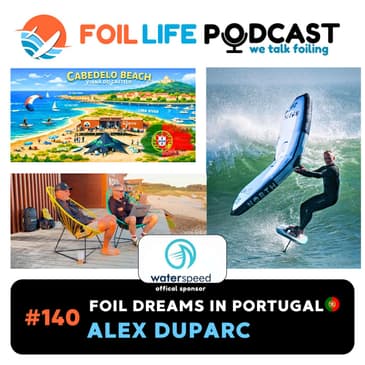
[00:00:00] Hey everyone, welcome back to the show. On this special travel episode recorded live on location at Club North in Viana da Castelo in Portugal, Frank hosts his first ever Foil Life Podcast episode. Let's all give him a hand. Frank is joined by instructor and waterman Alexis aka Alexis Duparc. The two dive into Alex's 30-year journey teaching windsurfing, kitesurfing and wingfoiling around the world.
[00:00:28] They explore what makes Vienna da Castelo such a unique foiling destination. Its thermal winds, mellow summer swells and clean waves. To see how conditions are like at Viana, make sure to watch the brand new episode of Force of Nature with Alex as the judge. So we do hope you guys enjoy this episode. Once again, congratulations Frank. Thanks for recording.
[00:00:55] Next, we want to say a big thank you to our team. We have Frank, Stefan and Pam. Thank you for your hard work behind the scenes that makes this show possible. Next, WaterSpeed is the official app of the Foil Life community. It is the app that water sports athletes use to track their performance on the water. Connect your Garmin, Coros, Apple Watch or Vaccaros and it starts logging everything. Speed, tax, jives, foiling time, life tracking, VMG and even polar charts.
[00:01:23] This is the kind of data that actually tells you whether you're getting faster and better or just feels like you are. It works across 30 plus water sports including downwind, wingfoiling, sailing, windsurfing and it turns every session into something you can learn from. This is what performance tracking actually looks like when it's actually built for the water. So before you listen to this episode, we ask you to go over and download WaterSpeed now. It's available on iOS and Android.
[00:01:51] Lastly, thank you very much to our sponsors for this season. We have North Foils, Mystic and OnKiteboarding. I just took out my awesome OnKiteboarding wing in Mauritius a couple days ago. It was the 4.5 meter flash. That thing is really bomber actually. I loved it. It's light, it's responsive, it's super rigid. So make sure to check out OnKiteboarding.com and you'll find them at FoilifePodcast.com forward slash sponsors. Now I hope you enjoy the show.
[00:02:20] Welcome to Foilife. Whether you wing, kite, parowing, downwind, pump or e-foil, thanks for being here. Welcome to a special travel episode on the Foil Life Podcast by SFT. I'm Frank from the team. I'm on site here at Viana do Castelo in Portugal. Yep. I think it's one of the really falling meccas here in the north of Portugal.
[00:02:48] I've been here last year actually the first time. And this year, second time. And I'm just stoked here to be here. Tonight I have a special guest. We have Alexis Duparc. Is that right? Duparc. Dupar. Dupar. Dupar. Dupar. And yeah. So tonight it's not Luke who's hosting the podcast. You have Frank who's doing this. It's my first time. But yeah.
[00:03:17] It's always the first time. It's always the first time. And I thought I have to take the chance because we are sitting here really. The sun is almost going down. It is 8.30 in the evening. We had a great session. The wind is still on. The last kiters are still out. And yeah. So I thought it's a great location to record an episode. Nice to have you here Alex. Thanks for being here and for joining.
[00:03:46] No worries. Pleasure. Maybe we could start like short introduction who you are, where you're from and just a quick one to introduce yourself to the listeners. Yep. So my name is Alexis Dupar. I prefer Alex of course. It's a bit more friendly, easy.
[00:04:10] I'm a, I'm, I had, I worked with some English company a short time ago. They called me a veteran instructor. Oh, okay. It sounds quite, sounds quite nice because I'm, I'm teaching now for like 30 years about since 95. I've been teaching windsurfing, kitesurfing and wing foiling now for a bit more than five years.
[00:04:34] Um, I'm super passionate by water sports and teaching water sports especially. Um, and I, I've, I've been traveling quite a lot around the world and I'm now working. Um, I'm, I'm basically mostly doing repairs, but I still teach and prepare some teaching program for club North.
[00:05:01] Um, and that's the main part of, of what I'm doing now. Hmm. Okay. Yeah. We have to mention, or I forgot to mention that we are sitting here actually at the club North. It's a club North, uh, Viana. It is a wing foil destination, uh, a, a, a, a water sport center, not only for wing foiling. It's for windsurfing, kitesurfing. All the water sports are popular here and, uh, it's, it's such a great place.
[00:05:30] And yeah, the club North, um, we are sponsored, uh, podcast is sponsored by North and Mystic. And, uh, club North is basically here on site. It's, uh, it's a franchise, right? Um, so this school here is, is operated by the, uh, local resort. It's called the Filiana. Yeah. Um, it's a really four star resort here directly in a, in a pine tree forest, uh, with, uh, just a few meters.
[00:05:58] You walk down to the beach and there here we are at the club North center. Yeah. Um, so yeah, it's an awesome setup. Uh, I can only, uh, refer to some, some videos and, uh, all the reels that we are going to do here for this episode. Um, then where we will showcase, uh, how really cool it is, but yeah, um, coming back to you, I mean, let's start, uh, what brought you into, uh, wing foiling?
[00:06:27] What is your journey into wing foiling? I mean, you are a long time instructor, but when did it start? Um, it started in 2020 actually, uh, that was the start of wing foiling and I was working in, uh, Cabo Vergi in Boa Vista. Oh, nice.
[00:06:46] And we, yeah, it was, it's a nice place. And we had, uh, we had a wing foil board. So one day I tried it, uh, and it was a quite big board, 140 liters. And on, on the first day I was flying and I was jibing. So I was like, okay, that sounds like, like, uh, like the future. And like, it, it, it touched me. It was like very interesting. I was, I was windsurfing a lot and I was already kite foiling.
[00:07:16] Mm-hmm. So it was kind of a mix of both. So obviously I had a quick progression, but I, I could feel that it might be interesting to, to try it on, on smaller boards, smaller foils, et cetera. So then, uh, I was moving to Brazil at this time after this only first try. Okay. So I directly bought a 65 liter board. Mm-hmm.
[00:07:43] Straight on. And first day was a little bit difficult. It's, I remember I spent like 20 minutes on my knees before being able to stand. Mm-hmm. But then I was flying also on the first day. Oh really? So yeah. So I got like really, really hooked. And now mostly what I'm doing is, uh, mostly I'm, I'm doing wave riding. Uh, I've been doing quite a lot of freestyle and jumping, but my body is not. Welcome to the club.
[00:08:13] Yeah. My, my body is not so happy about it anymore. So, um, I have, I'm forced to focus on free riding and, and wave riding with less jumps. Um, and, but I'm, I'm super happy about it also because wing foiling is, uh, uh, is transforming the conditions. Even if you, I mean, you don't need to have perfect waves and perfect wind to, to enjoy a lot.
[00:08:42] If you have a, a small meter and, and 12, 13, 14 knots, it's already, it's already perfect. Yeah. It's for me to, it's for me the sweet spot, to be honest. I don't need that strong winds. Uh, I feel really much more the wing and the board, uh, if the conditions aren't that, that strong, to be honest.
[00:09:02] Yeah. It's my, I'm just used to it, uh, where I live. Um, and it can get really, yeah, it's, everybody has its own sweet spot. Uh, and mine is the same, I think. And how did you then get to, uh, to Vienna? I mean, what, what brought you here? Uh, some kind of luck. Actually I was in Brazil. I was, uh, I was working there and I saw, um, a working offer here.
[00:09:25] Ah. Uh, so I, I called them and luckily, uh, the guy who was in charge of, of the selection was, uh, someone I, I met in Morocco a few years before where I was working. Okay. That person was working also in Morocco. So we had an easy meeting, let's say. And then, then decision was done that I would work here.
[00:09:55] And, and I, I started to work. So in, uh, 21. Oh, that far, that far back. Yeah. Yeah. So it's, it's my sixth year here in, uh, in Phil, Vienna. And, um, yeah, super nice place. As you said, uh, it's very versatile. Uh, yeah. So it's very versatile. Today it's flat, but we have days with nice waves, especially at the, the start of the season.
[00:10:21] Uh, it's quite a lot of wind along the, the season because there's some thermal effects that are working very well here. Um, guys are still riding. We have like one, two, three, four, we have five kites on the water, enjoying the sunset. Uh, it happens a lot. We have a lot of sunset session after work when it's, uh, when it's a little bit less busy.
[00:10:47] Uh, the scenery is perfect. The, the water is not that cold. If you have a 5.4. Yeah. I brought a 5.4. 4.3 is enough. 4.3. Sorry. I, I'm, I'm, I'm, I'm 4.3. I took, uh, we actually use 5.4 for teaching because we get a bit colder when we teach, but 4.3 for riding. You're perfect. Yeah. Yeah. It's, I'm really happy that I brought it. I just thought maybe the 3.2 could be. No. No.
[00:11:16] No. 3.2 is not a good idea. No. 3.2 you do one session, then you start to feel cold. So you cannot do a second session eventually. No, no. 4.3 is, 4.3 is the good one. Yeah, exactly. And, uh, I mean, this year I, I'm here for two weeks. Uh, I, the very first day was proper, properly windy. Yeah. Uh, I, I would say like, uh, three, five or maybe smaller, but there were waves and, uh, that is what, what I'm a bit missing.
[00:11:44] I mean, last year when I was here, I had awesome wave conditions. I mean, I, I'm not so much into wave falling, but I, I got really pretty much into it and loved it. And this year I, yeah, I had one day, but how about the wave, the waves here? Can you maybe give an explanation of how the waves, uh, uh, show up?
[00:12:06] I mean, it's a, it's a special setup here. We have a harbor. We have a river that goes into the ocean. There's a huge, um, how you say that? Um, this. A pier. A pier. A pier? There's two piers to, to protect. Yeah. It protects the whole thing here. So, uh, directly at the pier you have super flat water. If you go maybe 500 meters further down, then I think the waves are showing up.
[00:12:32] Yeah. Actually the point is, um, it's a bay. Yeah. And, uh, the swell will enter with different directions. Uh huh. So, the point is during the, the summer months, which are, uh, um, middle of June until the end of August, uh, until middle of September, we have stronger wind, more wind, but less swell.
[00:12:57] Ah. And the swell is actually, um, it's not a ground swell. It's a wind swell. So it's because it's windy. It creates a swell, but it's kind of short and it turns around the pier and comes in the bay.
[00:13:11] It's not that powerful. It works, but it's never really big and powerful. Before that, uh, depending on the low pressure passing, uh, outside the bay, we have different direction and we can have the swell coming more in front. Mm. And it comes much stronger, much more powerful, much bigger waves. Yeah. Yeah. Super nice conditions for wave riding. But, uh, yeah, it's, uh, you need to get used to it.
[00:13:40] Yeah. I can imagine. And I think it's like, uh, yeah, you have the seasons and I think in spring and maybe fall when there are really strong, uh, storm systems on the Atlantic, then you have the proper waves here. Yeah. But now you are really a bit depending on the, the wind direction is the, the, uh, usual is Northwest, right?
[00:14:00] North, Northeast. North, Northeast. Ah, okay. Yeah. And then I think, uh, you have to have a bit of luck. Um, but then you have here, uh, in my experience, the cleanest waves I've ever seen, to be honest. It's, it's, they are, I mean, I'm not used to go into waves that often, but it was just like my dream come true. Yeah. The wave, the period is, I don't know, like 10 to 12 seconds and you have huge waves and they don't have this power.
[00:14:28] Yeah. Just like rolling through you without, you don't need to be afraid. It's just, uh, doesn't have the power. Yeah. And that is what I, what I like so much because if I go in the chaotic, uh, um, North Sea, uh, where you don't have proper sets, then it's, uh, it's chaos. And here everything is sorted and it's, uh, it's a dream to be honest.
[00:14:50] Yeah. This you have, you will have, or you, we would have now if we were, we would have like one or two days of strong wind. Yeah. Then it builds up. Yeah. Then it builds up and then down in the bay, you start to have more, uh, more of those soft waves, which are still very good and, and usable to ride, but not dangerous.
[00:15:14] As you said, uh, in the winter or in the, in, in spring, it's a bit different because they are, they are much more powerful. So you, you, you may have, you may have to be humble sometimes. Yeah, but you don't need to be afraid. I mean, that is my point. I, I, when I came here first time, uh, last year, I saw the waves and I was really like, Oh, should I really go out?
[00:15:40] Yeah. And then I did. And I, I, I was not afraid suddenly because I felt that there is not that much power in the waves. Yeah. They are really like soft and mellow. And, uh, it's just, uh, it's just awesome. Now, uh, yeah, this was a bit what I was missing this year, but otherwise, I mean, I was here last year and was riding two nine every day.
[00:16:04] Yeah. And this year I was, uh, the smallest was a three five and the biggest a four eight, but proper wind, uh, also the forecast didn't look that good. I'm, I'm still surprised that we had these, these good conditions. So I cannot be, uh, uh, disappointed. No, it's, it's, it's, it's awesome.
[00:16:34] It's, it's awesome. It's awesome. Yeah. Um, let's come back a little bit to, uh, to life and work here at the club. You said your, your day, day to day job here is like you're doing repairs. Yeah. Uh, and the repairs for the center, like foils, kites and boards. So what, what does it, uh, what is the main focus? I, I repair only sails. So I repair wings, kites and windsurf sails. Okay. For the club and for private people who come here in, uh, in Vienna around.
[00:17:04] Okay. Um, and, uh, um, one of the, the other worker at Phil Vienna repair boards also when people need, but I, I focused on sails. I also with my wife, we recycle all, all the kites and wings and we do, we do bags and accessories. Uh, and that's, that's what we leave from.
[00:17:33] Um, um, I rarely, I still teach a bit, but like very rarely, uh, it's for special occasions. Okay. Uh, and so that's, that's how his life at the moment. Repairing all day and then coming for a sunset session at the end of the day. What a dream. Not too bad. Not too bad. Not too bad. And I mean, uh, I know that in the winter times you, you, uh, when, when here the center shuts down, you're escaping to, uh, to another dream.
[00:18:03] Yeah. Where is that? Uh, I do exactly the same thing in, uh, in Brazil, in San Miguel do Gustavo. Okay. It's, uh, it's, uh, it's a very nice place close to Natal. Okay. So it's a bit different because, um, uh, most of the people know about Seara, but it's, uh, uh, where I go is closer to Natal, which is the corner of Brazil.
[00:18:27] It's another airport. Okay. Um, the transfer is a lot shorter from the airport to San Miguel. The wind is lighter, but, uh, it's still very good. Like 22, 23 knots every day. Okay. Whoa. Instead of, it's not 30, 35 knots. Yeah. But, uh, for wing foiling, especially, it's not bad, uh, to have 20 and a bit, 20, 25 knots, for example.
[00:18:52] Okay. Uh, we have waves also. There's a reef outside. Uh, uh, it's not too crowded. It's quiet. And it's warm. It's warm. You don't need a wetsuit. There's, there's not much nightlife, uh, but that's also pretty nice because it brings a different type of people.
[00:19:15] Different vibe. Different country. Different vibe. It's, it's all quite relaxed. But it's, uh, it's Brazil, you know, it's, it's, it's automatically relaxed when it's Brazil. Yeah, I've never been there. So I, uh, you should, but I should, um, you have to even, um, yeah, nice. I mean, maybe one day I can, I can make it there.
[00:19:38] Yeah. Um, what, uh, yeah. Okay. Anyways, nice. Um, then about coming back to the, to the club. Um, I mean, how do you collaborate with, uh, with the, with the team here at the club north? And what, what, what, what kind of dynamic, uh, or they work together? Is it, uh, how are you guys, um, working together?
[00:20:00] I mean, there's so much nice guys here in the team, uh, and you support each other. I see every day, um, setting up the whole location each, every day. Uh, you're supporting that as well. Uh, I do it much, much less now because, uh, uh, uh, because the repair takes me more time. Okay.
[00:20:21] There at the workshop. So I'm, I spend less time at the beach, but, um, I've been giving a lot of, loads of inputs when I, when I came in. Uh, uh, because obviously in 30 years of 30 years of, 30 years of, of teaching and traveling, I've, I've seen a lot of clubs. Uh-huh. So I helped a little bit for the, for the setup, but, uh, the team is perfectly able to do it alone.
[00:20:48] They don't, they don't need me at all anymore. Um, I'm, I'm just helping sometimes when there's new equipment. Yeah. Or new things to do, then I, I explain, I collaborate, uh, when we see problems of, uh, uh, regular breakage on the material because it all comes to me, then I explain the guys what they, what they could do eventually to avoid it.
[00:21:14] Um, and I, I directly refer to the brand also so that they know what, uh, what is good and what is less good, what, what people like, what people would like more, et cetera, et cetera. I work, I work very closely between the club and the brand and the hotel. So, uh, it's interesting for me and it's interesting for, for both of the, of the structures also.
[00:21:42] So I'm, I'm kind of a link between the, between the club and the brand. Yeah, we are both riding North Falls. Uh, the wings, the boards, the foils, everything from North. And, uh, I mean, you're riding this brand most likely much longer than I do. You are also in touch, as you said, with, uh, with the foil and board designers, right? And give them feedback.
[00:22:06] Um, I mean, you're riding a huge range of foils and I saw your back full of, of stabilizers and front foils and everything. Um, so maybe if we come down a little bit to, to your gear choice, what is your preferred gear here for riding in these conditions? And what is your personal favorite gear? Let's say that way, uh, board, board wise, foilsize, uh, foil wise, wings wise?
[00:22:34] Uh, let me think just one second. Uh, the perfect setup for me is, um, it's probably three, five in size. Okay. I, I, I use a lot two nine because I go, I go always with as small as I can. So I have maneuverability in the wing. Um, but three, five means it's not too choppy. Yeah. Three, five, two, nine is, is, is the two I like.
[00:23:04] Then for the foils, it will depend on the, on the wave conditions. If I have soft, slow waves, I will use SF. Yes. SF is the surf foil. The surf foil. Yeah, exactly. North, North foils. And what sizes do you ride in that, uh, surf foil? 530. 530. Only 530? Almost only. If it's, if it's very light, if it's 12 knots, then I use the 680. Okay.
[00:23:31] Otherwise, um, over 17, 18 knots, 530, no problem. Uh-huh. And, um, it, it, but it depends on the waves. Then, um, if, if the waves are a bit bigger or faster, then I would use, I would use MA. Yeah. 600 or 500 depending on the, on the wind. What is your weight and your size, if I may ask? I'm, I'm one meter 80 and I weighed 75 kilos. Okay. Okay.
[00:24:01] Good. And, and board-wise? Board-wise, um, I have, I'm waiting for my, for my Swell Pro 45, which I think will be. 45? Yeah. I think will be, it will actually be perfect because I received the 65 and I like it very much. Yeah.
[00:24:24] Um, uh, it starts planning, it starts flying very early, not as early as the midi 60, for example, because I had a midi 60, so I can compare. So the mid, uh, the midi is the mid-length board? So the midi 60 allows me to take off easier, let's say. The Swell Pro 65 is very close to it.
[00:24:51] And that's, that's what is very interesting is that it's not made for a light wind, uh, board. It's made for wave riding. Yeah. And it has a very early start, which is a big help because then that means you can go wave riding in light wind, very comfortable, um, uh, glassy water, uh, eventually a six, six 80, uh, SF front foil.
[00:25:18] And the board is narrow and allows you to carve the same way as the midi. Okay. So you can really go down with the rail down to the water. You don't even touch it and the foil is coming out already. It's a, it allows a lot of aggressivity, even with 65 liters, which is, it's just crazy. Yeah. I should have tried it. Maybe I have to chance, uh, who knows in the next days, uh, I've never tried the midi.
[00:25:45] Um, but I'm also riding the, the SF foils and I switched from the MAs, uh, the mid, uh, the mid aspect to the surf foil as exactly, as you said, uh, the glide is unbelievable for me. I mean, really, uh, it's, if you compare it to the, to the MAs, the MAs are a little bit slower, but the SFs are much more agile and I can turn much better. And, and the most exciting part for me is that I can ride smaller foils.
[00:26:14] I mean, I was on the 850, um, on the mid aspect and I'm now down on the 680. Yeah. And think about it. This is my biggest foil. I mean, I'm, I'm 67 kilogram, but, uh, and I'm 183. Yeah. But it's really, I would have never imagined that I can ride such a small foil as my biggest foil. Yeah. And, uh, the 530 I'm, I'm running as well.
[00:26:40] And I mean, this is my, my high wind setup, but yeah, I love these foils to be honest. Um, they are not the, uh, let's say they are on the market for quite some time, but they do a perfect job. So big, big shout out to the guys. Uh, I think, uh, they did a really great job and, uh, looking forward for what's coming next. Yes. Um, because I think we have a progression going on and, um, I think the next thing, the
[00:27:09] big thing will be those monoblock, um, uh, foil parts. Um, so we're looking forward, both of you. Yes, we are. It's, uh, it's coming up. Um, okay, great. Uh, so about the gear, um, about the progression, um, maybe you have some tips, uh, or what tips do you give your guests here when they are asking for how to progress quickly?
[00:27:38] What, what kind of advice do you give them? I mean, you have so many guests here and they are all having the same problems, uh, to choose the right foil. Yeah. So what is, uh, what, what, what, what is your, uh, let's say usual advice? Well, it depends on, it's a, it's not an easy question because it depends on the, on the problem people, uh, people have mostly.
[00:28:02] But, um, very often it's a question of adjusting foil and stabilizer to the, to the size and the, and the level of people very often people ride too big equipment. Yeah. Because they, they, they, they call them a mistake. Yeah. Yeah. But it's kind of normal because it's, uh, it's not so easy to decide.
[00:28:27] For example, if you don't know the, the SF, you don't know that it has a, an, an incredibly early takeoff, an easy glide, and it's still comfortable. Even if you start to, to push it on speed. So, um, if you're, if you're riding middle aspect foils, um, a lot of people use, for example, the 1050 middle aspect when they could go already on an, on an 850.
[00:28:57] The difference is they will have to be a bit more physical to start, but then they will enjoy much more. In the other hand, in between, if they would try a 930 SF or an 830 SF, poof, it's like no more efforts. Everything is easy. So, um, it depends on what people want to do, but very often I make, I, I, I bring people
[00:29:24] to the, to test the SF because it's a very comfortable one. And even if they already know it, for example, um, I help people to go down on the stabilizer. The stabilizer is much more important than people think. Yeah. Stabilizer is, is a, is, is a very big, uh, piece of material. It's a big change when you, when you change your stabilizer.
[00:29:50] The mask position is important, but it's not that much influent as the, the stabilizer, for example. So as I have a lot of stabilizer, that, that was my idea. I, I tried to get almost all of them and I think I have all of them. So I tried all of them in different configuration and I realized that, uh, uh, it makes a, it almost make, make, no, it doesn't make more difference, but it makes a big difference to
[00:30:19] change your stabilizer. So I, I help people in this because here we have the equipment, people can test it. Yeah. This is what I, what I really like about here. You have the whole range of foils that you can, you can try and you can test and decide if it's good for you or not. And, uh, this is great. And, uh, you have, it doesn't help that you are talking about foils. You have to, to test drive it.
[00:30:44] And that is, I think a great chance here, uh, as a guest, uh, to try whatever you want. Yeah. And, uh, really make the, the progress, uh, by trying it out. And, um, what I remember is also what we talked about already last year is, uh, I see a lot of people without straps riding, uh, like, but not the, the, I mean, here at the, at the
[00:31:08] school it, I think all the teachers should, uh, teach, uh, people start wing foiling to start with straps, right? That's what I recommend. Actually, I, I strongly recommend people to start, uh, wing foiling and to learn with a front foot strap, at least a front foot strap. The back foot strap is not necessary. A front foot strap wide open. So people don't, don't get stuck in, don't get blocked in.
[00:31:37] Uh, it's a lot less risk. And, uh, basically what I do, uh, in the first lessons to avoid people to have bad catapults. Yeah. Which is the risk of twisting your ankles. I, on purpose teach with the mast relatively back. So they don't have an easy, crazy takeoff. That is, that is. They don't get surprised and, and, and, and throwed out by the sword. Like a rocket. See?
[00:32:06] So, uh, at least for the two, three, two first days, uh, because I teach directly with the foil on the first day. Okay. Uh, because it's stabilized the boards because we have hundred, uh, 155 sick air, which is stable. So you put the foil just to stabilize the board to avoid drifting and also for the people to get used to have the foil under them. Because a lot of people are like, Oh, but I'm going to fall on the foil.
[00:32:33] Uh, so they realize in the first day that no, because it's not, you don't flip 155 boards that easy. So they get used to it. On the second day, they start to take a little bit of speed, eventually some takeoff. Yeah. And then it's our job to adjust the mast position to help taking off, but not having too much lift. Mm-hmm. Too much lift can lead to catapults and problem with the foot strap.
[00:33:02] Um, and, and I like to have the foot strap in front because it avoids a lot of mistakes of positioning. It's not so easy in the first hours to have, uh, a correct position, positioning of both of your feet. So if at least the front foot is in the correct position, the back foot will move, we'll start, we'll try to get the, the, the idea of where it has to be, but it helps a lot. It helps a lot to know where to put your knees because you have the foot strap.
[00:33:30] You use the foot strap to climb on the board. There's a lot of advantages in having a foot strap. And to be honest, I never had an injured, uh, student, uh, with the front foot in the foot strap. So, um, I guess I know it's, um, there's, there's a possibility, but there's a very, very, very small possibility, especially if the strap is big and the North straps are slightly, uh,
[00:34:01] elastic. So you can even have a, uh, your foot turning in inside the foot strap. So it's, I think it's safer than what people, uh, who don't like foot straps say. And it's without any doubt, much more efficient for learning to learn with foot straps. Then I'm not against once you know how to foil, taking off the foot straps, because then you will realize where is your technique.
[00:34:30] Yeah, that is funny. Because it's a lot more difficult strapless and it's very good to work strapless to improve your technique. And it's, it's nice, but it's difficult. Yeah. Now, now comes my story. I, I'm, I mean, I'm was windsurfing for ages and started wing foiling. And the first thing I did when I got my board was putting on the straps because I'm so much used to it, but that is depends on where you're coming from. Yeah. Yeah.
[00:34:57] And, uh, I mean, for me it helped a lot, but I, I think I got quickly into it just because of my experience over the years. Um, but now the funny thing is that I, last week, uh, I tried here, uh, a strapless board, uh, midsize. Um, and I mean, it's, uh, it was at a different station. Um, in, uh, yes. This is, um, Moledo, Moledo, you know, uh, it, uh, it's some guys that I visited there
[00:35:27] that are also running a full school and I was riding a, uh, 100 liter without foot straps. Very first time. And, uh, yeah, of course I was orienting on where the inserts are on the board that I have an idea where to place my foot, but it was really, uh, something. Um, it makes fun. Okay. If there's less wind, but as soon as I can't imagine if there's strong wind, how you can
[00:35:53] balance, uh, uh, something you have to experience, but there's something you just have to do it, try it and see how it feels. Yeah. I mean, I don't ride skateboards, longboards, skate longboards without, with straps. I mean, that's stupid. So, uh, why should I, shouldn't I ride a full board strapless? It's just about getting into the sport and if you get into it, it will help you so much to find the, to get the board going. Yeah.
[00:36:20] Because I think, uh, having the foot in the strap helps you to get it going. Yeah. Yeah, sure. That is, that is, uh, a, uh, this is, uh, just, uh, a tool to help you, um, to, to progress a little bit faster because I mean, you are the teacher, not I am, but I, I see it all the time. People are struggling, uh, to get, to get a board balance without a strap. That's my opinion. Yeah.
[00:36:46] I'm not a, um, I'm not a coach, but hey, uh, it's getting, uh, the sun is already set. Uh, the kiters, they just, they're gone. Wrapped things up now. Yeah. They are packing together. So maybe we can wrap it up as well. But let's have, uh, just, um, just one thing what I'm like to know from you is, uh, what was your favorite moment here?
[00:37:12] I mean, you are living here for such a long time, but what was the, the most memorable moment for you here at this, on the water here directly in front of us? Most memorable, memorable moment was last year. Uh, the end of the season, there was this, um, um, how do you call it? Storm. Storm, yeah. Erin. I think it was Erin, the name. And we had, we had really good conditions.
[00:37:38] Uh, big waves, strong wind, too strong, but nice anyway. But it was like, uh, gusting 40 knots. I was on two nine, super overpowered, but nice waves. Um, that was a very, very nice, rough riding. I like it sometimes.
[00:38:00] I like it sometimes. It's riding on his, uh, dream day, uh, here in Viana. Um, okay. To, to close things down or to wrap things up. Uh, if you have a message to the listeners, um, what would you, uh, like to share with the people, uh, who haven't visited here?
[00:38:28] Uh, the, uh, the, uh, the, uh, the, uh, the club north, uh, in, in, in Portugal. Well, come and enjoy the, the very, uh, crazy good conditions we have here. Especially end of the day. Sunset sessions are, are a dream here. It is perfect equipment, perfect setup, less people on the water, uh, come and enjoy. Yes. Confirmed.
[00:38:58] Thanks a lot, Alex. You're welcome. It was really fun conversation. Yeah. Uh, pleasure. Uh, maybe, uh, just to, for the listeners to know, to get to know more about you. Um, you have, uh, an Instagram account, right? Yeah. Uh, you also have a website? No, I have, for the moment I have only the, the Instagram account. I have a YouTube channel, but it's, it's, uh, deactivated. Um, but I'm gonna reactivate it very soon because we're working on some tutorials. Oh, cool. With Club North. Nice.
[00:39:28] So it's gonna be on again, but it's not for the moment. So for the moment is my, is my Instagram and I'm, I will announce on the Instagram when, when the YouTube channel will be on. Awesome. Awesome. Great. Thanks a lot for, for joining the show. Thank you. It was a fun conversation. Yeah. Yeah. I think now we're going to need some long pants. Yeah. It's getting cold. And a good dinner. So yeah, hope you all guys enjoyed, uh, the show. Uh, it was a very special edition. Um, thanks a lot.
[00:39:57] It was my first time and, uh, now I'm handing over. It's a good, it's a good first time. To, uh, to another episode, uh, with your, uh, with Luke, um, your, your host of the show. Have a good one and see you around. Thanks a lot. Bye-bye. Hey everyone. Thanks so much for tuning into this episode. We do hope you enjoyed it. We'd love it if you could subscribe to our Instagram, YouTube, and TikTok channels to help our show grow.
[00:40:26] We're constantly putting out some great content. So that would be amazing if you could do that for us. If you have any questions, comments, or if you'd like to hear a particular guest, or if there is a cool company you wanted us to talk to, send us a DM and we'll do our best to organize a chat. Thanks again for tuning in. Hope you have a nice day and get out on the water. Bye. Bye. You