

Episode Highlights:
- Six months into the North role: keeping core talent (kite and wing designers), adding graphic design and admin capacity, and a shout-out to the original New Zealand team that built the brand
- Design approach: thinking in systems and architecture, staying radically open-minded, questioning line lengths, aspect ratios and connection systems, then dropping back into “who is the customer and how do we make it more fun”
- Innovation reality: most disruption still comes from outside the industry; entrenched connection systems can slow change; useful cross-pollination between wing, kite, windsurf and foil
- Barriers to entry vs. mastery: easier assembly, lower cost and more approachable gear for people who ride a few days a month, while still offering the nuance that keeps daily riders chasing the last 5 seconds of glide
- Current riding: MIDI Pro boards as a daily driver, Boost masts, exploring foil-drive, Nervas wings, and the more speed-focused Modes — plus prototypes already in the works
- Growing the pie: foiling as a gateway sport (pump foil on lakes, foil-assist, wing), speaking differently to first-time buyers versus five-year veterans, and why waterman culture beats putting people in boxes
- Advice for junior designers: curiosity first, radical open-mindedness, self-discipline, humility, and remembering it was a team that got you there
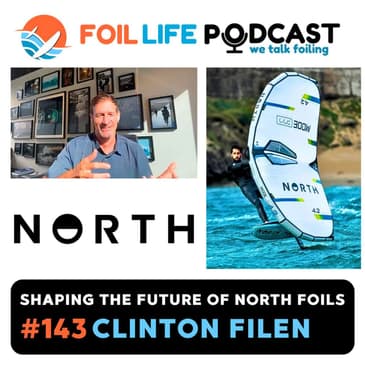
[00:00:00] Hey everyone, welcome back to the show. On this episode we sit down with Clinton Filen, the new Chief Brand Officer at North Foils. It's the first time Clinton sits down with anyone to talk about his new position, the transition to North and his philosophy on teamwork, leadership and innovation. He even shares what gear he's riding right now. So we do hope that you enjoy this episode.
[00:00:26] Next we want to say a big thank you to our team. We have Frank, Stefan and Pam. Thank you for your hard work behind the scenes that makes this show possible. Lastly, thank you to our sponsors for 2026. We want to thank North Foils, Mystic and On Kiteboarding. Please visit foillifepodcast.com forward slash sponsors to learn more about them. Now I hope you enjoy the show.
[00:00:50] Welcome to Foil Life. Whether you wing, kite, parowing, downwind, pump or e-foil, thanks for being here. All right, Clinton. Thanks for taking the time to join us on the show. That's great to connect. I guess we should probably start off by saying congratulations in the new position.
[00:01:09] Yeah, it's been a wild ride. So yeah, good to be able to get things moving forward. It's been, yeah, it's been a quick few months in the role. So yeah, it's been exciting to get rolling though. Yeah, I guess we were saying that it's just been about six months, right? So you're just starting to get your feet wet a little bit.
[00:01:31] Yeah, yeah. There was a lot of things happening, you know, a lot of key staff, you know, stayed with us and then they were quite, you know, moving location. We brought in quite a few new staff in areas like graphic design and administration.
[00:01:47] So we made quite a few changes. But, you know, same kite designer in the past, same wing designer, etc. So there were quite a few, you know, key positions, key people that have been in the company for quite some time, actually most of the team. So yeah, it's been an interesting transition from a completely different company.
[00:02:09] I can imagine. And we should probably take this opportunity to give a little bit of a shout out to that New Zealand team that had worked so hard to get the brand started and to kind of bring it up to the place where it is today. The guys there that we had the chance to work with were absolutely phenomenal. So I just want to give a bit of a shout out there. And maybe there's something that you want to say on your side as well.
[00:02:32] Yeah, I think that's been the amazing amount of energy that got put into the brand from, you know, from Kickoff. That is a huge amount of work and a huge amount of really good, deep work in a lot of areas.
[00:02:46] So it's been good to have a good connection with them and get to know them, you know, during the transition. And yeah, like have a lot of support. So yeah, I mean, I know Mike, you know, for many years, I've known him for many years.
[00:03:02] And so it was good to meet the other members of the crew that were not continuing and then, you know, have like a good transition and see all the processes and get a good insight into, you know, the direction from the team and kind of try to keep the momentum.
[00:03:20] And the same for me with Max, you know, he was, he was based in Holland and so also have a good, good friend of mine and, and, you know, seeing his and getting to connect with him and, and seeing, you know, his work when as traditionally on the outside is, you know, two very interesting, different people, different teams, different dynamics, you know, so it's created quite an interesting platform to, to move forward.
[00:03:47] I can imagine. Now, from your work with your previous companies, how has this transition gone? And are there any things that you're able to bring over from that past experience of working with the previous brands that you were with?
[00:04:00] Yeah, there's, you know, the one thing you'll see the, like the deeper design philosophy is always really interesting, you know, in terms of the, you know, the, the systems, like I believe a lot in, in architecture in terms of design, you know, like, you know, try to be forward thinking in your design and see how it's going to evolve over time and, you know, try to be relatively open minded.
[00:04:22] But it's been nice to kind of have built such a strong direction yourself and then, you know, be looking at, immersed into another really successful team, their direction, and then, you know, see how that, how, you know, where the, where the similarities are and where the differences are. Yeah. So that, that's been like a really amazing process. Yeah. I imagine. How did this whole journey start from you? Can we go back a few years and, and give a little bit of your back history?
[00:04:52] Yeah. So my, my background is, is being in brand management and product design, you know, so that's kind of what I have done for, you know, most of my, my life. Yeah. And then I studied business and always worked as a product designer and then got into, you know, into brand direction later.
[00:05:12] Yeah. Yeah. Became a shareholder in the company that I worked in previously. So, you know, had, got to do the whole nine yards and then, you know, get this opportunity to, to like, you know, come into this new role, you know, after 20 years with the previous company, you know, in, in different roles. So it's, it's been, yeah, quite a, quite a difference.
[00:05:38] Yeah. I imagine. And when was the first time you windsurfed kite or winged? I probably, you know, windsurfed when I was, you know, like a 10 year old, 12 year old, it couldn't up all, rig was too heavy. That's all I can remember. So, so somebody had to pull up the sail and then once it was up, then I would get to cruise around until I fell over.
[00:06:00] Yeah. So kind of from my childhood around, around sailing, around, you know, around surfing. Yeah. So it was always something really close to, to me. It's always been a part of what I do. Yeah. And then I got into kiting relatively early as, as well. Yeah.
[00:06:19] A friend of mine, Don Montague gave me a kite and said, try this. And yeah, that was, that was also a while ago, got pretty hooked. And, and then we'd been playing with wings, the concept of, of wings. Yeah. A long time ago, actually. And just been experimenting and, and so built a few weird prototypes very early on and then left it alone for a while. So yeah, did have, have had quite a adventure through all the different sports.
[00:06:48] Um, you know, I'm just interested in, in, uh, in new stuff. Yeah. I'm interested in, in, uh, you know, all the ways the sports can evolve. And so that's, yeah, for me, it's been a big journey. I imagine. That's pretty cool. Any kind of insights coming from outside and then kind of coming into a company of this size? Cause you're managing a whole bunch of different, it's kite, it's wing. Um, what else is it that you're, that you're managing there at North now?
[00:07:16] Yeah. So I'm, I'm working basically across wing, kite, um, windsurf foil and accessories, you know? So it's, it's, it's quite a, a big, um, portfolio. Um, but you know, there's dedicated teams working in each of the divisions.
[00:07:32] And for me, I'm kind of interested in everything. So it's, it, that, that's what made it such a exciting opportunity is like, I really, you know, I try not to think in absolutes and I try not to, you know, think that there's any one end solution and, you know, try to be radically open-minded as possible.
[00:07:50] And this is just a great place to do that because there's so much happening. And, and so you've got dedicated people pushing very clear things and then, you know, being able to look at like the broader systems and to look at the key technologies. Um, you know, that, that's the stuff that's really interesting.
[00:08:08] Like, and, and how can, and how can we apply them in different areas is, is, is being really incredible. And then having the support of, you know, North technology group and, you know, the, the chief technical officer there and his team, you know, they're basically doing what we're doing, but focusing on materials. That's, that's incredibly, um, useful. And it's, yeah, incredibly insightful as well.
[00:08:33] So there's a lot of aspects to the business that are like, um, really feeding your, like the creative and technical soul. You must have a couple ideas on the back burner that you're waiting and hoping to be able to implement or put through your team. How is that to be able to just get, you're pretty much getting open door to the, to the, uh, to the entire universe of there and then being able to see what you've done, what's coming. And then that must be pretty fun just as an enthusiast as well.
[00:09:02] Yeah. Yeah. I think that's the best thing is you seeing so many things happening on any given day. And, you know, it's like to be able to, you know, see what's holding people back from, you know, from what they're trying to achieve. I think that's, that's like the, that's always difficult. Like either you work as a designer where you're very hands-on and then you're solving problems yourself. And then a lot of the times you're frustrated by the system. You know, the system's not around innovation, the system's around, you know, it's around how to monetize everything.
[00:09:31] And, and so, you know, for me, like building a culture of innovation is super important to, to like build those systems, which is difficult because it's kind of quite an administrative role.
[00:09:42] Um, in essence. So it's, it's, it's a little bit of, uh, yeah, you, you kind of end up having this balance between a lot of innovation is about disrupting everything, but then, you know, you, that still needs to exist within an ecosystem, you know, where things can get done, where, where, you know, their, their, their commercial outcomes.
[00:10:04] So I, I think trying to build that balance is, is interesting and I'm interested in, in like technology companies and trying to think like a technology company, you know, like, okay, like how, what can we do different? How can we disrupt? How, you know, what, what can we take forward? Um, so I think there, there's some of the, that side of the business that is really fascinating.
[00:10:27] Is there anything without spilling too much looking at those, all those different areas that you're working in? Is there a particular area you think the entire industry is going to keep running along in?
[00:10:40] Yeah. I mean, there's so much going on, you know, I, I mean, I always think there's, you know, it's very difficult, you know, you kind of in development, you're going down all these different rabbit holes. And when you get to the bottom, there's a whole bunch of other rabbit holes and some of them are dead ends. And, and so, you know, the, the nature of, of that means that at any moment, you know, you might stumble across something and, and, you know, I do think a lot of things are really connected, especially when you're working, say, in composites.
[00:11:10] You know, composites is such a broad term, um, that, that, you know, and if you're working in sports and if you take another step back and if you say, okay, well, we just build pieces of foam and pieces of cloth and they drag you around in one way or the other.
[00:11:26] Um, then, you know, if you have that kind of broad mindset, then you look at everything, you know, like nothing exists in absolutes as well as a good way of, you know, you're like how long should lines be on a kite and, you know, how, you know, how, how high should the aspect ratio be on a foil?
[00:11:43] Like you can just carry on, you know, questioning, you know, everything, but in the end, doing it within a commercial framework, of course, like you got to drop back into it and say, okay, like, what are we trying to achieve with this outcome? Who's the customer? You know, how, well, how can we bring something new to the customer? Uh, you know, how can we like, you know, make this easier, more fun? Um, yeah. Make it feel better, you know?
[00:12:10] So I think those are the, like, then you kind of zoom in again to, you know, the specifics, which is, is the interesting side as well. Like we just had Keith Tabool on from, from KT from Maui. We were talking about board development and the progression of, let's say, parowing boards and making that transition easy for people to be able to learn.
[00:12:30] Um, I guess those are also decisions that you're making to either specialize equipment for the smaller percentage of people who want specific things rather than helping out the mass amount of intermediates and beginners and making sure gear is friendly. Cause that's a, that's a big thing to navigate. Yeah. I think looking where, you know, there's, there's obviously people coming into the sport all the time and you want to, you know, you want to make that experiences, um, you know, the, the barriers to entry. You want to have those as low as possible.
[00:13:01] So I think that's everything from ease of use and cost and, and, you know, ease of assembly. You know, I think that's, that's super important, but I also think developing sports that are easy to learn, maybe hard to master is also quite an interesting thing because you have all these levels of, of nuances that, that keep people, you know, trying to perfect what they do. So, you know, there's, there's a few ways of, of looking at it.
[00:13:27] I mean, I think that's, so looking, as you said, you know, from the people getting into it who want to do it once a month, you know, for a few days to people who wake up every morning and just obsessing about, you know, the, the, the smallest detail. There's those guys as well. So that's very true. I think both equally are as important. Where did you spend the majority of your time growing up and, and working within the industry? What parts around the world?
[00:13:55] So I'm, I'm South African by, by birth. And so I grew up, um, accommodation on the coast and inland and then, you know, just moving around a little bit in, in South Africa. So really exposed to lakes with very little wind and then being on the coast with, you know, with surf. Um, and I think that that was interesting because then, you know, you see very much a product of your environment. Like if there's no wind, you, you know, you go skateboarding and, and, uh, you know, if you go, if it's windy, then you go and do something else.
[00:14:25] And if there's waves, you surf. And so I think that's quite good because that, you know, it gives you like a broader view of things. And then, so I spent a lot of my time in Cape Town ultimately, and that's kind of home for me, but got to travel to Maui a lot, got to work with some really, really talented people from a very, very young age. And that really, really helped me. Um, and then I was in Australia for, for five years running, you know, Southern and Air Rush.
[00:14:52] So kiteboarding and windsurfing brands for the group, uh, for the, you know, worked in the past with Starboard, um, Severn and Air Rush. So they, you know, they also have quite a diverse portfolio. So that was quite a, a good, uh, experience working, yeah, with, with Ben Severn and Sven Rasmussen and, and a lot of really, uh, open-minded people trying to make some amazing equipment in different, uh, sports.
[00:15:19] So that was a cool, um, you know, cool middle ground as well. So that also, you know, put me in quite a good space for, for what I'm doing here. You know, did quite a lot of new brand development. So, you know, you learn how to fail and then, you know, how to get things right. And try. And sometimes, yeah. And sometimes the difference between the two is not that far away, you know? So it's, um, yeah.
[00:15:44] And, and then, you know, mainly back in Cape Town and, you know, now in, in Holland, which is another, which is very different experience as well. Yeah. We had some members of your team that have moved there recently and there's a little bit of a, of an adjustment. How is the writing there? What is the culture like working at North, um, with every, with a lot of people working in the same central office now, right? I think there's just generally a lot of stoke around, you know, everybody is, is very connected and wanting to get on the water.
[00:16:11] And so I think that's the best thing is that there's a, there's a community of people doing different things and you're in a big enough organization that it, you know, there's a lot of energy. There's always something happening. So it creates, you know, quite a nice, uh, like kind of broader ecosystem. And then also, you know, like a lot of people traveling. So, I mean, for me, I still try to get back to Cape Town as much as I can. And, uh, you know, that's an important connection point for a lot of the work that we're doing.
[00:16:40] And then I also spend a fair amount of time in Tarifa again, you know, working with a oil designer, Sam, you know, he does boards and the foils. He's based there, um, you know, working with Dano in Sri Lanka and working with the team here. So there's, you know, you still have that diversity, um, of location, which I think brings something, you know, something different every time.
[00:17:01] But then, you know, having the nucleus in the Netherlands is also really good having everybody together because, yeah, it's quite a, um, a good design culture that, you know, that's existed here for quite a while. There's a lot of guys, you know, a lot of stuff. So it's nice to, to also connect with them, you know? Mm-hmm. Yeah, I imagine. One question about innovation, because I know you guys have been pushing innovation since we've been talking to the team there.
[00:17:27] Um, what do you think about tuttle masks for foiling or all these kind of different variations of equipment to just help improve and get rid of, um, I don't know, to keep pushing that envelope to making, refining the sport more and more and more.
[00:17:44] Is that something you think, you guys are obviously working on your own ideas and concept behind the scenes, but do you think there's going to be any kind of crazy brand new innovation or is it just continuing to refine the current systems for mass market kind of thing? I mean, it's difficult, you know, once you have entrenched systems, like connection systems, you know, and, and, and, you know, like your whole ecosystem of your product, it kind of tends to, to stifle things a bit.
[00:18:13] You know, because there's, you know, everybody's kind of a little bit in their, in their role, but I mean, there's always somebody new coming in from the outside. And that's one of the reasons like most innovation comes from outside of the industry in most industries, you know, most of the disruption because people, you know, you kind of get into your little system on the one side. But yeah, I mean, I think, you know, there's, there's the speed of innovation is also always increasing.
[00:18:37] And like, as we have more kind of sports working together, you know, as you have parowing and, and wing crossing over with kite, you know, like even, you know, for us, even like looking at what's happening in windsurfing, you keep seeing these, you know, these evolutions in one space. And I think that that's quite difficult to, you know, you'll see, you know, one connection system, say working in windsurfing and then in kite, there'll be a different one.
[00:19:05] And then, because then in wing, there'll be again, the same thing. And it's, it's, you know, a fair amount of that is entrenched in the, you know, in the sports. But I do think, you know, if there's like, you know, once the demands become very clear on something, then it's quite a good chance that it could go that way over time. Yeah. So it's, it's interesting to see how, you know, each aspect's going to develop and when it kind of comes to a dead end as well.
[00:19:32] Hmm. Is there any advice you would give somebody at home or a junior designer trying to revolutionize or trying to find their foothold in the industry to kind of put forward something? Yeah. I think like for me, looking for people who are curious is like, you know, and like, I mean, curiosity is just one of like the most important things is like just being, you know, deeply interested in things is, is like the greatest inspiration.
[00:20:00] I think to be, to just want to understand, you know, and, and want to try something to see if it's going to work and, and, you know, being like for me, being radically open-minded is, is so important. You know, in terms of, you know, in terms of design, but I mean, also just think for, you know, for moving your life forward.
[00:20:20] And I think, yeah, like, I mean, I didn't come from a place where, you know, I was surrounded by designers, but I mean, in the end you find like-minded people.
[00:20:31] So, yeah, and I think, I think it's, it's, I mean, there's a lot of kind of, I guess, obvious stuff that it's, you know, like if, you know, you hear all these, you know, sayings where like, you know, if it was easy, everybody would be doing it, you know, so like trying to get people to like, you know, make something, something difficult.
[00:20:51] And, and I think like, that's the challenge, like, you know, to try to, you know, find your own space is, is, yeah, it's super difficult to do. But I mean, it's, I think it's the most rewarding thing, you know, for me is like making something work, but like coming up with some, you know, some, some new, you know, some new concepts is, is extremely satisfying.
[00:21:16] You know, so like for me, it's an obvious thing to do, but it's like when you work in marketing, you know, coming up with a crazy campaign idea and that it actually works, it's, you know, it's all, it's all connected. Yeah. So I think, I just think the main thing is like, you know, I think like self-discipline is hugely underrated for getting somewhere, you know? So like, it's just like, and being honest with yourself and, and then having, you know, chasing things like really chasing things.
[00:21:47] Yeah. So I think that's, that's super, super important, but yeah, like, I mean, that's something that we're lucky to, you know, like, you're lucky to have people around you that, that move you forward in life. And that, you know, that, that, that, yeah, that basically, you know, keep pushing you to be, you know, to dream and chase things and then, you know, helping you to, to, to do that.
[00:22:10] I think like that's, it's important to keep in mind, you know, like if, and always, if you're successful, it's probably wasn't you that made you successful. It was probably a bunch of people, you know, around you that have, have been there and helped you get there. So I think it's important to be humble as well, you know, cause just, it's everybody else that helped you, you know? That's very true. And where did your concept of like the radical open-mindedness come from?
[00:22:38] I mean, just reading stuff, you know, like, I'm just, I like reading, I've probably read it somewhere and quoted it a million times and, and, you know, kind of built these design values for the teams that we've kind of evolved. And then, you know, my, like my one business partner, Graham, you know, we'd always challenge the ideas and they would challenge each other.
[00:22:58] And then we'd work with, you know, foil designers and wing designers, like, you know, really, you know, trying to push each other and, you know, through, through meeting, you know, through meeting other designers and then working closely with them. Then you see how easy it is to paint yourself into a corner. So, you know, so, you know, you hear these triggers, like somebody will, will treat you, I actually think it's an investment guru who says you've got to practice radical open-mindedness, you know, and that's an investment, you know?
[00:23:26] So, and then, and then you got like, that translates so much into what we do, you know, when you're working in teams, being able to hold two ideas, you know, your idea and somebody else's idea in your hands. And then you go like, okay, like, yeah, that's, that's a really, that's a really difficult thing to do, you know, especially like the more convinced you are, the more difficult it is to say, actually, this could just come in from the other side completely. Why didn't I think of that, you know?
[00:23:55] So it's like, you know, so it's, there's so many examples in life of that. Yeah, that humility to be able to approach a problem and include somebody else's point of view, and then rather than stifle innovation work as a team to push it forward, I think it would be the determined, either successful or start losing money, right? Because the time wasted or the, the energy lost. Yeah. Yeah. I mean, that's the whole thing is it's teams.
[00:24:21] Like, I mean, good teams solve, you know, the world is where it is. It moves forward because of, you know, like people working collectively. So, I mean, I always really enjoyed that. I mean, it's the human aspects can be challenging sometimes, but, you know, like the, the beauty of it is when you see, you know, things all sync. It's, it's like a really, you know, it's really a pleasurable moment, you know?
[00:24:46] Is there anything behind the scenes that surprised you or any kind of products that surprised you? I mean, for me, like the level of details, like you'll meet some, you know, some engineers, like for me, you know, Hugh, one of the engineers at North, like the amount of detail and work that he would, you know, that he would put into something.
[00:25:09] And you see how somebody has resolved a mechanism, you know, like that, that really interests me, like the way, you know, people have different ways of approaching things. So, I'm always, you know, every day, I like see the way somebody's thought about something. And then, you know, for me also working within, you know, within North Technology Group, seeing how hands-on people are, you know, because traditionally, I, you know, not wanting to be part of a big organization because you feel you're going to lose a touch with the product.
[00:25:40] You know, and then, you know, meeting, like for example, Paul Hayden from NTG, and he's like, I'm going to go and do that myself, you know? So, he's the, you know, he's, he's the CTO and, and he's working on these amazing big projects. But then, he still wants to go and do things, you know, get his hands dirty, see how something works, see how it goes together.
[00:26:02] And I think that's, that's also inspiring to see that, that, you know, you can do things at a huge level and, you know, and then still really get, get very involved instead of being stuck in your office all day. So, yeah. Yeah, that's fair. So, what's your current favorite setup that you're riding from North? Oh, I've got some amazing prototypes kicking around that are going to land soon.
[00:26:28] And, and yeah, I think, I think, yeah, Mike would know what I was talking about if, you know, so there's a few of the, so there was a lot of stuff that was in the works that, you know, and there's, and then, you know, as I came in, there was a few new projects and ideas that, that I've been actually working on before and really excited about.
[00:26:47] So, it's been cool to see like a great, we've got like a whole bunch of other people's ideas that are all being developed and then a bunch of stuff that I was really passionate about and had been, you know, pushing along and like getting to blend everything together. It's been incredibly exciting. Yeah, I imagine. So, yeah, I guess riding that kind of equipment, what about the equipment that we can access right now? Is there, let's say, a piece of wing foil that's your favorite board or favorite foil or your go-to? Yes.
[00:27:13] I mean, at the moment, like just, you know, jumping on the MIDI Pros, like that's been the style of board that, you know, that, that's a really amazing, you know, like an amazing product to ride, you know. And then, and generally like the whole foil program is, everything's been really well put together. Yeah. So, there's like, you know, good product in terms of the, the masks. I mean, you know, I've been riding the boosts, like playing a little bit with the foil drive stuff, getting into that. And that's all really well, well resolved. Again, trying to be open-minded and, and try, you know, try, try new stuff.
[00:27:43] Yeah. And then, and then there's also like a good foundation, you know, like if you take the Novas, they're like such great wings. So, like, they're just really well resolved, like the tensions are made. So, you get to see a product that's like been really well refined. And that's been, you know, that's been really good to, you know, to see all the, the products. And then also like, you know, you know, areas, you know, like with the modes where, you know, there's, there's a product that you would never have made yourself.
[00:28:09] And then you get to try it like a little bit more focused around speed, which for me has never been something that, you know, like I've been focusing on, you know, with, with wing. So, then you get to try, you know, another aspect of, which is, that's always interesting when there's like a direction that, that a team's taken that you wouldn't have taken yourself. And then you, you get on everything beautifully resolved and well balanced and you're like, huh, okay, this is a really, really good idea.
[00:28:38] So that, that's been, that's been very, very refreshing to see. And obviously everybody talks about this, but how do you think with the products that we currently have in the industry, we'll be able to tap into a larger audience and attract, let's say more youth or more adults or people from around the world to, to enjoy these sports? Um, yeah, I mean, I, I think, you know, like I said, barriers to entry is really important.
[00:29:05] Um, and, um, and one thing like around foiling, I, I feel like foiling as, is this whole own sport entity. And when people start foiling one thing, they seem to just want to foil everything. So, you know, looking at all the places that people can get into foiling, I think, you know, if you see like pump foiling in certain parts of the world, it's, it's an amazing access point, you know, for people, you know, who live on a lake that, you know, they can get into.
[00:29:30] So that, you know, the other side for me is, you know, like the foil assists, like that's another entry point for people who, again, don't have wind, you know, they, they want to get into foiling that way. And then of course, anybody who comes from the wind sports sides, you know, winging, you know, brings them in easily. I think foils are still a little bit difficult to use. I've had a few debates with some very good friends where they like the other stuff so easy. And I'm like, yeah, it's still, you know, it's still a lot going on.
[00:29:59] And you kind of got to learn, learn two sports at the same time. You got to learn how to wing and you got to learn how to foil at the same time. Yeah. So I do still think that that's a little bit of a barrier, but the more people can, you know, learn how to foil, then the easier it is to transition to the wing. Yeah. Um, yeah.
[00:30:17] So I do think there's, there's that side and then the more, you know, diverse foiling becomes, you know, I just think that that's also, you know, you'll see people coming from every time there's a new sport, you'll see people coming in from, you know, all over, you know, to try it and experience it. And I think that's also something that's interesting to see.
[00:30:37] One other question our audience had, I think it's like our audience is between 40 and 60, but the majority of the marketing material being put out is, is by kids ranging from 13 up to 30. So it's a completely, there's a complete disconnect in that marketing. Do you see that adopting as we realize where and what the market of purchases are, or do you find that the current marketing is working just fine?
[00:31:07] I mean, we kind of, you know, put customers in, you know, in different groups and I think it's different for each of them. And how, you know, like, as I said, like, you know, how many, you know, how many young people we get coming into foiling versus, you know, for me, kind of these ocean athletes that have been doing everything their whole life. They're much more technical. And so you've got to speak differently to, to, you know, to each group. And I think, again, a good brand can be different things to different people.
[00:31:37] So, so, you know, the challenge for that is when you're talking to somebody who's, you know, buying their first setup, you need to have a different conversation with them, you know, than when you having a discussion around tail wings and, you know, and, and from, you know, like that's, that's a different, you know, with, with somebody who's been riding for four or five years and they're trying to eek, you know, another five seconds out of their glide, you know, like that's, that's, I think those conversations are different.
[00:32:06] I think, you know, just kind of being honest, you know, with people is the easiest way, build good stuff and just, you know, share the stories. I think it's important, but I mean, it is always challenging when, you know, in the end we have such a diverse group of people who are participating. And so like, you, you know, you've got to speak to each of them individually, but, you know, you're not always going to be, be able to, you know, hit them with exactly the information that they need.
[00:32:36] At that time. So it is, yeah, it is always interesting to see how to communicate, you know, with different people. But I mean, I try to get out there and meet people and learn. One client that we had, he was 90 and he was just learning how to tow foil and he had been in the wind sports in Mauritius currently had been in the wind sports industry since he was, I don't know, he had started kiting in the early days, but just learning how to foil and tow foil at like 89 or 90 years old was just something that blew us away.
[00:33:07] Yeah. But, um, it's cool to see that foiling is bringing people together. Do you find comparative to what it was 20 years ago and it was windsurfing versus kiting or French versus English? Now foiling as a whole kind of merges all these different disciplines and people are more apt to kite foil or more apt to pair a wing. And how, how have you seen that just on the whole kind of community aspect of things from your position?
[00:33:33] Yeah. I mean, it's, it's always, uh, can be polarizing, you know? Um, but I mean, for me generally, like again, you know, growing up in Cape Town, there was always this kind of waterman culture. Um, and then, you know, they, they were, it would go to specialization, but you know, like some of my biggest influences were, you know, guys who would go windsurfing and then sell Hobie cats and then be surfing, you know, like four foot barrels.
[00:34:00] And then, you know, like that would be their day, you know? So, I mean, when I was, like, I always kind of got brought up in this, um, kind of culture. So for me, I always have really celebrated that. And, and I think separating the sport from your identity is also for me quite important. Um, you know, and that's, that it's great that people identify so deeply with the sport, but I think it's important, you know, to be an individual and to be open-minded.
[00:34:30] Um, and then see, you know, the sport is a vehicle for self-expression. How they wish. You just leave people to express themselves, you know? Um, and yeah, how they wish. So I do, I mean, that's maybe too philosophical, but I do, you know, like, I do think, you know, again, like where you live, you know, like you might grow up on the lake and then you're not going to be a surfer, you know, you're going to find something else to do.
[00:34:56] So like, I think that that's, you know, people are way too quick to, to put people into boxes. Um, and I think that that's, that's always, you know, it's kind of something I think that, you know, you want to try to avoid doing, um, just because it's more fun to, to not do that.
[00:35:13] I think ultimately, you know, the reason we're talking a little bit about philosophy is because this is a big part of the upper echelon when you're working with different teams and different groups, because it's, it's how you, how you work with your team, how you talk to them, how those ideas become actually real. And I think learning a little bit more about you would give all of us consumers a good idea of where we could see North going, um, on this next kind of takeoff.
[00:35:41] Um, and once again, congratulations to Mike and everybody who have brought it to this point. And it's pretty exciting for you to be able to take the reins and take it to the next level. Yeah, it's been absolutely, like I said, it's been amazing to, you know, have connected with them and, and see the direction and get insight. And yeah, I mean, for me, it's a, it's an incredibly cool challenge. Um, yeah. And it's incredibly cool to see the team, you know, around as well.
[00:36:07] And to also to watch, you know, what, what people who were doing that, you know, because it's, it's more important that, you know, we grow the whole industry and we grow, you know, the whole culture and the sports around it. But for me, that's, you know, for me, firstly, you make a big pie and then everybody's happy, you know, like, and so I think it's, it's, it's important to build a, you know, good community. Um, yeah. And take a, like, see that from a higher view.
[00:36:31] Um, so yeah, but I'm, yeah, really grateful to, you know, to have this opportunity. I imagine. Hey, congratulations again. And we're going to follow closely. We're looking forward to seeing what Norris is going to do in the next several years. Thanks for taking the time. I know you're a busy man, but it was a pleasure chatting with you. Great. Thank you very much for your time. Hey, everyone. Thanks so much for tuning into this episode. We do hope that you enjoyed it. We'd love it if you could subscribe to our Instagram, YouTube, and TikTok channels to help our show grow.
[00:37:01] We are constantly putting out some great content there. So that would be awesome. If you have any questions, comments, or if you'd like to hear a particular guest, or if there's a cool company you wanted us to talk to, send us a DM and we will do our best to organize a chat. Thanks again for tuning in. And we do hope you have a great day.