
Episode Highlights:
Why Nazaré is the ideal big-wave foiling training ground in Europe
Gear progression: from mid-aspect to low-aspect 600–700 North foils + 85 cm mast
Riding strapless on stock Surfle board (4.2 / 25 L) in serious waves
Speeds averaging ~35 knots and the feeling of banking turns on a bomb
The real danger: jet-ski safety recovery with a foil, not the wave itself
Chop, mast length trade-offs, and why shorter masts can make more sense in big waves
Foil Drive / foil assist place in medium-to-big waves (and why you still need jet skis)
North trench boards, mini pods, and integrated masts for reduced drag and travel
Growing up between Réunion and Bora Bora + life in Tarifa
Physical prep and team training before the Nazaré season
Advice: stick with one setup and learn it deeply
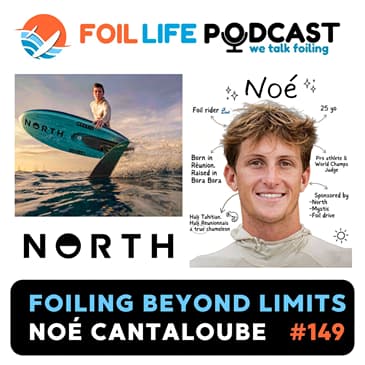
Follow Noé: @noe.cantaloube
Follow Foil Life Podcast: @foillifepodcast
Gear: @northfoils
[00:00:00] Welcome to Foil Life. Whether you wing, kite, parrowing, downwind, pump, or e-foil, thanks for being here. Hey Noé man, we finally made it happen brother. After like a few months of fighting. And Frank on both of our butts. Thanks Frank, you're one of the best managers a team can ask for.
[00:00:28] Anyway, stoked to finally sit down and chat with you. It's gonna be pretty fun. Thank you. Yeah, thank you for the invitation first because to be honest, I don't have a lot of time but I really wanted to do that podcast because you have so much like important guests. So it feel, I'm feeling like super proud. So thank you so much. And thanks for the work that you do for the foil and the sports. It's super nice.
[00:00:57] Thanks man. We've had the opportunity to talk to so many cool people like you said. It's fun. First off, Foiling Dazar, how is that? Because we saw a few of your clips coming out and that looks obviously it's next level but how is that riding that wave on a foil?
[00:01:17] Yeah, first like Nazare is just a name. I don't really like to say like Nazare that I'm riding Nazare because it's a bit, yeah, it's, I don't like to say that but it's, Nazare I think in Europe it's one of the best places to have like some average conditions every day.
[00:01:40] So it's a really cool spot to train and to push like if you want to surf some big waves. So that's why it's, it's quite famous and that's why it's getting famous and, and everyone knows Nazare for big waves. And I think this is where you have like, yeah, every year you can have some, some 20 meter like easy waves. So this is one of the places that I think is, is the biggest wave in the world.
[00:02:04] So, so I'm not going to be afraid to say that, but yeah, it's, it's the best place to train if you want to go in big waves. And I've been there like for three or four years now and I arrived and everyone was surfing, surfing, surfing. And they were doing a bit like, like it's, it was always like the most competitive one. So surfing who have the most, the biggest one on the, on the surf.
[00:02:32] And I arrived here with my fall and I was completely in love with the fall and everything around the fall, the wind for the, the downwind. And I was like, wow, I'm pretty sure we can look to this wave with another angle, with the fall angle and have something completely different than what the Nazare rider are used to do.
[00:02:55] So for example, going super down and doing some big cutbacks and, and stuff like that with the fall, you can go at so much speed that actually the, the curves are really different from the surf. So that's why I, I really, I was super hyped about the falling, uh, this, that wave and especially falling in big waves. I didn't want to go there for the biggest one and having like the, the biggest big wave in the world with the fall.
[00:03:25] I just arrived like, wow, I'm pretty sure we can do something really different than the surf. And that makes sense because chasing, I think the biggest on a foil would be a little bit dangerous, right? I think, I think everything is, is possible, you know, like, um, I'm pretty sure we are far away right now with the fall and the performance of the fall, uh, especially in big waves.
[00:03:53] But yeah, it will be dangerous, especially the safety. The safety is the most dangerous part. Uh, so having a fall with you, another guy, the jet ski, this is really sketchy. So the safety part is the most dangerous on the fall. It's not really the riding because ride, riding, you can get smoked and the fall just go like 20 or 50 meters far away from you. But when you do the safety with the jet ski, that's where it gets really dangerous.
[00:04:23] Because you have to obviously have your board on the sled and get back out. Yeah. Yeah, exactly. So you, you, you never put some leash in Nazare, in big waves in general. Mm-hmm. Like for towing, most of the toe, like when you do some guns, of course you need a leash because you need to recover your board. But when you do some toe, you want to have the bar, the, the board as far as possible from you. So the fall, it's exactly the same.
[00:04:49] So as soon as you fall, you need all to recover your board on the beach and then go back to the peak or to recover in the white water. So that's where it gets dangerous because you have to go with the ski with your mate and take the board with a fall, flip the board on the sled and then go back to the peak with the, with the jet ski and the fall.
[00:05:12] So you can do like one shot, having the bomb and just like throw the board on the beach and break everything. But this is not how it works. I really want to have something a bit more like taking more waves and not taking the biggest one, having a nice session with a friend. So yeah, the safety is the most dangerous part. What kind of equipment or what equipment are you riding and how has it progressed?
[00:05:39] Because I know they tried it a couple of years ago or a year and it was, yeah, it's come a long way since then. So yeah, the first year that we, I was trying to surf some big waves in Nazare, we, I was using some, some normal material, like really mid aspect, the smallest one. I was using like a 500. So something really nice, but too much lift. So the thickness of the foil was too, too much.
[00:06:08] So then I, we tried to develop like a foil with my old sponsor. It was like a 400 low aspect. So something like, it was looking like a stabilizer, you know, it was super small. Oh, whoa. Like 400, like low aspect was looking like that. And it was just amazing. Like, to be honest, instability, I was absorbing the energy of the waves. So everything was super cool.
[00:06:34] But the only problem is that I was going so fast on the wave that the wave didn't have time to break, that I was already like on the next like peak or I was already out of the wave. So it was actually too fast for what I was looking for, like playing in the wave and turning. I didn't really have time to turn and to, because the foil was going way too fast, like a 400 front wing.
[00:07:00] So then after that, the second year and the third year, I went with the 500 low aspect. And now with North, I just switched with the 600 low aspect. So something actually like bigger than the first year. Yeah, because I think I can manage the lift even when I go super, super fast.
[00:07:23] And also with the 600, you can really like play and yeah, because you are slower, you can play more into the dangerous area and like you can play more in the wave. So now I'm looking for something like between 600 and even 700. Obviously not for the biggest day, because I'm not looking for the biggest, biggest day.
[00:07:48] But just to have fun in big waves in general, I think going too small sometimes could be a bit, yeah, not, not, you lost a bit the energy, you lost a bit everything. So I will recommend to have something low aspect between 600 or 700. And what kind of speeds are you hitting? So the first year, so the funny part is like the first year I got like on the wave, I was with the average of like 35 knots.
[00:08:17] So yeah, I was going like exactly at the same speed as the kite, the kite surfing, you know, like the, the Olympic kites. So it's pretty crazy, but the average was like 35 knots. So that's why we decided to actually go like on something bigger because I was going too fast.
[00:08:37] And when I was crashing, I was just like, you do one crash during the session and then you are done for the session because you, you, you, it hurts so badly that, um, when you crash at like 30, 30 plus knots, you just, yeah, you can, then you crash. And then you have the wave on you. So it's not super fun. Yeah. That's about 60, like anywhere from 60 plus kilometers an hour. That's getting, that's getting fast. Yeah.
[00:09:06] And are you able to bank some, is that like kind of just going straight turns at 60 and make them controllable? Yeah. I am. So at the, so the first, like the first, first year I was going with like a 105, like 105 centimeter mast. So you can imagine that at that speed with 105 centimeter mast, the, the foil, even if you do like the stiffest mast on the market, we were doing some prototypes, like super stiff.
[00:09:35] The foil was like a chewing gum, you know? So I was always crushing because the foil was like two chewing gum and boom, I was crushing on the side, a bit of cavitation and then crash. So then I decided to go like for 85 centimeter mast. So something smaller. So actually harder when you have some chop and when it's big, but I had more stiffness and I had more control as well.
[00:09:59] So that was like a compromise of stiffness and control and a bit less like much of error during the ride. Whoa. I was riding my 85 today on flat water, catching up to a client, so ripping as fast as I could. And that was scary. Just like, I can't, I can't imagine being on a bomb and then bank and turns and stuff, but that's a completely other level.
[00:10:25] So are you using stock stuff that people can buy for North equipment right now to ride? Yeah. A hundred percent. Everything, everything that I'm using, you can buy it like on the website. All right, folks, you heard them. I mean, don't go to Nazare, but still. So what mask are you using? It's like an 85. It's like an 85 centimeter mast that I'm using.
[00:10:54] And yeah, you can go to your next, like to your dealer in the next corner and buy that mast. And that's the one that I'm using because I have more stiffness and I don't have a lot of drags and I have a lot of control at high speed because I don't need to. So the difference with like big waves and, and for example, racing, why in racing they take some long mass? Because they really need an angle. So with that angle, they don't want to have the tips out, the foil out of the, of the water.
[00:11:23] But in my, yeah, yeah. In my, in big waves, it's completely different. When you drop a wave, you most of the time go like you go straight. So you don't have an angle. So the 85 actually make more sense, I would say. And, and it's a really good compromise. Whoa. I wouldn't even have thought. I thought it'd been mostly custom, but where do you think that sport?
[00:11:49] Cause I know on your website, you were just talking about the possibilities. What do you think is next to come in that? Do you think they'll incorporate it into like big wave surfing contest, that kind of thing? Or do you think it'll be a bit niche? I think, I think it's still a bit niche because I think for the safety first, secondly, like, because not everyone can surf and foil that wave.
[00:12:17] Not everyone wants to foil this type of waves. Foiling, you have so much energy that when you go in small waves, you can have a lot of fun because you have a lot of information. But in big waves, it's, it's like this multiplied by thousand, you know, because you have a big wave with a lot of energy. So you want all this energy makes a bit, everything scared. So scary, I would say.
[00:12:44] So for competitions and contents, I think the foil don't really have, I think it's too niche. But for content and for showing to the people the possibility of foiling, I think that's why I'm doing it because I'm in love about foiling and I really want to show to the world what is foiling. So I think that's why I'm doing some big wave foiling.
[00:13:08] And yeah, the foiling big wave is going to be more in the media side, I think, in the next years. And it's a choppy wave, isn't it? Is what we're reading up. Like it's not, so 85 does not leave you a ton of room if there's chop down a face, right? Yeah, exactly. As soon as it's a bit choppy, if you have a bit like of wind going offshore or sideways, then it gets super, super sketchy.
[00:13:38] And because it's choppy, so as soon, imagine you have like a 10 meter wave. If during the wave, you have a chop of like one meter, like with the 85, you just fall, you know? So that's why it gets really sketchy because we have bigger waves, so bigger chop. So you have more risk with a small foil, with a small mast, sorry. And what board are you using for that?
[00:14:07] So right now I'm using like one of the North board, the surf foil one, the Verte. So it's a 4.2 for 25 liter. So that's one of the smallest one. I didn't took the smallest, smallest one because like my vision of the Nazare and big wave is like, I really want to go with the gear that I know. And that's the board that I'm using for surf foil. It's also the mast that I'm using for surf foil.
[00:14:36] It's also the front wing that sometimes I'm using for surf foil when it's a bit bigger. So I always try to keep my quiver and to minimize my quiver, to know everything about my quiver. So in big waves, I'm riding actually my surf foil ball because I know it perfectly. And I have space. I have enough room to go in the front, go on the back to carve. And obviously strapped in, right? No, no, no. I go strapless. Strapless, bro!
[00:15:07] That's insane. Yeah, yeah. I'm really in this, I would say, school of if you ride strapless, you have more feelings because you have to put your feet at the right position straight away. So strapless makes everything actually more comfortable for me because I know if I can ride strapless, I can definitely ride with straps.
[00:15:32] But with the strapless, I always have the freedom to move, to move a bit forward, to move backwards, to pump. So all this freedom, it's only when you are strapless. Fair. Yeah, I love riding straps. It's cool to be able to micromanage your feet like that. And how does that, what's the feeling like when you're going down something like that in the moment? I don't know. Did you already try some big waves? No, not that big.
[00:16:02] I remember Lake Ontario, 8-12 kind of thing. So I've ridden that stuff on a foil. And you think you're banking a hard turn, but then you watch your video and you're just running away from it. But that's probably 6 foot, 8 foot. That's about the biggest I've ridden. And yeah, very exhilarating. And then you, that's all you focus on is what you're doing in the moment.
[00:16:28] So that, that I imagine would be the same, but, but bigger. Yeah, that's kind of the same because with the foil, you go so fast that sometimes you see the white water breaking next to you and you're like, wow, I'm in the impact area. And then you watch your clip, exactly what you say. And you are like at six meters from the impact area and you look like a chicken because you're on the shoulder super far away. Yeah.
[00:16:57] That's right. So I know that feeling. And, and yeah, in Nazare again, I'm always trying to do, because we have a jet ski, because we have some safety boys, because we, we are trained for that. Yeah. I try to push as much as I can in the white, in, in the waves to go closer as, as much as I can in the white water.
[00:17:20] But the only problem I would, I would say like, it's sometimes that like, for example, if you take like the first wave, you have like a really clean wave. But then the second and the third, you get like a lot of perturbation in the water. So with the surf, you don't really care. But with the fall, that's where it gets really, really dangerous. You don't have a lot of lift. It's like, it's not, you cannot support, you cannot control the, the wave.
[00:17:48] So most of the time with the fall, you need to go on the first wave. And the first rule in Nazare, it's don't go on the first one, because then you have like the second and the third and the fourth one. Yeah. Yeah. So that's where it gets sketchy. You always have to, okay, take the first one. I hope the second is not going to be too big.
[00:18:11] But, yeah, that, that, that's, we always try to push and to go as close as we can from the impact area. That's where you get really a lot of power and where you have the, the good feelings. Yeah. Currently you're towing into it, right? With a ski? Yeah. Yeah. Where do you find foil drive or foil assist in that kind of big wave or even medium wave category?
[00:18:37] Do you think that has a place or obviously the, the toe and the ski is obviously. Like the, that's a really interesting question. In terms of riding, if we only take about riding, like taking a wave, I think the foil drive, the foil assist, it's a really good way because you, you can take it from far away. You can even get up with like a 500 foil or something super small.
[00:19:04] Can you go really fast now with a different propeller, with a high power motor and everything. But the only issue that I would say it's for the safety. So in big waves, the jet ski, we don't have only one jet ski for like, if for example, I'm going with my mate to surf, we always have like a second jet ski for the safety and the third one for the pilot in case.
[00:19:30] So we, when it's medium big, we always go with three jet ski. So that's where, if you only go with your foil drive and your board, even if you have a backup and everything, then you, you always need to jet ski. So that's why like, you can take some medium waves that you can, like, you can dive and everything. But as soon as getting a bit serious, you always need a ski for the safety.
[00:19:58] If you have like a safe, safe spot and then, yeah, if you just need to ride the wave with the foil drive, you can definitely ride some, some big, big waves. You can do enough, like 10 meters plus with the foil drive, definitely. But then the safety part is not super, super serious. It doesn't replace the need for the safety jet skis for sure. And you're saying the new mini pods and stuff reduce drag. So it's not nearly as bad as it was before.
[00:20:27] But what do you think new boost board and stuff and how the foil assist boom is kind of taking on it? I don't know, wave sessions into something. The new boost one from North, for example, so it's like a trench board. So the foil drive, it's the foil assist. It's like a system that you put between your board and your foil. So between you have like a system and this system was generating some drag.
[00:20:56] So what North decides, they decide to do like a, like a, like a hole in the board to put the system basically in the board and to don't have any more drive. So what, what I can really say, obviously it's during the takeoff, you spend like maybe 40% less energy during the takeoff with a trench board.
[00:21:20] So it's kind of super important, especially when you do like some, some prone session, you reduce the, the, the takeoff. And it's also, especially in big ways, when I tried the, the trench and the normal one with a trench, as soon as you're going to touch the water, you don't going to, you're not going to have this effect of like super draggy and everything. Yeah.
[00:21:44] So the, the trench board makes, makes actually a huge difference, especially when you ride some waves, I would say. And secondly for the takeoff. So the new mini pods are, are into, do you like obviously integrated mast pretty good as well for North just so that you can reduce that drag and everything? Yeah. The integrated mast, it's a pretty cool, like tools because you don't have any more, this, this feelings of getting really uncomfortable.
[00:22:14] As soon as you touch the, the pods, it gets really smooth and you can actually control the drag. So it doesn't like, it's not unstable anymore. It just reduce the speed because you create some drive. So I really like the, the integrated mast and what, what I really like as well now with the mini pods is that for traveling, for example, you take only one mast.
[00:22:39] Before I was always traveling with my integrated mast for full drive and the normal mast for wing full, surf full. Now with the mini pods, you take only one mast and you can full drive, surf full, wing full. Oh, sick. Yeah, that would be pretty cool. And I've heard really good things about that from friends who are on the ones loving the weight difference, right? Yeah. Yeah. Also it's, it's, it's way, way lighter than the, the old ones because you, you don't have all this system who takes the mast.
[00:23:09] So it's, it's, it's something that you just clips and it's almost ready to go. So it's a really nice tools for, for traveling and easy. I would say like super, like, um, how to say like plug and play. Yeah. Super plug and play. Nice man. How was jumping back at you? How was growing up on like switching between Réunion and it was Bora Bora, right? Yeah, exactly. Yeah.
[00:23:34] Um, I, it's, it's kind of, uh, when you are kids, you don't really realize how lucky I was. And now more I grew up and more I realized that I was really lucky because when you are kids, you are just like, uh, I have my friends. I'm, I'm living here. It's, it's, it's cool.
[00:23:53] But when you travel a bit and you go all around the world, that's where I realized that, wow, it's, it's something I'm, I'm super lucky and, uh, I'm super proud of because I didn't, I didn't do anything. But my, for my parents, they were, they were bringing me there in this place.
[00:24:14] And, uh, yeah, it's, it's, I have another, I think I have another vision a bit of, uh, after seeing in Europe what like people they, they are, they are used to. And when, what I'm, I'm used to at home, I'm, I'm really, I'm really lucky. We're in Mauritius and we've been here for four months now, but like driving to the beach is four or five minutes. The grocery store is not too far. You can get into every single day. If you want to get waves, it's an hour away.
[00:24:43] And for that, it's really simple. It's a beautiful, simple. And I finally got to go to a reunion three, four weeks ago to visit my buddy. Shout out to Alex, but a beautiful little spot. But they had this baguette with, with these boy, bouillons or whatever, these little balls inside and French fries and cheese. Have you had that before? Uh, the macaccia? I don't know, but it's like a baguette. They cut it and they put French fries and then they put these like meatballs.
[00:25:12] Ah, the American. The American. Yeah. That's it. The gratiné American. Oh my God. I can kill for that. It's like a baguette with fries, meal, like a lot of sauce and some cheese. And it's like toasted. So you eat it and you're like, on the beach, you eat that and you're like, wow, that's the best feeling in the world. It was my first time having it.
[00:25:37] The good spot that he was talking about was closed, but he brought us to another place and happy with it. But it was still pretty beautiful island. And the hiking and whatnot is gorgeous in there with all the different valleys and stuff. And we went into some waterfalls and glace. Yeah. Sharky though, I heard. Yeah, it's a bit sharky. They have some problem with the sharks. And actually that's why I'm not going back. Like when I'm going back, it's only to visit my family.
[00:26:08] Of course, I'm doing a bit of fall, but I'm not spending like six months there. I could, I can definitely do it because I have really like half, even more of my family there. So originally all my family, they are from Rhino Islands. So my grandparents, my, and then when I was kids, they moved like half of them in Bora Bora. So they are all originally from Rhino.
[00:26:34] So when I go, it's like super nice because we do like a lot of family things. But yeah, they have these sharks problems where it's, it's a bit, um, it's a big problematic for, for the people who live there because they have some beautiful conditions. And unfortunately they cannot surf because you have sharks. So yeah.
[00:26:56] Anyways, um, back from our commercial break, talking about Bora Bora and, um, I guess how, how you're fortunate that you were to be able to experience. How was life there? Cause that's another beautiful example. Yeah. It's another really remote life that I think you like, nobody can really, not nobody, but, uh, if you are there and you can realize how remote it is.
[00:27:21] Like, especially when you go to the supermarket and you don't have nothing because you don't have a lot of food and everything. So you, you almost go fish and, and trade some stuff with your friends and life is, it's, if in Mauritius was life really easy. In Bora Bora, it's even more easy, you know? Cool. Everything is chill. It's, it's super nice. I really like it. That's not bad actually. And then now you're in Tarifa, right? Yeah.
[00:27:51] I just arrived in Tarifa. So I think Tarifa, it's one of the places where I'm, I'm feeling really nice in Europe because, because you have some conditions because of the people. So I, I love Tarifa. And today, there was no wind. That's fair. That happens every once in a while. So, but, and what's your winter like? When are you heading back to Nazare? Yeah. I'm going to go back like probably in a week or two weeks because the season already starts.
[00:28:19] And my team, like, there's some people who are waiting a bit for me. So I'm, I'm happy to see them and I will go ahead and spend the winter there in Nazare. Okay. I hope the season goes well and hope training goes well. Do you prepare physically at any of that stuff before the season starts? Yeah. Yeah. We have some, some apnea training. We also have some reinforcement like muscular reinforcement.
[00:28:47] And we just kind of go surf every day to train with the team. So we always stay a bit all together to, to really know your partner, to, to, to be super in fusion with your partner. So to train together really helps during this. And I guess shout out to North that you can ride stock gear on such a, so I guess that's pretty cool for R and D purposes. Yeah. Yeah.
[00:29:15] Definitely super happy that I'm riding some, some regular gear. They are not really marketing. They are not doing a lot of marketing on it. And I'm, I'm happy about that because I'm pretty sure we can actually work a bit more on the, on some projects, especially for big waves. But again, the market is so niche that it's not something that they're going to do it tomorrow, you know, but it's super nice to have the pro like a project that you can buy and you
[00:29:45] know that you can go in big waves, even with that project. Well, that's the thing. And even if we're riding two footers at home, the, the knowing that you've been riding something 30 feet on the same equipment will make you feel pretty cool. You know what I mean? It's neat to be a part of it. Yeah. Yeah. And make you actually know the, the foil, you know, if you ride that foil in kind of every condition, then you can actually push a bit more and go in bigger size. It's, it's really like a tips for all the people.
[00:30:14] Don't change front wing every morning or every afternoon. Try to get one setter, even if it's different support and try to evolve with that setup. You're going to know better your foil and you're going to have way more skills, even in extreme conditions. All right, man. Thanks for taking the time and schedule. Come on, chat with us. Yeah. Thanks to you for, for this podcast. It was super cool. Super nice to talk about big waves. Cause I know it's such a passion of yours. Yeah.
[00:30:44] Enjoy, enjoy when that stuff goes well. Cool. All right. Bye everybody.