
Episode Highlights:
- History of TWC from the mid-80s Outer Harbor roots through name changes and steady growth into Canada’s largest windsurfing club
- Location advantages at Cherry Beach: protected flat water in east winds, rolling conditions in southwest, and challenging offshore days that build skill
- Gear storage in 11 sea cans, membership benefits, webcam, WhatsApp groups, and real-time community coordination
- Summer camp program (WeCANFoil-based levels 1–4) now integrating wing handling, longboard practice, and low-speed boat-assist foiling
- New Learn to Wing Foil program and Max Robinson’s private lessons (dinghy follow + video feedback)
- Youth high-performance development team: volunteer pro coaches (Max Robinson, Sam Ireland, Anna Sagulenko, Simon Rickard) coaching kids on windy evenings
- Weekend Foil partnership bringing X-15 boards and wind foil kits to Toronto
- Family progression stories and why wing foiling is more accessible for partners and kids than previous wind sports
- Great Lakes riding opportunities (Lake Ontario waves at Bluffers, Georgian Bay, Sauble Beach, Lake Huron) and the joy of maximizing days with foiling
- The inclusive, multi-generational spirit that keeps 80-year-olds racing and kids developing into the next coaches and competitors
A warm, community-focused conversation packed with history, practical program insights, coaching wisdom, and genuine enthusiasm for keeping foiling and wind sports accessible, fun, and multi-generational right in the heart of a major city.
Stay tuned for more great episodes, including the return of additional guests and continued adventures with host Luc Moore!
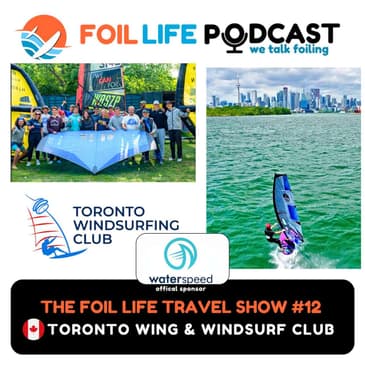
[00:00:00] Hey everyone, welcome back to the show. On our 12th episode of the Foil Life Travel Show, we chat with Brendan and Ian from the Toronto Windsurfing Club. Now this club has a special place in my heart as it's one of the local clubs that my brother and I attended while we were learning how to kite and we were learning how to windsurf. So we have a lot of history there. It is such an amazing place and we do hope that you enjoy this episode as we deep dive into the Toronto Windsurf wingfoil and kite scene
[00:00:27] to learn more about the services that this amazing place has to offer. Next we want to say thank you to our team. We have Frank, Stefan and Pam. Thank you for your hard work behind the scenes that helps this show go on. Lastly a big thank you to our sponsors for 2026. We have North Foils, Mystic and On Kiteboarding. Make sure to visit foilifepodcast.com forward slash sponsors to learn more about them. Now I hope you enjoy the show.
[00:00:56] Welcome to Foil Life. Whether you wing, kite, parowing, downwind, pump or e-foil, thanks for being here. Alright guys, thanks for joining me on the show tonight. Really looking forward to learning more about the TWC. Thank you for having us. Thanks for having us. Toronto Windsurf Club is a pretty special place in my heart. My brother lived in Toronto for I think it was seven or eight years and we started windsurfing back in like 2010, 2012.
[00:01:24] And we would go to Silent Sports for the swap. And I remember one day I picked up a used sail for like 50 bucks and was over the moon about it and I had to go try it. So we ripped down to Toronto Windsurf Club to hop in the water. I was way overpowered. I think it was pushing 20 to 25 knots. But that was one of the first times that I was introduced to that spot. My brother had seen it before because he lived there.
[00:01:51] So it's really cool to come full circle and have you guys on and be able to talk about this amazing centre. Really close to downtown Toronto. Yeah, we're so fortunate having this in our backyard. Both Brendan and I live quite close to each other and on a day that I'm working from home, I can be down at the club in 16 minutes from my house. 22 on the bike. So yeah, it's remarkably close.
[00:02:18] And total gem in the city, like you say. Hub's been around since the mid-80s and has, from its inception, one trailer has just grown into this incredible little hub. You know, accessible to all right on the beach in downtown Toronto. What was the initial kind of inception of that? Where did the idea, I guess the idea came from wanting to be able to access the water? Sure. But I'll let you kind of take that one.
[00:02:46] Sure. So ultimately, we are a string of about eight clubs down as what is part of the Outer Harbour Sailing Federation. And that came about in the early 70s. And ultimately, it was a group of RCYC racers who wanted a place to be able to sail in the winter and the fringe months without having to take the ferry over the island and things like that.
[00:03:11] Paul Henderson, who is a legendary Canadian sailor, past Olympian and things like that. Him and his buddies were basically the driving force between opening the first club there, which is Water Rats. And then the expansion just kept coming and coming and coming. All of a sudden, we jumped forward to the early 80s. And the one thing that wasn't represented was the new sport of windsurfing. So we are sort of outside of the main strip of where all the other clubs are, but right on the public beach.
[00:03:39] Obviously, perfect for the windsurfing end of things. And that was the beginning of Toronto Windsurfing Club. I actually had a different name back then, but what revolved into the Toronto Windsurfing Club. What was the name back then? Oh, even though I was around the industry in those early days, it was Toronto Board Sailing Club maybe or something like that. Yeah, I'm sure it was a windsurfing trademark issue or something like that. But yeah, it did change name and somewhere through the 90s.
[00:04:09] Oh, that's cool. Do you know how many members you guys had at the early days and what the club was offering? It started as a handful of members. The first sea can was added in the first couple of years. So people were actually able to store their equipment down there. And then slowly over the years, it just kept building and building. We've got a decent size Quonset hut down there that acts as sort of a mini clubhouse, a place for some of our lessons and our camp program, a little bit of storage in there.
[00:04:37] And then essentially we've got 11 sea cans and we've got vertical board storage in those. You know, there are crazy people like me who actually rent four of those spots per year just because I've got so much bloody gear. There you go. But yeah, no, it's so nice. And, you know, as you alluded to earlier, you know, the ability to drive down or ride a bike down, have your kit there ready to rig and go is really, really such a pleasure.
[00:05:06] Whereabouts in like at the Toronto or the Toronto waterfront is the club situated? So Toronto Windsurfing Club is at the eastern end of Cherry Beach, which is contained by a man-made spit, the Tommy Thompson Park, which was built out of old construction waste for the development of the city of Toronto. So we've got a really unique combination.
[00:05:33] We're sheltered to the east and to the south. North end is captive by the city. We've got natural beach on immediately in front, but then also a great windbreak and wave break, which allows us some pretty protected conditions in most sailing. So can you guys see the screen? Yes. All right, perfect. So here it is.
[00:06:02] Here, let me zoom out just to see in relation to the city itself. And then we'll zoom into it. So it is a pretty protected area, correct? Because you got that. That's the island, right? Kind of that or the whatever. Yes. Toronto Island is over there to the left or to the west. Oh, here it is. Yeah. Yeah. Nicely protected.
[00:06:28] So east wind, which is somewhat prevalent in the spring, makes for some really amazing flat water blasting. Yeah. Yeah. You'll be out there in a 20 or 25 knot day with yay much chop. Southwest is sort of our most common wind, which can make for some really nice big rolling conditions, especially with the advent of the wing foiling now.
[00:06:56] The good wingers, not the slowest just like me, but the good wingers are out at the point playing in the waves where they enter into the harbor. And then west and northwest are what make us good sailors in Toronto because you have to learn to sail in adverse, crazy, shifty offshore conditions. You know, essentially some of the winds are coming in around the skyscrapers of downtown Toronto, including the CN Tower. Yeah. Yeah. Fair enough.
[00:07:24] Were there, is there coaching or any of that kind of thing back in the day or was it more a place where people could come store their gear and access and enjoy the water? It started pretty grassroots. The first lesson programs we did were often run by one hired coach and two or three volunteers. And then it just kept building out from that and building out from that to the multiple different programs that we offer now. And then obviously your membership has grown significantly over the years.
[00:07:51] And how does that feel like to be able to have a place where gear is stored, you can rent gear, and then you have that kind of camaraderie where everybody is situated? Because let's say for Ottawa, Ottawa doesn't have that. All these other cities across Canada, there are not very many clubs that are set up in this way, which facilitate community building, right? Yeah. Once again, great sense of camaraderie down there. A lot of the focus is around some of the various events that we run throughout the course of the year.
[00:08:19] Canadian Masters windsurfing is regularly at our place. Every year we host the Mammoth Marathon. I'm wearing an older shirt for that event right now. And the Wednesday night races. So it's amazing how you'll get a group of 15, 20, 25 sailors coming down to the beach with a zero wind forecast, hoping to go out and drift around with their buddies.
[00:08:47] And if not, we hang out and have a barbecue after. So how did you guys get involved in the center and when? I started sailing there occasionally back in the 80s and then through the early 90s. Sometimes as a member, sometimes just sort of going and hanging out at the facility and launching with everyone else that was there. And then I actually jumped forward 30 some odd years.
[00:09:12] It was about 10 years ago and my son was starting to get into windsurfing following my footsteps. And he was becoming a windsurfing instructor up at his camp, ultimately became a windsurfing instructor down at the club as well. And I was like, oh, OK, this is a great place to be. COVID happened. We had some accessibility issues with getting into the various beaches that I would often sail at.
[00:09:36] And then realized, wait a minute, there's this amazing gem down on the harbor, $120, $150 a year to join. And you've got unlimited access. And unfortunately, in the year of COVID, it was about the only place you could park in and around the city. So yeah, it was the perfect way to continue getting out on the water. Oh, let's go. So what role do you play at TWC?
[00:10:03] Myself right now, just I manage a bunch of the different committees. So I help with the school program that we have. I help Simon, our lead instructor, trying to develop some of the new programs, integrate boiling into our camp program, evolving with Max Robinson and the private lessons that he's been doing down there.
[00:10:28] And then also most exciting that we've done just in the last week or so, we've hired Eric O'Brien, who's going to be coming in and leading a new Learn to Winfoil program based on basically we're mirroring something we've been doing down at the club for 20 years, which has been our Learn to Win surf program. And so combination of sort of three hour intro sections or three times three hour leveled instruction programs.
[00:10:58] Yeah, we've had incredible success in introducing windsurfing to new sailors, which is ultimately why we're able to still be here, why we still have such a good population of people down at the club doing what they do. So, yeah, we're now so excited to be mirroring that on the winging end of things as well. So, yeah, just totally, totally psyched about what's going on there. Oh, congratulations. So, yeah. So for those who are learning about this for the first time, I guess you're combining storage, facility, community,
[00:11:27] but then also offering high quality lessons from coaches that have been in this industry for a long time and who have a heck of a lot of skill and value to deliver. Luckily, all in that area. Yeah, that's a good summary. It's a very special place. And I started back in, you know, Toronto had a huge boom with windsurfing. When windsurfing first started, it took off like a rocket in Toronto. And people were excited in around 1984 in the Olympics.
[00:11:54] And I was 14 at the time and I got my first job working for Mistral, teaching windsurfing a few kilometers over from where the Toronto Windsurfing Club is under the cage. And did that for 10 years. And we used to go over and do races at the Toronto Windsurfing Club, which was a happening place at the time. And has carried on and throughout. And it's been there all the time. It's just expanded, as Ian said.
[00:12:21] But now we have sort of a new generation of wing foilers that are coming. So it's a real interesting mix. We have members that are 80 years old and are still on the water windsurfing and taking part in the Wednesday right races and the like. And a lot of those guys are storing their stuff because the windsurfing gear is so big. But we also have a nice big parking lot. We have a webcam. So you can be at work watching the conditions.
[00:12:49] And if you're a winger, you jump in your car. You probably have your gear in your car. I'm a winger now. I think I've done all the sports, but now a winger. And you can be there quick. And we've got a WhatsApp community for the wingers, a WhatsApp community for the windsurfers, WhatsApp community for the racers. So you kind of get real-time information. And we're seeing a real boon. I think Ian and I were on the board together. I'm still on the board. Ian does a ton for the club. But I think we have about 600 members now.
[00:13:18] Oh, congrats. And probably, yeah, it's a big club. People come in to use it. We have some paddleboarders. We have windsurfers. We have wind foilers. We have wing foilers. We have people putting up docks and pump foiling on the calm days. That was sick. We have some foil drivers. You know, we kind of have it all now. And it's a really fun mix. And obviously, all this programming.
[00:13:46] Probably have, I'd say we have probably about 60 or 80 wingers now coming down to Cherry Beach on any direction. And, you know, as Ian said, even on the offshore now, you know, the good guys, there's a fun group of us that we will paddle out to the wind line and just ride, you know, straight offshore out and around some of those islands. And so any direction of wind and, you know, anything from eight knots and up and the wing foilers are flying.
[00:14:13] So it's really a very, very active club and community. Not just the wingers going on on those crazy offshore days. I spend most of my time on IQ Foil, the Olympic wind foil board. And basically, it's a short, wide dock. So even in these cases where you've got a couple hundred meters to get out to the wind line and out to the open water, it's as easy as can be. And then obviously, once you get to the magic point, off you go. Yeah, that would be pretty fun.
[00:14:42] I was in Mexico or something last year. And I was talking to one of your members. And it was late too. It was either late or super early in the spring. Anyways, it was cold. But he was still so jonesing from his session that he had at Cherry Beach and at the center. And he's like, it might be best now that I come and see you guys down in Mexico. But it was like, it was pretty awesome to be able to get out today. So we talked about that for a little bit.
[00:15:06] So it's cool that you guys have been able to weather the storms, literally, and then maintain the club and grow the club from the humble beginnings to what it is today. What are some of those new foiling programs that you guys have put forth and are continuing to put out there? I'll start off with the camp end of things.
[00:15:32] So we offer a pretty decent full camp program for seven or eight weeks over the summer. We'll have somewhere between 20 and 35 kids down there at any time. And it is based on the canned sail windsurfing program. So level one to four, you work your way up.
[00:15:53] And what we've introduced this year is wing foiling or winging into the mix for those students who are at the level three and level four levels.
[00:16:04] And, you know, essentially what we'll do is even if we don't get them out doing the complete combination of wing foil board and all that is one starting them off with small wings on the beach, learning basic wing handling, then putting them out on a long board with a dagger board on it. So they can go and get the sense of how that's different from a windsurfing sail without just drifting straight downwind.
[00:16:31] We are starting to do boat assist foiling. Not to call it tow foiling, but boat assist foiling. And we've amassed a great collection of big sort of older generation foils. So go foils, 2200, 2500 front wings. We just found an older Nash 2450 front wing.
[00:16:58] And what's great about these, we're pairing them on some of Casey's older reef warriors. And those behind the boat, when properly instructed, these things are popping up and starting to fly at eight or nine kilometers an hour. So very controlled, very manageable and very, very low risk for the people doing it.
[00:17:20] Yeah, like we've been doing that for quite a while and progressing from sitting to kneeling to standing is such a gentle way of getting somebody to kind of connect those pieces in their minds. Because there's so much that goes on with foiling. And it's great that you can offer all of that. Maybe touch on a little bit of who's working with you guys now as coaches and how did you guys get connected with those individuals?
[00:17:48] Yeah, well, as Eric mentioned, or sorry, as Ian mentioned, we just hired Eric O'Brien is leading up our new foiling program. So that's, you know, learn to foil program and also teaching with the camp. But we also have Max Robinson, who was basically, he grew up at the club. Yeah. And then you've had Max on your podcast before I listened to it. It's a great session. So Max is, you know, Max is like, that's such a proud point about the TWC because he grew up at the TWC.
[00:18:17] And grew up windsurfing and became a professional windsurfer and became a professional wingfoiler. Went off on the world tour with Gong as a competitor, then was also part of managing their team, etc. But has recently stopped that and has come back to his hometown of Toronto. And he's gotten re-involved in the TWC, which is amazing because he's an incredible coach and an incredible instructor.
[00:18:44] So he's been our main wingfoil instructor through his program, Max Sports, that he runs out of the TWC. And in that, he's doing private one-on-one lessons. And I would encourage those to everybody. He actually taught my wife and both our daughters to wingfoil over the last couple of years. He does an amazing job. He uses a dinghy and he follows you in the dinghy so he can talk to you directly. And then he films you on your iPhone while you're doing it.
[00:19:12] So when the lesson is over, you have a series of videos of you doing your lesson that you can go back, plug into your TV and listen to time and time again. And it's just a really effective method. So he's an incredible coach. Eric is an incredible coach. And they're both, again, kind of grown up through the program. And then we have a bunch of other members that have also come back that coach on a volunteer basis.
[00:19:36] So we have Sam Ireland, former Canadian pro windsurfer, who's a big-time winger now, one of my best friends. And he's there with his son, Beck, who's incredible. We also have Anna Sagalenko, who works with North and is a former windsurfing competitor and champion, active member of the club. And she helps coaching some of our youth.
[00:20:01] And then we also have Simon Ricard, who's grown up at the club and really runs all of our camp programs. And so, like, we have a youth development team that we've just put together, which I can talk more about. But I kind of administer it. And I know what I'm doing on a wing full, but I was never a competitor. But for these kids to have those coaches, right, Sam Ireland, Anna Sagalenko, Max Robinson, and Simon, like, you know, basically for free on a grassroots, it's really just –
[00:20:29] it shows, like, the depth of the community and the depth of the history and the depth of the skill. And it's just a great opportunity, whether you're looking to learn to wing foil or whether you're looking to get your kid, you know, seriously ramped up in the sport and maybe even the industry, maybe become a coach, maybe become an instructor at the TWC, which is a fun summer job. That's kind of our main coaches.
[00:20:54] And then we have a – also, maybe, and you can speak to this a bit more, too – we have a whole group of youth instructors that we hire to run those camps that we do in the summer. Where the club, I think, has been really successful is the board of directors has always realized that if we're going to keep current, if we're going to keep active, if the club's going to keep going, we need to keep bringing the next generations in. So, you know, that's why we run the camp program.
[00:21:21] The camp program is remarkable, a value for the money for City of Toronto summer entertainment, summer learning. But in the grand scheme of things, that's also keeping the next people coming in. More importantly, that's where our next group of instructors come in. And as a result of that, you know, the club would have aged itself out years ago if there hadn't been the, you know, the fresh new people in.
[00:21:47] You know, those of us who have been playing around in the windsurfing industry since the 80s, you know, it kind of faded out almost to oblivion. Other than unique places like Toronto windsurfing club or, you know, obviously there are certain communities in California or in the gorge or, you know, the great stuff that Mike Burns down and OBX is able to keep running.
[00:22:12] But yeah, no, keeping new kids coming into it to become our instructors, to become our foil instructors is really what's guaranteed the long-term success for the club. Really great group of kids that have been around as well and some incredible sailors. Oh, awesome. Yeah, glad to hear. What is that youth high performance development team slash program?
[00:22:36] Yeah, it's kind of unique in its structure and I think it's something that other people should think about because we all have jobs and we're all busy and we make time for this sport that we love. But, and we think we're social, but really like I run to the beach, I see some of my best friends, I talk to them for two seconds, I ask what they're rigging and then I go out on the water by myself for two hours. Exactly. And then I stay on the water too long. Don't bug me, Mike. I stay on the water too long. I'm late when I get back. I drive home in my wetsuit and I apologize to my family.
[00:23:06] Like it's not actually, it's a lot of fun, but, you know, I don't know how much sharing you're doing. So we really wanted like for the reasons that Ian was saying, we really want to bring up the next generation. We really want them to learn. They've done their lessons, their intermediates. The question is how do they get the coaching? And so the way we structured it is we got these five volunteer coaches, all of whom have, you know, jobs and other things they need to do. But the one thing we know is that when it's windy, they're going to be at the beach.
[00:23:33] So what we did is we got together our youth and we created a WhatsApp group. And what we do is when it's windy and one of the volunteer coaches is going to the beach, we kind of throw out the bat signal. And we say, hey, it's Brendan. I'm going to the beach. I'm going to be there from four till six. Any youth team member who wants to come and ride with me and get some tips, let's do it. And then we use, we have the BB talking headsets.
[00:24:01] So we'll put those on if we want between like one of the volunteer coaches and one of the students and we'll ride that way. I'll throw a Insta 360 camera on my wing and follow some of the students around. Sometimes there's some drone footage. And so it's really kind of like a grassroots, like, let's be honest, nobody wants to sit in a classroom on a Thursday night to hear about. So let's just ride together. It's really a ride together program. But how do you make that happen?
[00:24:29] You make it happen on the windy days where I'm going to be there anyway. I'm going riding. I'll coach you, but I still want to ride. I don't have that much time. And so I'll get out there on the water and we'll give each other quick tips, maybe do a quick thing on the land. You know, when you, you should flip your hand when you go into your jibe, you know, you need to like whatever it is, like just those little tips just to get the kids stoked. And then, you know, in the fall, which is really windy, I think we'll get some, we just started this. It's going well.
[00:24:57] Um, but in the fall, I think we'll get some group trips together. You know, there's a lot of great places to ride in Ontario. We'll go out and do some road trips and maybe have some talks to the kids about how they can get in the industry. Matt Aiken at North has been a great sponsor of the team. Um, and you know, yeah, he could talk to the kids about, you know, you could have a life in this sport. You could go into the industry. How do you do that? How do you become a competitor? So that sort of stuff, that's kind of the nature of it. Oh, that's amazing. Yeah.
[00:25:26] Having the opportunity to get out there and actually get some coaching on a night, on a night like that and building that camaraderie on a group is not something that I've heard of before. Yeah. It's kind of just putting the pieces together and making it happen. Cause you know, you never know when it's going to be windy. Um, but when it is windy with the forecast that you could say it's going to be two days out, we can now say it's going to be windy Wednesday, you know, from five till nine, you know, who can be there and let's get together. So it's fun. Oh, yeah, that's amazing. What's your tie in with weekend foil?
[00:25:56] So it's taken a little bit of time, but, um, we are finally at the stage where the memorandum of understanding is signed and we are now a weekend foil hub. Um, yeah. So a lot of calls, a lot of, a lot of talk with Augustine over the last couple of years.
[00:26:15] Um, what's been amazing is so many of the people who they've used to develop their learning and develop their programs and things like that are the people who are involved in around the club. Um, so Max obviously was pivotal in some of their, their early things. Uh, Eric O'Brien, our new wing instructor, um, was there for the first Canadian instructors clinic. Um, Carl, uh, I'm up on Georgia Bay.
[00:26:44] Uh, he's in the club regularly, which is a amazing expertise, amazing perspective on how to teach this, this new sport. Um, we're definitely learning a lot as we go along. Um, but the, the relationship with them is we are their hub in Toronto just for the board sports. Um, they provided to us use of a couple of the X-15s. Um, the, the, the, the, the, the starboard race board.
[00:27:12] Um, unfortunately a little, a little bit too small for someone my size or at least at my current skill level. Um, but yeah, really cool being able to, to get those and get some of the people from the club practicing on them in advance of say the, the foil we got that just happened this past weekend in Kingston, Ontario. Um, and you know, weekend foil has also been great in providing us or will be providing us with two complete wind foil kits, uh, to, to integrate into our program.
[00:27:40] So yeah, it's a long time coming, but totally, totally pumped. Um, both in terms of what I think we can do for them and what they can do helping us in terms of equipment and also bring some more light on terms of. You know, Toronto Windsor 3 Club getting some more people coming down our way to, to learn these incredible new sports. Yeah. Aug is awesome. We've had him on a couple of times just to talk about, um, yeah, weekend foil itself, but then they were also at Halifax events.
[00:28:08] We had them coming on with Carl, um, to talk about that and they do great work and it's awesome that you guys were able to make something work together for the betterment of everybody. And one thing to mention actually is the fact that you guys are on Lake Ontario, but there's so many other really beautiful lakes in that area for people who are in the U.S. or across the world. Um, the great lakes are actually a really awesome place to ride. Yeah, for sure. That is a great point.
[00:28:36] I don't think people realize that enough. And I'm always trying to talk my friends into getting into wind sports in Ontario because like whether it's Lake Ontario, which by the way, can produce some huge waves. Like we have a quite a serious surfing community over at Bluffers Park. There'll be 50 guys in the water when the wind is right and they'll be in the water all year round. And now you see the foil drivers, uh, showing up at Bluffers Park and see some pair of wingers too. You've even seen some downwind runs.
[00:29:06] So it's funny that that's all happening on Lake Ontario, which I tell you, those waves can really pack a punch. It's surprising. And then we have Georgian Bay and, you know, I've been doing wind sports since 1984 and I've been to a lot of places in the world. And I will tell you that the waves on the Western side of Georgian Bay are some of the best I've seen anywhere. Fresh water. Uh, this is amazing wave riding up there. Amazing downwinding opportunities, uh, with pair wing or wing.
[00:29:35] Sobble beach on Lake Euron, uh, you know, back in the kite surfing days, I can remember days where the waves were like by kite was just bare. The lines were just barely, uh, making it over the waves. Um, just huge waves out on, uh, Sobble beach and then Lake Euron, you know, if anybody checks out Great Lakes Waterman, who I don't know if you've ever had him on your podcast, but I would give him. Did you? Yeah, there you go. So you know him. Yeah. I don't know him.
[00:30:05] I follow him. I watch every video he puts up. I think it's unbelievable what he's doing on, on, uh, Lake Euron. And then you have, uh, Lake Erie that's got tons of spots. And also, you know, if you're going to go further up North, uh, Lake Superior, which is, which can really pack a punch. Um, so if you've got a car and you're willing to travel, you know, or even head over to Michigan, it's not that far away. So there's just a ton of great spots. Yeah.
[00:30:31] And you got sandbanks not far away and a big windsurfing crew from there. And huge, amazing waves there. And, and there's so, there's like, you can ride the beach, you can ride other spots that I'm not allowed to talk about. And, uh, it's such a, it's such an amazing place. And I, I still, that's where I actually overcame a lot of fear of water and learning how to like go out windsurfing and on spiring eight to 10, 12 foot swell. And it was in 35 knots.
[00:31:00] And so it's such a beautiful part of the world and, and then, yeah, drive a little bit from sandbanks in Kingston and boom, you guys are at your location. So it's, uh, very well situated to travel. If for example, you want to catch some different varying conditions. Yeah. Follow the wind. And, uh, you know, now with foiling is like, I know you guys have talked about many times on this, you need eight knots.
[00:31:23] Uh, so with the right gear, you know, from eight knots to 30 knots, that's like tripling and quadrupling. Uh, you know, the number of days he used to get on the water, uh, not only with windsurfing, but even with kiting, you know, kiting, you get lured into the light winds. Uh, cause you want to maximize your days, but when then that kite goes down, cause it drops to four knots and you're offshore, that's no matter how good you are, that's complicated.
[00:31:50] Uh, whereas if you're winging and you got the wing leash on your back, all you gotta do is paddle home. Uh, and so that's what a lot of us do. And so the light wind sessions are great, you know, particularly after the wind drops and the waves day, those make for great days. And that's the beauty of foiling. Like in all these various disciplines, it's just really maximizing the number of days on the water, which is really fun. What about looking at wing foiling as a family discipline?
[00:32:16] Because this is something that was, that I think foiling makes a little bit easier than kiting, for example. Um, how have you guys seen that at the club? One of my favorite days last year. Um, was hanging out with Brendan, just floating on our boards is Max was out teaching his daughter to get her first flights. And I tell you like the, the, the, the Cheshire cat grin from ear to ear on Brendan's face for it.
[00:32:44] Not for him, just like for his daughter. Okay. Okay. She's hit this new milestone. She's hit this new threshold. She's one of us. And yeah, like that, you know, you can see the, see the smile on his face now. Just pure family pride. Yeah. Anyways, Brendan, go ahead. Thanks for that, Ian. That was, that was a great day. Um, like kind of, like I said before, you know, I started in 84 with the windsurfing that became kiteboarding. That became kite surfing. That became kite foiling, became winging and now a bit of power winging.
[00:33:12] But, and my wife has been along for all of that, like a hundred days in the van at, in Baja. And, but all of these sports just didn't take, uh, you know, windsurfing didn't take, kite surfing. She tried, but didn't love. And then winging came along and through Max, um, you know, she has learned and we're 55. Um, and she's picked it up and loves wing foiling. Now wings foils all the time. And our two daughters at 20 and 16.
[00:33:40] And our 16 year old daughter is, is quite tiny and she will go in 25 knots and she's becoming quite a winger. Yeah. And it's, you know, the progression of the gear, right? Like the gear has become so good that whether they're riding beginner gear at the beginning, or even I find putting them onto the advanced gear earlier.
[00:34:03] Like I recently took my wife, who's probably an intermediate and moved her up to the HA and the UHA Armstrong series of foils, which, you know, people would say the UHA is like an advanced foil, but it was actually unbelievable how much it improved her foiling. Just on the change because, you know, learning jibes, she's got so much more, um, float so much more time because of the way that foil works.
[00:34:28] And so it's interesting the way you can progress them into the very gear you're using as an advanced person. And now we, you know, I used to drag them on wind trips and they didn't always love that, but now everybody's like, when are we going? And we've been going kind of all, all over the world on, on, uh, family wing foil trips. Um, kind of figuring it out often being focused on, you know, duotone centers or north centers. That's a good way as a family trip.
[00:34:57] You just pull up their website. They're all over the world. It's plug and play. Um, and then also we've done a couple of, um, catamaran trips. There were a few outfitters like, um, yeah, like they're kind of more focused on kiteboarding. Um, but they're now progressing to wing foiling and, um, that, and there, there's a lot of them that are not that expensive, cheaper than going to a resort.
[00:35:23] And to wing off the back of a catamaran, you know, in Antigua or wherever with your family for less than it would cost to go to, you know, some resort, uh, is really pretty good. And as long as you can make sure that the instructors are not kite foilers kind of pretending to be wing foil instructors, but actually wing foilers, uh, then, you know, you can get a hell of a family vacation out of that.
[00:35:46] So I think that to your question, I think that that's something that the industry as a whole, like can focus on more because again, our 16 year old daughter is like ripping it up. Sam Ireland's son, Beck is basically a phenom. They went to the gorge for two weeks. He's riding two, five and 10 foot swells. I can't even, I think he's 13 or 14, but it's not, but he's not a gorge kid, right? He's a kid from Ontario. Um, and he's just out there killing it.
[00:36:12] So the opportunity for kids here and youth and wing foiling, like we see it in the videos, but it's actually much more domestic than I think those videos suggest, right? You can do it in your hometown, wherever you live. Yeah. Yeah. That's the nice thing about it. It's opened up the entire kind of world and you can do it on smaller lakes and it's a lot, a lot more easy, a lot easier to do that. But, but it is nice to be able to incorporate all of those new youth and then help them spread out, especially today that kids are more and more online.
[00:36:42] I think it's a really valuable service that you guys are doing to the entire community. Um, and I want to say thank you for doing it and taking time to invest in the future. Um, because kids need something now, I think more than ever to stay grounded and to give themselves something like goal oriented task. Learning is something that's going away with the advent of AI and social media and all that stuff.
[00:37:07] Cause it's like everything they want instantaneous, but these skills develop these like ground level things of overcoming, uh, fear and overcoming obstacles and be able to progress in life. So it's really nice to be able to pass on that passion. So thank you to you guys for taking the time to do that. Cause I think that's something that's really needed today. Yeah. I would say just, um, to your very point, like I spent a lot of time on the TWC webcam watching to see the wingers.
[00:37:37] Go out. But the other thing I actually like, I keep it on at work, but the other thing that like really gets me emotional sometimes is when we're running our camp and anybody can do this, go on the Toronto windsurfing website and look at our webcam. And look at it during the day of the summer. And you'll see our camps running and you'll see these kids, you know, kind of seven to 18. And they're there, they're running around with windsurfing sails and wings and they're rigging gear. And it's a proper, it's a proper summer experience.
[00:38:07] And they are learning to windsurf and they are learning to wing. And we're starting with the toe foiling. And, you know, there's all these kids running around and they're all having a great time. And they're right there, uh, you know, at the bottom of Toronto, Cherry Beach. I think we're $450 a week Canadian, uh, ish. And it's just a great summer experience. And there's lots of kids doing it. And we run programs for underprivileged kids and we run, um, all kinds of different programs just to get the kids out.
[00:38:35] Anyway, if you take a look on the webcam, you can, people can see for themselves kind of that next generation growing up in these sports that we all love so much. Oh, that's awesome. And what's, how do people get in touch with you? How do they reach out to either get their kids involved or get themselves involved? Through the website's the best way. And the website is mystery. We spend more time on the water than the website, but it's, uh, but it works.
[00:38:58] And, you know, the other thing I'd like to throw out to, to all the sailors in around Toronto, um, you know, our Wednesday night races are a great opportunity to get on the water, whatever it is you're doing. So it's open to all, you don't have to be a club member. So if it's a windy Wednesday, like it is today, and you've got a wind kit, you've got a windfoil kit, you've got an old windsurfing equipment, throw it in the car, come on down and get racing. And you'll get a quick sense in terms of what the club's all about.
[00:39:27] And, you know, it's, it's just such a fun, vibrant place to be, uh, especially on a, any windy day. Um, yeah, the, the, the vibe down there is, is really remarkable. You, you forget you're in downtown Toronto. You're, you're in your own little, own little haven sort of thing. And who's the barbecue chef between the two of you guys? Neither. We're on the water. Fair enough. Hey guys, is there anything else you want to put out there before we wrap her up?
[00:39:56] I just want to say thank you for having a couple of old dudes on who are pushing community. I can't tell you about back loops or any of that stuff. I don't even jump anymore, but, uh, but we really are passionate about, uh, especially taking advantage of this foiling thing to kind of reinvigorate the everybody. And it's just, uh, it's great to hear, uh, from you and to have these opportunities. So I really appreciate it and hope people will come down and check us out at the club.
[00:40:21] Um, and just sort of final thought for me is the, like the, the foiling is just such a great new activity and a way of extending and getting more people into, into sailing. Um, you know, I'm a couple years older than Brendan and I've got some, some body issues and some arthritis and stuff like that. But, but combination of either wind foiling or wing foiling and on a slightly bigger platform, you know, I can't put my shoes on in the morning, but I can go ripping at night. Yeah.
[00:40:50] But Hey, thanks to both of you for coming on. It was really cool to be able to learn a little bit more about the history of the club because I haven't been there in a few years, but, uh, thanks a lot for coming on and sharing that. It was, it was awesome to learn about it. Appreciate you having us. Thanks for having us. Look forward to seeing you there. Yes. I'll have to get out there one day and bring the wing foil kit. I'm riding KT stuff right now. So I got some new Atlas wings that are kind of a little bit more flowy, but they still snap and they got literally good low end and it's insane.
[00:41:20] The new gear that's coming out, eh? All the new technology and stuff that people are putting in. I didn't think it would progress as quickly. No, we, I could go on. I won't start. We could. A lot of thoughts on that. All right, guys, we will chat soon. And yeah, thanks a lot for, uh, for coming on. It was great to have this opportunity. Take care. Thank you. Amazing. Thank you. Hey, everyone. Thank you for tuning into this episode. We really hope that you enjoyed it. We love it.
[00:41:46] If you could subscribe to our Instagram, YouTube, and TikTok channels to help our show grow. We're constantly putting out some great content. So that would be awesome if you could do that for us. If you have any questions, comments, or if you would like to hear a particular guest, or if there is a cool company you wanted us to talk to, send us a DM and we will do our best to organize a chat. Thanks again for tuning in. We'll see you in the next one. We'll see you in the next one. Thank you.