
Episode Highlights:
The raw reality of a cancer diagnosis at 38, surgery, radiotherapy, and the hidden mental toll that almost ended everything.
How one kite lesson created a three-hour “mental reset” — the first time in nearly a year Baris didn’t think about cancer.
Why wind sports (especially kitesurfing and wing foiling) are uniquely powerful for rebuilding mental health and presence.
The birth of Kite for Life Foundation: pairing survivors with their support person for shared beginner lessons, community, and stoke.
How the foundation works — online prep sessions, kickoff beach days, partnerships with 11 schools, commitment fees, and fundraising to make it accessible.
Real impact: 750+ people introduced to kitesurfing, powerful stories of renewed hope, relationships strengthened, and new chapters started.
The importance of “plus ones” — supporting not just the patient but the partners and family who carry the load too.
Practical details on season structure, what participants can expect, and why even one session can be life-changing.
Packed with honest emotion, practical insights, and genuine inspiration, this conversation shows how wind and water can heal in ways medicine alone cannot. Whether you’re a cancer survivor, supporter, or simply someone who knows the transformative power of kite and wing sports, Baris’s story is a reminder that one session on the water can shift everything.
Tune in for a deeply moving episode about resilience, community, and paying it forward through the stoke of wind sports.
Visit: kiteforlifefoundation.org
Follow on Instagram for more stories and ways to support.
This episode is brought to you by Waterspeed. Download the app — live tracking, deep analytics, and community vibes for every watersport adventure! Available on Andriod and IOS
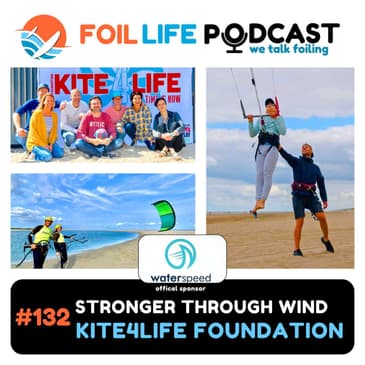
[00:00:00] Hey everyone, welcome back to the show. On this episode we talk with the founder of the Kite4Life Foundation. His name is Baris and this is a raw, honest, and heart-opening episode where he tells his story and introduces the foundation. So we do hope that you enjoy this episode. Next, I'd like to say a big thank you to our team. We have Frank, Stefan, and Pam. Thanks guys for your continued work into 2026.
[00:00:28] Next, we want to introduce WaterSpeed as the official app of the Foil Life community. It is the app that water sports athletes use to track their performance on the water. You can connect your Garmin, Coros, Apple Watch, or Vacaros and it starts logging everything.
[00:00:45] It tracks speed, tacks, jives, foiling time, live tracking, VMG and even polar charts. It's the kind of data that actually tells you whether you're getting faster or just feels like you are. You know us folks, we always feel like we're going faster. It works across 30 different water sports including downwind, wing foiling, sailing, windsurfing, and more.
[00:01:09] And it turns every session into something you can learn from. This is what performance tracking looks like when it's actually built for the water. So before you go any further into this episode, make sure to go download WaterSpeed now. It's available on iOS and Android. Lastly, thank you to our sponsors for the 26th season. We want to thank Norfoils, Mystic, and OnKiteboarding.
[00:01:32] Make sure to visit foillifepodcast.com forward slash sponsors to learn more about them. Now I hope you enjoy the show. Welcome to Foil Life. Whether you wing, kite, parowing, downwind, pump, or e-foil, thanks for being here. Well, hey, Barris. Thanks for taking the time and joining us on the show. Thank you for having me. Great being here. You run a really inspiring foundation. And yeah, just thanks for taking the time, especially in the wind sports.
[00:02:02] I think wind sports in general has saved a lot of our lives. It gives us something to focus on. And it's helped me through a very severe motorcycle accident. So it's going to be fun to get the opportunity to chat with you about this stuff and see how many lives you've been able to impact on the positive scale as well. Definitely. Shall we start with that? The number? I don't think the number matters. You know what I mean? It doesn't matter. It doesn't matter. Every single one is one.
[00:02:31] That's how we stepped into this journey. So mine started in May 2016. So it's almost 10 years ago, which I'm going to celebrate big because I'm still alive. Congratulations. Sounds very... Thank you. Yeah. I don't want to jinx it. I have a month and a half left now.
[00:02:55] So May 16, I had a wonderful trip planned to Scotland with three of my friends. We had rented a Land Rover Defender to go into the Highlands and Wild Camp. Just the four of us have fun, drink some whiskey, do some fishing, just hang around and do good chats. And we're going to do it again to celebrate life in May 26.
[00:03:24] About a week before that, I'm laying in bed and I had an itch. So I needed to scratch between my legs and I felt a lump on my left testicle. And I thought, this is not good. Alarms went off in my head. I freaked out. My brother, who's eight years older, had testicular cancer. We have an uncle who unfortunately died from it in the beginning of the 90s.
[00:03:49] So you can imagine all the alarms went off in my head. I got scared. But the first thing I thought was, if I tell people about this now, I'm going to end up in this medical rollercoaster. I'm never going to see the Highlands with my friends. Yeah. So I decided to keep my mouth shut about it for about a week. I did enjoy the trip in Scotland. It was really fun. Came back and told my wife about it.
[00:04:16] And the next day, a new chapter started in my life. General practitioner on the Monday. Specialist urologist on the Tuesday. Going into the hospital on the Wednesday. At the end of the day, I got operated, which means amputated, which means they pulled out the left testicle. On the Thursday, I woke up from the medication.
[00:04:41] And at the end of the day, they pulled me through the CT scan. Told me that the rest was clear. That I was on time. That everything was good. That I could go home. So they put me in a cab and sent me out. Four days. On Friday, you're like, okay, this is good news. I'm going to need about two and a half to three weeks to walk. Normal again, because of the stitches and operation and everything. And I got, you know, cards and flowers and people calling from the office.
[00:05:11] Asking how I'm doing, etc. I'm like, okay. Did it, done it. Check. Next page, please. You know, that feeling. For sure. Yeah. I'm 48 now. So I was 38. I have two kids. I'm 16. So one of them is almost five. And the other one is like one and a half-ish. Yeah. Life just goes on. People go to work. And they have to go to the kindergarten. That's it, that's it. Two weeks.
[00:05:40] Let's say three weeks later, I go back to work. I'm in sales. Specifically in the meeting and events industry. So working for an event agency that is specialized in organizing corporate events all over the world. And actually just thinking of the time I lost. This is the way I think. Three weeks of lost time in sales, in action, in targets, etc. So I start running again like hell. Trying to make up for lost time.
[00:06:08] And trying to, I don't know, impress the bosses so that they prolong my one-year contract. You know? Yes. You just end up going back to the daily life. In the meanwhile, you need to be checked. Medically checked every three months. This is a normal procedure. So the first check was okay. Everybody happy. And the second check was in November of that year. But in October of that same year.
[00:06:33] So like about a month before the check, we decided that this process was not going well for me. And also maybe it was not the right time with the right company. So we did decide not to prolong the contract. So I was actually home and trying to decide what to do with my life. And waiting for that second check. And that second check came out negative. I had a metastasis.
[00:07:00] Not on, but very near to my left kidney. Because if it was on, the situation would have been a lot worse. So I needed to go back into the hospital and really get, how do you say, therapy. And they decided to go with radiotherapy first. To check in order to, how do you say, in order to see how far they can go. And if that wouldn't help, they would go into chemo and etc.
[00:07:28] In that period of time, we had decided to emigrate to Dutch Caribbean Bonaire. Which is obviously great. So we had decided to get married. We did some big decisions and everything was packed. And suddenly I got bad news. So I had to go into the hospital. And I'm like, yeah, we can plan this and that. And it'll be like February and blah, blah, blah. And I said, okay guys, we need to reschedule this.
[00:07:57] If possible, I have a flight leaving February 16th with a lot of, you know, the whole house and the kids. So we rescheduled and they managed to put three weeks of radiotherapy every day for three weeks. Until the day before or two days before we got married. And that's about exactly a week before we were flying to Bonaire. A lot of stress in my life.
[00:08:23] I'm doing this in detail so that you understand what happens next. Yeah, for sure. No, we appreciate it. The whole medical part is even for a young guy. I was quite fit. It's not nice. It's painful. It's uncomfortable during the night. When you have to go to the bathroom. I'll spare you the details. But it's really, you feel horrible.
[00:08:50] But at the same time, there's this voice in my head continuously going like, stop complaining. You're not even having chemotherapy. You still have your hair. You still have your outlines. You still have your nails. So there's this guilt in me eating me up from the inside. Telling me just to shut up, not to complain. Whilst I'm having these aches and mental challenges and fear. All this stuff coming at you at the same time.
[00:09:17] Anyway, after three weeks, I said, okay, well, we have to wait and see till the next check, which is in three months. But you're going to Bonaire. The medical system there is good. The specialists are mainly from the Netherlands. And actually, at that time, they had the newest CT machine of what we call the Kingdom of the Netherlands. Because Bonaire is still officially part of, we call them a special province. So the island is autonomous.
[00:09:48] But it's still politically and economically in many ways connected to mainland. Let's call it European Holland. So that was good news. So I could get checked there. Because there was a big question mark about if I had to fly back every three months or every six months. So that wasn't necessary. So that was all good. Anyway, we traveled. We got there. Amazing place. Nice house. Beautiful view. Getting used to the bugs and temperature, etc.
[00:10:17] You know, unpacking stuff. About two weeks of paradise. And just parking the whole thing next to me. Okay, we did this. I can't change it. We have to wait three months till the next check. So let's enjoy the now. The time. Yes. Yeah. After about two, maybe a bit less. But let's say about two weeks, my wife starts working there in the hospital as a pediatrician. That's why we emigrated there for work. And the kids go to kindergarten and school.
[00:10:45] So I'm there all alone. And the first day is okay. But after a while, everything just started to... The dust started to set. Yeah, big time. The chaos started getting... Well, yeah. I started... I started... How do you say? Digesting everything. Literally. And it just blew my mind off in a thousand pieces. Because I couldn't think straight anymore. And I was thinking too much, actually. Maybe I had too much time on my hand. Too much time to think. So I was... How do you say it?
[00:11:14] Mulling the whole time. Yeah. Yeah. And this ended up in a lot of uncertainty. Like fear. In when is it going to come back? Am I going to see my kids grow old? And all these medical question marks. As well as this whole situation pushing me mentally into a depression. And resulting in a lot of fights. Like, not fights as in fists. Like really fighting.
[00:11:42] No, but that'd be emotionally very difficult. Yeah. I was emotionally unbalanced. And I was having a lot of complicated conversations with everything and everyone. I'm quite an open, outgoing events, you know, corporate events professional. I was cocooning. I didn't want to see anyone. I wanted to be alone. I didn't want people to bother me with anything. Anything that you would ask me was too much. There was this general discontent and general depression.
[00:12:11] And it went thus far that I started talking about leaving the island, going back to the Netherlands to maybe see my friends or family. That evolved into not bothering doing that or just taking the plane into South America and just traveling there and doing whatever to myself. Not in search of myself or just...
[00:12:40] And my idea was not even like traveling as a tourist to discover new countries or make new friends. I was just escaping. I started drinking a lot to avoid reality, to escape reality. Doesn't help because you end up with headaches the next day, which makes you even more tired. All this mulling and all these thoughts and all these conversations resulted in less sleep because I was super stressed.
[00:13:09] It was one big negative spiral going down. Not sleeping doesn't help. You get even more tired. When you drink and not sleep, it's even worse. So I got so mad at myself and so frustrated that the thought that the world or this family deserves a better father came up. Yeah. This little voice going like, you are a bad guy. These children and this beautiful wife, nice person deserves a better guy.
[00:13:39] You need to leave. You need to leave them alone because you're destroying your daily existence. And theirs as well. So I started thinking of forget the whole South American tour. Just end it now so that people are relieved from you. And when that thought came back a second or third time and maybe a fourth time when I even started like planning how to end it, I thought, okay, this is really bad. This is going bad. This is going bad. I need help.
[00:14:06] And I actually, I don't know if I was on my knees or I did that. It's like 10 years ago, but I really went as a crying baby to my wife. I said, please hold my hand. I'm thinking stuff I don't want to do. I need help. We need to talk to somebody. So we went to talk to a psychologist and I started sessions about what on earth is going on in my mind.
[00:14:33] And I think the first two sessions I just cried nonstop. And then I started talking and my gibberish talking started to make sense. And the more we talked, the more realized that the fear of the cancer coming back was just blurring my head and making me a very annoying, uncomfortable, jealous, impatient, too much drinking person.
[00:15:00] Then came the day that our, so my, my doctor said, so there's a storyline in here and I hear what you're saying. I understand what you're saying. I think maybe after all these chats, it's time for the next phase. We also tried EMDR therapy, which didn't help. She said, well, it doesn't help or maybe you should try doing other stuff. And I have the feeling that you don't need this.
[00:15:28] I have the feeling that you just need to go out there and just enjoy activities, enjoy life, try to be among people. So it wouldn't be a good idea if you and your wife went trying something new, but something active. You know, don't, don't make it a date night, getting a babysitter, making a reservation in an expensive restaurant where you're sitting there not saying anything for a very expensive meal. But you know, go do something active together.
[00:15:54] And my wife came back home one day and she said, we're going to the beach. It's always a good idea. I love the beach. And she said that she'd booked a kitesurfing lesson. So in that storm in my head, in our lives of survival, well, physically, but mentally and in a relationship wise as well. So I ended up at the beach looking at this guy called Simon, Simon, Dutch guy.
[00:16:23] He was an IKO instructor there on the island. He didn't know about anything. He just saw us as two new people coming to learn to kitesurf. And we were there and he introduced himself and he had a stick in his hand and started drawing the window, wind direction in the sand and started talking about tubes and pumps and lines and bars and whatever you hear in the first lesson.
[00:16:53] And then we ended up taking a power kite in our hands and steering it through the wind window going from 12 to 1 to 3 o'clock and back to 9 and started making 8. Yeah. And then before I knew it, I had a harness around my waist and we were, it's an offshore wind spot on Bonaire. So the two schools there, they work with, with little boats like dinghies.
[00:17:22] Before I know it, I'm in the water with a, I don't remember. I think maybe it was a 10 or probably a nine or 10 square meter old North Evo kite, turquoise greenish. Not going to forget that. And I'm getting dragged in the water offshore. It's like, it's okay. It's okay. I'm behind you. I'm making this long, but again, to make the point, the lesson altogether is about three hours, right?
[00:17:48] We were, afterwards we were back on the beach having, I think a Coke and went back home and sitting on our terrace and having a beer and looking at each other. And I said, oh my God, this is like the first time in, in, in, in about a year. Yeah. How long was it been? It's been three quarters of a year, right? That I have not thought of those whole shit we've been through. Excuse my language. This rollercoaster called cancer for three hours.
[00:18:17] I haven't thought of the word or all this stuff we've been fighting about the last couple of months. You know, it's all gone. It's, it's blown away by the wind. You know, my head got cleared by the wind and salty water. When are we going back? So that, that, that's, that's how my kitesurf journey started. Our kitesurf journey started. Yeah. Please do interrupt. Pretty miraculous though, isn't it?
[00:18:46] Like how she was able to just find an activity that happened to be so helpful. Was it a coincidence? Is it, is it? Yeah. She had talked about it. Faith. Yeah. She had talked about it before, but I'd never really like, I had heard it, but not recorded it in my head. I don't know. It was, it was just the solution at that moment because what happened is we kept, well,
[00:19:13] we had, I think altogether, we had about 12 lessons spread over quite a while because she's working and she had to do like duties and sometimes there's just no wind. And, you know, you have to be perseverant to learn kitesurfing because we're, yeah, because we are dependent on wind and because I'm not 18 also, maybe I don't dare as much as my, my son is 14.
[00:19:40] He started learning at seven, you know, he's, he's a lot quicker. Can you pinpoint maybe how that first session felt or what was it about this particular activity for people who haven't yet tried it that allowed that disconnection? Cause look at it as an extension cord. You're literally able to plug it out, like disconnect that cord for a little while and have your entire energy and your entire mind captivated on something else. That's a hard thing to do.
[00:20:09] Drugs don't even do that to that degree. And that's why it's so bloody addictive. It's, it's, it's a very good question. I realized that after the lesson, because I was sucked into the topic for three hours. It's full action. You have to be super sharp because you don't want that kite to crash and you don't want to get pulled, which it obviously it happened because at one moment Simon goes, so, okay, you want some power?
[00:20:39] I'm like, yeah, I want some power. He said, okay. So, you know, just pull that bar to the right and go from 12, not to half past 12, but go all the way to two, but with a firm hand and you're going to get ejected. I'm like, yeah, sure. It happens. Of course. So you get, you know, ejected for two meters and up with your face in the salty water and get dragged a little more in the kite crashes and you get pulled even more, you know, the feeling.
[00:21:05] And then you have to, you know, like, like play around with the, with the, with the steering line to get it out of the water, et cetera. So you're continuously on, well, on literally on as in contradictory to off. You're on, you're focused, you're in the zone. You're, you don't have time. Well, you, when learning in the beginning, you don't have time to think of anything else. You're not, you're not busy with the, the, the fights that you might've had in the morning
[00:21:31] or the food that you're going to be cooking in the afternoon or what kind of whatever. You're just busy in the moment. You're busy with that kite. You're busy with your direct surrounding. So don't crash into another kiter. Where's my board? Where's the kite? Where's the wind coming from? Why is this kite not doing what the kite instructor is telling me to do that I'm supposed to do? You know, all these kinds of stuff. Why did I crash again? And why am I not going on the board?
[00:22:00] It's just a lot of questions, but it's all dedicated to the sport. It's all about the exact thing you're doing at that moment. And it is, you know, your motivation needs to be big, obviously, but I, I, I just, I was hopeless. So I just let it happen. And it, it unpacked as being something magical. I know people use this word very easily. Again, I'm very grateful with, with capital letters that my wife decided to do this and,
[00:22:28] and that this sport exists and that all the gents and, and, and ladies who've helped developed, developed this sport into a less extreme sports over the last 15, 15 years, 10, 15 years. So that, you know, the, the, the, the, how do you say the regular Joe and Jane? How do you say that in English? You know, the guy next door like me can learn. Yeah. Yeah. The weekend warrior. The weekend warrior. Yeah.
[00:22:58] Well, we've become a very, uh, uh, how do you say, uh, big warriors because I, I mean, I could go at it daily, right? At a certain moment, the school was satisfied with our level because it's an offshore spot. They are strict about it. But at a certain moment it was like, okay, you guys are ready. And in the meanwhile, knowing that we were getting there because I was, you know, I was kiting upwind both ways.
[00:23:25] Transitions were going well, the rescuing the kite from the water, all this stuff that you need to do. All the basics. Yeah. All the basics were good. The only thing that we spend more time on was really kiting upwind in order to come back to the, to the beach, an offshore spot beach, which is a bit. It's not easy. It's tricky there because that beach is not very big either. So, uh, but when we managed to do that and then of course you have to launch and land your own kite.
[00:23:53] I think it's one of the final, in my remembrance, it's one of the final on your own. And that all went well. And after a while we had a beer and he said, okay, you're off. Well, I mean, you're here. I'm going to see you every day and we have the boat. So if you need help, whatever, ask us anything. And that's also the beauty of the sport. It's, it's learning a new activity, but it's also a soft landing into a warm bath of enthusiastic people. It's a new community. Very true. Very true.
[00:24:21] And very helpful new community. You touch on an interesting point actually, because you use the word enthusiasts. Uh, it like almost it, you become the activity, but it, did you find that it reinvigorated you with life in general? Correct. Like that in essence, it's like, it's a tap of something that this activity, a lot of these activities seem to, some of them actually.
[00:24:46] My buddy who had never surf said something about surfing or wind or board sports or, but it's not every activity that does that for you. Cause I biked across the country in Canada and biking doesn't do what windsurfing does for those sports do for me. There's something specific about the wind and the water and that, that, that does something. I think contact with salty water. Smack in your face certainly wakes you up too. It wakes you up. Oh, definitely. The North Sea wakes you up, but you're, you're from Canada.
[00:25:16] You know what cold water feels like. I know what cold is. Um, yeah, I think, I think salty water in combination with wind power does great stuff and, and, and maybe, maybe going too fast or too slow, please tell me, but maybe this is a good link into, towards the foundation. The foundation. Yeah. Very silly. I don't have the logo here, but our logo is, is a windmill of kites. Let me see if I can find it.
[00:25:45] Yeah. Yeah. If you can put it, so kite for life foundation.org and see if I can share the screen here. There we go. Yeah. So it's in Dutch. Yeah. You can translate it from the, from the browser. So on the upper left, you see our logo. So this is a little video of an event we did last year with the Rotary Club. So the logo is a windmill of kites. So the, the turquoise. Oh, that's what that is.
[00:26:15] Oh, that's really cool. Those are kites and kite for life. Yeah. Obviously the name of the foundation, but the whole idea of the windmill of kites is that wind power is general, no transformed into mental, no, um, uh, meant. So wind energy is transformed into mental power through this windmill.
[00:26:42] So the windmill, not only Dutch, many countries use windmills, but maybe the Dutch windmills are very famous worldwide as well. They're old factories, right? They used wind power in, uh, to, to, to transform into, um, uh, uh, functionality to maybe to cut wood or to pump water or whatever. And now we use it obviously to charge our batteries to, to make electricity. The kite for life windmill uses wind, wind energy to charge mental power.
[00:27:12] Oh yeah. That's a good, it forces you to focus, kite surfing, focus learning to kite. And we'll come back to winging maybe later. I feel the same with winging. The activity itself makes the mulling stop, makes everything stop around you. You're just busy with the moment. You're learning something new or you're progressing, whatever you're busy with kiting. And that enables that, that, that results in the fact that you're not thinking of anything else.
[00:27:40] For me, that resulted in the fact that I was recharging my mental energy during kiting because I was only busy with that and I was not thinking of cancer or, or, or negative things. So that meant that when I, when I came off the water, like every kite or surfer is completely hyped and energized and euphoric, especially when the session was good. That helped me in smiling again.
[00:28:09] And I genuinely feel that energy still now. If after a session I come off the water, even, even if the session was bad, I know I did something good. I've been busy. I've been physically active. I've been mentally active because you're continuously cross-checking. You're continuously challenging yourself. You're making a million different decisions every second. Because the interesting thing that I noticed about the water is especially kiting and windsurfing,
[00:28:38] especially if you're in small chop or you can go anywhere. So your brain is analyzing, oh, what about this? What about this? What about this? What about this? What about this? It's like, oh, would this kicker be fun? Would that be fun? Is that something that you found as well? It's like your brain loves to have so many things to do, but it's focused on something that gives back rather than just drains you. Yeah, absolutely. And there were days that anything else was a lot more boring that I just wanted to kite
[00:29:06] nonstop and that my body would just say, okay, you've had enough now. You're making mistakes and that becomes dangerous. But definitely, definitely. How did the foundation progress then from the initial concept? So what happened is after a while, so we're down the line, we're guiding ourselves, we're having a lot of fun. I'm feeling a lot better. I have this new community around me. I met new people, meeting up, having dinners together. Really nice.
[00:29:36] Some friends are coming over and I'm showing them. It was really great. So I'm kind of feeling healthy again whilst I'm still doing these checks, but the checks are good, right? Every three months, it's good. So I'm touching wood. I'm saying, okay, on to the next one. What happened is I started feeling better. I started being outgoing again. I wanted to do something with my life again, not only be a house man and doing the drawers
[00:30:03] and doing the shopping and cooking, etc., which is all good. I got the opportunity to really make time for myself, my mental health. I started doing some volunteer work on the islands, like cleaning beaches and helping in animal shelters, etc. But I really thought I should be doing more. And I started analyzing the situation, looking at what am I enjoying the most right now in
[00:30:29] my life and how could I translate that into something sustainable in the sense that social responsible sustainability to help others. And I thought kitesurfing has given us so much. And I am who I am like 10 years ago. I am who I am now. I'm still here. Of course, I'm thankful for the doctors and specialists who've made sure that I'm here. But this sport is so amazing.
[00:30:57] More people should know about this and specifically people who've been through what we've been through. So that was the trigger to set up an organization that would share the stoke with others who've experienced cancer themselves or as a plus one. That is a very important factor in our foundation is the plus one because there's a lot more attention to this. But we forget the plus ones. It's all about the person who's ill.
[00:31:26] But I mean, setting up this foundation is also a way of thanking my wife that she actually coped with all this shit. And she stayed with me. And she was strong. And we're still together. We love each other. We have a great family. And we wing foil and kite as much as we can still. But that was the idea. So to share this awesome method of recharging mentally whilst being physically active on the
[00:31:55] water and making use of wind energy. Nothing motorized. Well, you need maybe you need to take a plane sometimes to a spot where the wind is. But the activity itself is in touch with nature. It doesn't get more in touch with nature than this. Right. Yeah. Yeah. I have a million thoughts of I want to say this. I should. After all these years, I should have this slick sales pitch. Right. But it's all emotion. Your elevator pitch. It's like my elevator pitch.
[00:32:23] It's like transferring like what I labeled it to one time was that certain kind of people found this tool that gave them a lot of joy. And now you're able to transfer that joy via this activity to somebody else. And then you don't know what the repercussions of that will be in their lives because there's multiple tools that we can use. Like my mom was the one who helped me through my accident. And I would never have made it through an eight year battle for all of that stuff without her.
[00:32:53] And I don't know how she stayed there some days either. So I understand what you're saying because the your support network within those, even when I talked to Brandon Scheid who went through his near fatal accident as well. It's the same thing. It's the plus ones that are there. But and giving them. So what is it that, for example, that your foundation does on the on the practical level in that stuff that that people can either take part in or or join in? Because I had Jelle who just came on from Foil School Netherlands, which is a pretty cool
[00:33:22] story as well of how long you guys have been connected. Yeah. Let's start with that. Jelle. Sure. Is actually the guy who was. Well, he sold me my first kite gear. So the connection started there. The connection started via email because I had sent an email to Natural High, which is a. Oh, I've heard of that. School in the south of the Netherlands in Zeeland, Brausdam. Very nice spot. I was there last weekend as well. And we connected via the mail.
[00:33:51] And and after many years, he transitioned into wing foiling and he actually started his school. And when in a further phase, we decided to set up Wing for Life. It's not a new foundation. It's just a new topic, a new discipline within within our organization. I wanted to. Work with several wing foiling schools.
[00:34:19] So we got reconnected because I sent him a message. I said, hey, he always knew where it exists. He knew about kite for life. He knew about everything. He was really enthusiastic and he actually accepted to work with us since this season, which maybe I should now explain how the whole thing works. We have a couple of events on the beach annually. And the first one is actually this Saturday on the 11th, which is our season kickoff event.
[00:34:45] On this day, we meet the participants for the first time live. So people can register online. They can choose between two activities. Well, they can do both, but they choose between two activities. It's the Cardsurfing lessons. It's a beginner's lesson package of three times three hours or four times two hours, depending on how to school, which type of lessons they use.
[00:35:14] But it's a beginner's package for two persons. So the person who's been ill and the plus one. Cool. Your plus one was there in the bad days. He or she is there. When you're going to learn something new, you're going to learn together. You're going to share the stoke together. And hopefully you'll be able to manage the whole situation and give it a place in your head, in your history, and start a new chapter together. That's the whole idea.
[00:35:40] Actually, translating what we experienced as a couple into a lesson format. Of course, as you said, everybody's different. Every cancer is different. Everybody copes with it differently. Not everybody goes mad and wants to jump deeply into the water. Some people just, you know, bike ahead and go and continue working and switch off. And they're okay. And the medical side is done.
[00:36:08] And they go on. But there are many people who have psychosocial problems after the illness. And the physical part, when the physical part is gone, doesn't mean that you're mentally healthy again as well. This is not an equation. Everybody's different in that sense. So you can either do the lessons or join us during the weekend, which we're organized in September. We don't give the lessons ourselves.
[00:36:37] I'm not an instructor. People always ask me, why don't you become an instructor? It would be so cool. You could do this. No, this is, it's going to feel like work. And I don't want to feel it. I don't want it to feel it like work. I love instructing people. I love giving tips and tricks on the beach and helping. But that's because it's my hobby. And I like, you know, I'm part of the community. I like helping. But yeah, I want to keep that separately. So, but from the beginning on, we said we have to bring experts together.
[00:37:06] We're good in planning events and connecting people and doing fundraising. These people are the schools. We have to work with schools because we want to be able to provide our services along the whole Dutch coast, which is not huge, especially compared to Canada. But we want to, how do you say, deliver geographically diverse, now dispersed service from the north to the south.
[00:37:35] And this means that we should work with several schools. Initially, I wrote to 15 schools. Five of them replied within 48 hours with, this is amazing. We've never seen this before. We want to help. What can we do? Shall we organize a call? Yeah, that was fantastic. In two days, we had five schools joining. And we started with those five.
[00:38:02] And now we're working together with 10 schools. Oh, congrats. Jelle is actually the 11th. Nice. Which is really cool. And he does wing foiling only. And some schools do both. Some schools do only kite surfing. So at the moment, we have three wing foiling spots, let's say. How does it work? People register.
[00:38:29] I organize three online sessions in January, February, March. And the fourth session is live in April if they can join. During the session, I explained to them what the format is. So what they can expect from us, from the lessons, how they can prepare themselves mentally, physically, practically. Don't go partying the day before. Yeah. Please be there on time.
[00:38:56] An extra 15 minutes will enable you to go to the bathroom, have a cup of tea instead of being five minutes late and stressing and coming there. You know, all these kind of things that I've experienced. This is going to sound very stupid, but I feel like they're dads, right? I feel like they're a mentor. I want everyone to have a nice experience and to feel welcome and to feel some kind of warm cloth, you know? Yeah. Yeah, yeah, yeah. Because, I mean, I don't know.
[00:39:26] In fact, I don't know them. They're not my friends, but I feel like I have this intrinsic mission and obligation to make sure that these people who've experienced huge medical challenges, that they get a break. That they really experience this mind-blowing first kitesurfing day. And it's maybe just hanging under a two-line kite. They might not even go into the water because that day is not going to work.
[00:39:55] And I try to explain this to them as well, but almost apologizing because I know that it might not happen. But it's, yeah, it's a very... I used to do this one-on-one like we're doing now. So, we have about somewhere between 30 to 60 registrations per year. So, that means they come in duos. So, let's say 15 to 30 couples every year. Well, couples, they're not all couples.
[00:40:25] Some of them are friends. Some of them are father, like family. Yep, family. Some people come alone because they just want to come alone. That's also fine. I used to do all these conversations one-on-one. They take 30 to 45 minutes. That means that sometimes I had 30 online calls during the winter talking about sometimes very heavy topics as well. After six years in accordance with our team, because I don't do this alone. There are eight of us.
[00:40:53] I'm the founder and I'm on paper the president of the foundation. But titles don't interest me. We're one big family, one big team. Actually, during one of our meetings, I said, Guys, it's becoming more and more heavy. Every year it becomes heavier because I feel that I'm creating a kind of distance with my own medical history. Maybe it's a good idea that someone else does these conversations,
[00:41:22] these introduction conversations. And then we decided that we should do it as a group. That it's more informative. That people can ask me questions, but we don't particularly go into depth of everyone's particular story. Story, yeah. I'm not trained for this. You know, I'm not a psychologist. I was coming out of these conversations quite touched, like really feeling the pain.
[00:41:49] And it was affecting the rest of my day, actually. So I thought maybe we have to change this format anyway. So then that's all online. Then we meet the people who are able to come on our kickoff day live. What do we do on that day? Introductions. Short introduction. But then we split the group. We have a little subgroup talking about lessons. One of them about the weekend. One group comes to me because I want to talk about some practicalities.
[00:42:18] And the fourth group goes to an instructor who starts explaining them about what a kite is, what a tube kite is and how it works and how you set it up, how you pump, how you have to face the nose, how you walk the bar lines and you have to disconnect them. Oh, so everybody's there at the same time for their introductory lesson with? Yeah. Oh. So what are the online sessions before then? The online sessions is really practical things about what they can expect and how...
[00:42:48] Oh, it's like preparing them for this first lesson. Yeah, yeah, yeah, yeah. Cool. And how they have to contact the schools and how they have to plan their lessons and the fact that we have paid for everything. Obviously, the people pay something. They pay... We call it a commitment theme. They pay the foundation 35 euros per person for this entire course. So that's 70 euros. Very affordable. Very affordable. Yeah.
[00:43:13] We pay the schools approximately, let's say, an average of 350 per package. But the commercial rate is... Yeah, it depends on the school. But somewhere like 600 to 700 euros, right? So... And the rest we create from fundraising. But I want to explain to them all the practical stuff that, you know, they don't have to rent anything there, that we've taken care of everything, that they just need to bring a bottle of water and some warm clothing for afterwards.
[00:43:42] And that is good that they take a good night's rest the day before, although they'll be nervous. And I can imagine that they'll have maybe a hard time falling asleep, but no big nights out and come there on time. And I talk about them, about the specific spots, because sometimes the parking is further away from the spot than really micromanaging the situation. I know, but I want that red carpet rolled out for them. Yes. Yes.
[00:44:09] And the main questions are like, yeah, yeah, what if I don't like it? What if I have to go back into the hospital? And what if I'm too weak? I realize that I'm not strong enough. What if... Yeah, very detailed questions. But it's all fine. That's why we have these sessions. And what I do realize is doing them as a group is that some, you know, people profit from other people's questions because they might not have thought of that themselves. Well, it's a new world for a lot of them.
[00:44:38] So it's nice that you're able to do these onboarding calls. Yeah. Yeah. So on the kickoff, they hear the story of how the lessons were from an old participant that we've invited as a speaker, right? So that they don't hear everything from me or from one of our team members being the organization itself, but from people who've experienced it firsthand themselves,
[00:45:04] with whom we've been able to keep nice contact. So we have someone talking about the weekend. We have somebody talking about the lessons. I do the practical stuff again, a little repetition, and it gives the opportunity for them to ask specific questions again. And then one group gets the introduction of what a kite is, because some people, some of them have never seen it up close. And then we relate.
[00:45:34] So we turn, it's like four times 15 minutes. So the morning is about introductions and some theory. And then we have lunch. We organize a nice vegetarian buffet, salads and sandwiches lunch for everyone. And then it's time to split the group in, well, it depends on how many people we have. But for this time, I have five instructors. So yeah, we split the group and then we start the power kite.
[00:46:02] So they really get to feel the kites. We don't have time or the opportunity could be, but it's offshore wind as expected that we don't go in the water. We don't use the real kite. We don't, I mean, the tube kite. We don't go in the water. Yeah, the trainers. Yeah. We need more time for that. And the thing is the community feeling of this group of people who've experienced cancer, they also like being together.
[00:46:29] And this community, this little subculture community is also there together on the beach. And I don't want to split the people too much. It's a nice atmosphere. This is the eighth season opening. And two of them were online fully because of COVID. That was, well, we should never talk about COVID, but that was special doing everything online. You know what the funny thing is? Please interrupt me if you want to ask me something else.
[00:46:57] But the COVID year, like the full year, it was the busiest year we've ever had because nothing else was allowed outside in sports. Kitesurfing was allowed here because it's an outside sport. You have the distance and everything. So we had like 83 or 84 registrations on that year. Yeah, it's really, really interesting, right? So what happens after this event? Well, some of them I never see again live.
[00:47:26] That's the bizarre thing about it because they planned the lessons themselves. Yeah, their own schools, their own houses, that kind of thing. I connect them with the school that they've chosen for. That is generally the closest one to their homes. That's why we have 11 schools now, so that we make that threshold lower for them, closer to home. What I want to hear from them is when they've had a lesson,
[00:47:53] not when they've planned it because that could change a couple of times because of wind conditions or private situations. That's also something I talk about in these onboarding conversations that they really, you know, the planning is the most difficult part, actually. And then I do want to know when they've had a lesson so that I can register that and cross-track it with the invoices I get later on, practical stuff. True. Yeah. So this is actually, yeah, what is the season here?
[00:48:23] It's from about now, let's say, let's say half April all the way to end of September. Then most of the schools close. We advise people to try to do their best to have these three lessons in this season. You would think it would be manageable, but it's not always the case because not everybody gets as stoked as I had been or of other obligations. Birthdays and weddings and holidays and stuff like that.
[00:48:52] Or they have to go back to the hospital. Some of them get bad news and they have to, yeah, get treated again. And also very beautiful stories like, hey, after all these years, I've been able to become pregnant. So I'm going to have a child and it's not safe for me to continue kitesurfing. That's also after medical treatments and everything.
[00:49:18] If you're at that age that you're, you know, as a, as a, what we call a Aya or a young adolescent between the ages of 18 and 40, which is our biggest segmentation, I think, with the biggest group joining us. You know, if after all that, you're able to become a mother or father, it's a value, a valid reason to stop kitesurfing for a while. So, so yeah, let's say that we, half of the group doesn't start at all.
[00:49:45] Funny enough, from the half that starts, half and finishes the whole course, so quarter. And from that, maybe, I'm not exactly sure, but I would say 30 to 40% continue kitesurfing. As a weekend warrior or a holiday warrior.
[00:50:07] I think, in the last eight years that we've been doing this, we have introduced 750 plus people to a kite. And I think maybe two handfuls are still practicing, are still kiting. It's pretty good though. Yeah. It's really cool.
[00:50:31] As I said in the beginning, every one person is a person and they're most welcome, even if it's one lesson only, even if it's a kickoff event only. If that, if that activity or that one lesson or that starter package of three lessons triggers something in their head and helps them look at the world differently, see the cup half full instead of half empty, make a decision that could be life-changing and hopefully in a positive way,
[00:51:00] then our mission is complete. I've never thought, I've never thought that everybody would proceed and become, you know, fanatic kitesurfers. I really want to show them something else that triggers an important decision in their lives that helps them understand that there are other ways.
[00:51:26] And this is easy saying when your body is clean and everything's going well. I know, I know this, I know this, but it's my way of, my way of doing something to help. Yeah. Giving back for the gift that you were given, which is a nice thing to do because not everybody takes the time. And I think that's a good place to wrap this up, but it's, yeah, A, thank you for doing this because you're giving people an option that they didn't know existed.
[00:51:57] So thank you very much for your time and it's amazing. And thank you to the schools who are also working with you to make this happen because you don't know what one session will do. It could save a marriage, it can anything. So that's the main thing that we can leave. So thank you for having the strength to go through your own journey and then helping others through theirs as well. I have nothing more to say. This is a good conclusion. Thanks a lot for listening.
[00:52:21] I know I'm, I can be a bit vague and emotional about it, but it's, that's, that's also Christ for Life. It comes from the heart. And without the schools, we are nowhere. Without people like Yelle, who, you know, I mean, I can name them all. I hope that if they listen to this, they're not going to feel, uh, not valued because I adore each and every one of them. They're fantastic people.
[00:52:50] Without them, we're nowhere. Without our team, we're nowhere. Without our volunteers, 40 plus volunteers who here and there try to join in, in some kind of activity. Uh, some of them are online volunteers who only share and like our messages. It's also a lot because 80% of our registrations come because they've been seen on Instagram. So, if I may ask one thing to your followers, please follow us on Instagram and share the stoke.
[00:53:20] And you might be in the other side of the world, but you might have a friend or a friend's friends, family's brother's sister's niece might be living in the Netherlands. So, every little bit helps. Well, hey, Bears. Thanks for, for coming on. Thank you. All right. Bye, everybody.