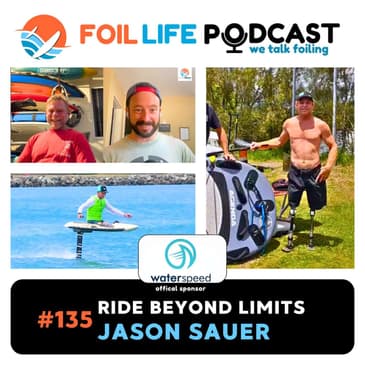

Episode Highlights:
The pivotal moment that led Jason from wheelchair basketball to bobsled and sit-ski racing
Transitioning from snow to water and building his first custom seated foil boards
The role of Foil Drive in unlocking independence and progression
Challenges and breakthroughs in seated wing foiling and wave riding
Living with chronic pain, sobriety, and the ongoing journey of self-acceptance
Why passion in adaptive sports can turn the lights back on after injury
Advice and inspiration for anyone facing major life challenges
A deeply honest, motivating, and stoke-filled conversation about overcoming adversity, pushing personal limits, and the universal joy of foiling — no matter your starting point.
Follow Jason on Instagram: https://www.instagram.com/jason_sauer1/
Brought to you by Waterspeed App — the ultimate app for tracking, analyzing, and competing in wing, wind, kite, and foiling. Download now and join the community! 🌊✈️
[00:00:00] Hey everyone, welcome back to the show. On this episode we sit down with Jason Sauer for an inspiring conversation about resilience, reinvention and the transformative power of foiling. After a life altering accident that resulted in a double above knee amputation, Jason shares his raw and honest journey from the darkness of early recovery and substance struggles through bobsled and ski racing to discovering the freedom on the water with custom built seat foiling setups and foil driver assistance.
[00:00:30] He opens up about the mental and physical challenges of adaptive foiling, building his own equipment, learning how to wing foil and the daily realities of pain, motivation and self acceptance. We do hope that you enjoy this episode and thank you to Jason for coming on and sharing it. We next want to say a big thank you to our team. We have Frank, Stefan and Pam. Thank you very much for your hard work behind the scenes that allows for this show to continue on.
[00:00:58] Next, WaterSpeed is the official app of the Foil Life community. It is the app water sports athletes use to track their performance on the water. Connect your Garmin, Coros, Apple Watch and Vaccaros and it starts logging everything. We have speed, tack, jives, foiling time, live tracking, VMG, polar charts and more. This is the kind of data that actually tells you whether you're getting faster and better or just makes you feel like you are.
[00:01:26] It works across 30 plus water sports including downwind, wing foiling, sailing, windsurfing and it turns every session into something you can learn from. This is what performance tracking looks like when it's actually built for the water. So before you listen to this amazing episode, we ask you to go download WaterSpeed now. It's available on iOS and Android. Lastly, thank you to our sponsors for this season. We have North Foils, Mystic and OnKiteboarding.
[00:01:54] Please visit foillifepodcast.com forward slash sponsors to learn more about them. Now I hope you enjoy the show. Welcome to Foil Life. Whether you wing, kite, parowing, downwind, pump or e-foil, thanks for being here. Hey Jason, thanks for taking the time out of your busy day. Thanks for joining us on the show. Thank you and thanks for having me, Luc. It's the end of the day here.
[00:02:20] For me it's 5.30 in the afternoon and I'm just kicking back having an iced coffee and smoking some cigarettes. Nice, man. I just caught your Foil Drive movie with Josh and it was really inspirational by the way. And it was really awesome to see how many people that foiling has touched. And I was curious to just talk a little bit more about that today. And I looked a little bit into you as well. And some of that bobsled and ski looked pretty fun.
[00:02:47] And it takes some cohibas to be able to rip yourself down a bobsled truck at that speed. So anyways, congratulations on what you've accomplished. I think it's phenomenal. Thank you Luke. Because often I don't see that, you know what I mean? It's like I still compare myself to materially successful label buddy people, to which I obviously pull up well short.
[00:03:19] I've always looked at it as like experiences give us an opportunity to showcase the strength that kind of is hidden inside. And not everybody can take on that challenge and turn it into something positive. And I find anybody who hasn't been like Rogan said this one thing on his podcast, the worst thing that's happened to you is the worst thing that's happened to you regardless.
[00:03:44] But I do like to see the strength and passion and resilience of that human spirit and of specific individuals that go through life altering situations and what they do with it. Because I think that shows the true strength and raw character that is possible. Yeah. Yeah. Yeah, definitely. I remember reading an expression once and I don't know, it's like, you never know how strong you can be until being strong is the only option or something to that effect.
[00:04:13] Like how, what was the first sport that came in or something that came in that gave you that spark of maybe this is like something else is out there for me? Um, there's no short answer. All there is, I think like, well, bobsled, I guess was the, was the one, but even that's not a hundred percent accurate, right? Because, um, and to try and answer it regionally, uh, in depth, but concisely, hopefully.
[00:04:40] Uh, I did, um, I'm on the Sunshine Coast in, uh, just, uh, 60 miles north of Brisbane, uh, in, in Queensland, Australia. Um, so it's a bit of a surfy culture, I guess. There's maybe some dudes ride dirt bikes, maybe there's some horse riding, um, uh, and other team sports, you know, but, um, but it's not a mountain area. It's not white water. It's, it's not an Alpine area, you know, it doesn't freeze.
[00:05:06] Um, and, uh, but I was involved with the volunteer surf life saving as a young fella. Um, but anyway, I digress. Well, my first year injured, uh, wheelchair basketball was the pretty much only disabled or adaptive sport, uh, locally available. And, uh, I was not a basketballer growing up anyway. It was not really, it was, in the late eighties, I viewed basketball as an American sport, right? We're Australians, we don't, you know.
[00:05:36] Uh, I, I had a very judgemental, I grew up very judgemental, I think. Anyway, um, but, but do the, the, the, and I did wheelchair basketball for a little while, but I was still playing up.
[00:05:49] I'd fallen back into substance abuse because I was not coping, uh, I think, uh, I think depression and, uh, grief and depression, uh, I guess after multiple amputations above the knee and the, and the mobility loss, I guess was a, um, because a single baloney. Um, because if you're not in the amputee, even at 60 or 70, you know, a little bit of real, once the wound heals and some rehabilitation.
[00:06:19] If you're not in, if you're not in absolutely poor health, like if you're in reasonable health, you'd be walking within a few months on a, on a, on a prosthesis because you're missing one ankle joint. Yeah. But for, and even, but for a bilateral above knee amputee, it's like, whoa, missing four joints, right? Two ankles and two knees. Yeah. And, um, so even, you know, it's like, oh, but what about Oscar Pistorius or whatever? He's still got his knees, right?
[00:06:46] It's a big, there's a, the difference between double below knee and double above knee is considerable. I wouldn't want to compare it to paraplegic and quadriplegic. Like that seems a very unfair comparison to the people with spinal cord injuries, but the, but there is a huge, it's apples and oranges, you know, it's not good. Yeah. I see that. So, yeah. But the, so even though wheelchair basketball wasn't really my sport, it was good for a bit of exercise.
[00:07:14] As I said, I was still a bit concerned, overwhelmed with grief and substance abuse. Um, but what it did do was, um, put my injury into perspective. It's like nearly anyone else that I played wheelchair basketball with probably would have swapped injuries with me in an instant.
[00:07:34] It made it difficult for me to justify self pity in their company because I was actually less injured or had more function than a lot of the people that I was socializing with at wheelchair basketball. And some of these awarenesses are coming to light as we speak, Luke, right? So you're editing radio is going to have a work cut out for her. Yes. But when I, I'd left my legs in Canada, right? I was, um, and then when I left Canada, I was given away snowboard.
[00:08:04] I was given my, well, I sold my better snowboard, right? But I, I was given away all my ski gear. And someone had said to me, uh, even when I was living and I was still quite dosed up. I was fresh cut amputee. And, um, so, oh, don't, don't give all your snow gear or the winter gear away. You'll ski again in one of them sick things. Or, and it was, there's no polite way to say this, but my reply was nasty.
[00:08:28] It was, uh, uh, uh, evolve in a very stern, almost, I don't want to say demonic, in a very stern tone, right? Skiers have legs. It was, uh, um, in the, and it, and it came out of me in the nastiest and angriest manner that I didn't even know that was in me. Yeah. Yeah.
[00:08:52] Um, but, uh, at the wheelchair basketball, I met a fella, um, who had done some sit skiing and he said, oh, Jase, it's like, once I'm in the sit ski, it's like I don't even have mobility concerns. It's freedom, you know? Yeah. And, and that got me over the line to be open to try and winter sports, uh, as, as a person with a reasonably significant, uh, body modification or the, the, the, the, yeah. Yeah. Yeah.
[00:09:20] Um, that was a long way to get there. That was a long way to get to. It took me, uh, it took me X amount of time even to be open to winter sports again. I can imagine. How was that first ski experience? Oh, the first, the, the first day was a spanking pretty much. Actually this, my second day was a spanking. The first day was exciting and then, but I thought I was more accomplished than I was.
[00:09:45] And then, uh, um, it's actually quite, I didn't give me my Sarah Burke. Mm-hmm. Yeah. So it's like, I think it was the 10th of January. I'm not sure. It was early January anyway, in, um, in 2012 when the helicopter come, I was at Park City. I was at two o'clock in the afternoon. I was having a lesson. Uh, it was my, we'd just done a week of, um, uh, Bob's lead driving school.
[00:10:12] So I'd got to try, uh, skeleton and I got to try bold sled and, and, and, and that turned my light on. I think like hanging out with those men and women and I got to experience enjoying myself. They were enjoying. Yeah. Anyway. And it was, uh, that week I was, uh, my first anniversary happened. It was like a year since I'd been cut. Yeah. It was a real, it was a life changing experience. Look, look, uh, I got sober again whilst I was there in Park City. Congrats.
[00:10:39] A man who I was renting a room off, um, David was an incomplete quadriplegic. So in my mind, um, he was like my wheelchair mentor. He was gonna, I was, I was hoping to learn from him how he gets around the house, how he lives daily life out of a chair as a, as a, as a more, as a, as a sportsman. And, you know, my first lesson was, it was humbling, uh, with the National Ability Center
[00:11:07] in Park City, uh, they, they, they cater for, um, people with cognitive and physical, uh, ailments. They have a whole, they have a ranch, like a equestrian horse stuff. They're in there and, um, they do all sorts of, uh, outdoor activities, archery, um, but they also have a ski program, um, based on the resort. So, so you had mentioned that the individuals who were at bobsled or the individuals who were
[00:11:34] at skiing really helped you transition into this and start to see, um, or, or start to feel those changes within you. Right. Yeah. Cause I got to experience, look, that I guess not only, well, the first couple of days it was men and women showing me that life could be still enjoyable after life altering injury, but I got to experience it myself, I think.
[00:11:59] Like my, and of, um, with, with sliding sports, uh, I guess generally the progression would be you, you know, you start halfway up at junior start or, or women's start, you know what I mean? To show the coaches that you can after a track walk and after some instruction, of course, you showed the coaches that you can drive safely from their height before they raise you up. But it's a bit even dropping in from junior start on the skeleton was just exhilarating for me. I'm more like, uh, I had no prostheses at the time.
[00:12:29] So I was a wheelchair user and I'm, I'm all of like, I was trying to show you my knee anyway, but I'm, I'm, I'm, I'm, I'm all, I'm all of four foot six or something. I think, you know what I mean? I'm not that much bigger than a skeleton sled myself. Yeah. So, uh, yeah, double barrel sawn off coming down to, and, and it was really, um, I was newly sober of course. I think I'd got sober on the 29th of December and this was the first week of January.
[00:12:57] So, um, I'm in my, just finished my first year as an amputee and about newly sober and getting involved in adrenaline based sports. And it was, it was one and it was nice to be back in the winter environment too, I guess. Um, how were those first skeleton rips? Like that, that thing, like the speeds you hit on those sleds is insane. Yeah. I think I did five or maybe six runs.
[00:13:26] And I remember saying to one of the organizers at the time, there's a nice fellow John. I said, the first few runs have let me know that life's still exhilarating, you know? And then the last few runs have let me know that I don't want to die. Yeah. So that's, so that's enough skeleton for me, right? That's enough. Yeah. But you ended up going on competing in bobsled too, right? Like you finished pretty good. Yeah.
[00:13:53] But bobsled, I was really just making up the numbers. I wasn't that dumb. I wasn't, I competed most certainly, but I was not competitive. I was, I was midfield tail end of the field. I was never a threat to the podium in bobsled. Um, but I enjoyed it. And it was, and it got to be para bobsled still trying to get into the Paralympics and to meet Olympic or Paralympic criteria. You need a world cup circuit.
[00:14:23] You need to have two world champion. You need to have a world championship every two years. You need to have, uh, athletes from X amount of countries from X amount of zones. Excellent. And so, um, me going as an Australian brought an extra zone and an extra athlete into it. And for most of my bobsledding, I was actually still obsessed with Alpine skiing.
[00:14:48] So, so, so, so, so to me at the time, bobsled was second fiddle, you know, I still enjoyed it, but it wasn't my primary focus, you know? I, um, I was obsessed with, with, with trying to make a, I didn't want skiing and ski racing to be a stepping stone. I wanted it to be a career path. Uh, so, uh, and as it turns out, it was like a stepping stone that I stayed on for seven or eight, nine years.
[00:15:16] Um, and it served its purpose, I guess, you know, uh, it turned my light on and it showed me that there's life after injury, I got to be, I was still prone to maybe tantrums at times, you know, but I got to socialize with the greater public in a pleasant manner, which was, yeah, and coming from a grateful space, which, which was nice, you know? Yeah. And ski resorts are pretty social, I guess, you know what I mean? Yeah.
[00:15:43] Most people are on holidays, you know, and it's a, it's a, it's a, well, it's a holiday environment, I guess, outside of the locals, you know? That's true. Yeah. What was your first experience like from snow to water? Towards the end of the Alpine skiing and Alpine ski racing, uh, a few of the European fellows were into their seated wakeboarding, um, and, and cable water ski parks, uh, seated
[00:16:12] wakeboarding, and I was, oh, that's interesting, but I, um, there's a cable water ski park close to home here. Um, I think it got built when I was 17 or something. And so I, uh, I, I, uh, had some time as a young fellow, uh, cable water skiing. And, uh, but one of the guys was doing seated. A few of the, a couple of the European guys with, with paraplegia were doing seated, doing kite surfing seated. And then one of them was doing seated kite foiling.
[00:16:40] And it's like, oh, and that, and that just got my attention, right? That's like, oh. Um, so when, uh, during COVID, oh, I fell off the wagon again during COVID, which was a, I splattered kind of hard. And, um, I struggled for, I thought, I thought I had self-acceptance as an injured man through like, uh, my faith and through sobriety and, and, and, and some anonymous fellowships, you know? And then I think what happened was I was skiing eight months of the year, right?
[00:17:08] I was doing five months in North America. I was doing three months here in Australia, five days a week, skiing eight months of the year, five days a week. Wow. Most people are happy with that, right? Yeah. Yeah. And then, you know, a month or two in between seasons to catch up with family and tidy up loose ends. But then I got to see when the skiing stopped that my acceptance as an injured person was
[00:17:34] more related to the skiing lifestyle than it was to my faith and sobriety because, uh, because without skiing, I didn't cope being me, I guess it was, uh, yeah, it was, it was back into the emotional mentality of the first year injured. I was, I'm still a bit intimidated by power kites, right? A friend loaned me his four meter trainer for a while and I flew a four-meter trainer. I took the seat off my Alpine, off my sit ski.
[00:18:03] It's under that white, under that black cover. I had an aluminium fabricator make up a cage and then bolted that cage to a wakeboard. And then it said the sit ski seat on a cage on the wakeboard and then bolted a foil under the board. And then I was also some toe foiling initially just behind the boat. And one of my friends here in Australia who'd done some seated waters, well, he's actually been world champion water skier at times for adaptive water skiing. He said, Oh, why'd you make the frame so tall?
[00:18:32] I said, Oh, because I didn't know any better. And because I thought that's an amputee with full trunk as opposed to being someone who has a spinal cord injury, who didn't have full trunk. I thought maybe I'd still be able to keep it in front of me for deep water starts. But the taller frame was too much. And then anyone who's done any water skiing or wakeboarding, obviously for a deep water start, you've got to be able to keep the board in front of you to be able to, yeah.
[00:19:02] And between the interface, the seat belt strapping I had was not tight enough. And I couldn't keep it in front of me. I didn't get up. I still haven't actually wakeboarded as an injured man. I've only wakeboard foiled, I guess. And we stuck the foil under it and I gave a wave to my friend driving the boat. And before I could finish thinking, I wonder if this will work, it was already up into taxi. Yeah.
[00:19:32] It was like the foil just made so much difference, even with that taller seat. Yeah. So initially, just trying to get used to it, toe foiling. It seemed the entry level progression. Never really got behind a boat that had a big enough wake to shorten the rope and try foil wake surfing, which I think for a lot of, even people that never want to do, that never want
[00:19:59] to do toe foiling, they're just learning to prone foil surf. They still spend a bit of time on the smarter ones. I think still spend a bit of time behind the boat, long rope, water ski length initially, just to get, to learn the trim of the foil and to turn it. And then shorten the rope to get under the wake so that you can practice catching the inclined water surface and hopefully. And then, so by the time they paddle out, they've already foiled.
[00:20:27] They're not learning to foil on a wave, but the time they get into the surf, they can already foil. And I think that's smart. And I would imagine that it's the approved progression, you know? Yes, it is. Yeah. Yeah. Or the ideal progression anyway, because who approves what, you know? Keep, keep. Yeah. Yeah, we can do whatever we want, but it seems that, yeah, learning behind a jet ski or a small boat is a great way to learn. That's for sure.
[00:20:55] In 2016, I chose to have osseointegration surgery. So they, instead of wearing prosthetic soffits, a surgeon drew out the bone marrow and the thingamers and hammered titanium rods in. So the bone anchored prosthesis, I guess is the short version of it. And then, and it's been really good, but I struggled with pain off and on from that procedure. And then, cause I bought a little rubber duck cause when I was a younger fella, a rubber
[00:21:24] duck, so the inflatable inshore rescue boat that the Australian cinephilips they've been used. I bought a second hand one of those, hoping that it'd be a tow vehicle. Cause it reminded me of being a younger fella when I was a teenager. I was a crewman in one of those, we raced them and it was fun. But I'd have to have, I'd have to find two friends that were available and willing to hang out with me at the same time because they need a driver and an observer. Yeah. Yeah. That's right.
[00:21:52] I thought I'll buy a jet ski because if you go in Australia, if you've got a rescue map behind the jet ski, and if you're close enough to the shore to say that you're doing tow-in surfing, well when you're doing tow-in surfing, you don't need an observer because that's, it's more dangerous to have one. And I think, oh, but legally you don't need an observer anyway. If you're doing tow-in. So I grabbed an old cheap two-stroke jet ski thinking, it's like, oh, now I've only got to find one person to put up with me, right?
[00:22:19] But then the four wheel drive, the second gen four wheel drive came out of it. I blew my budget a bit. It was quite, it was a bit of an expense, but I thought, oh, I can go and try and foil, you know, without being dependent on anybody to drive a tow vehicle, which is, yeah. Well, if I stopped smoking and worked on my paddle fitness, I could try a cone, I guess. There you go. Yeah, yeah. There's hope left. There's hope yet. Yeah, yeah.
[00:22:47] Actually, the longer rescue board that was, I bought that to try and improve my paddle fitness, I guess. A friend, we went out for a quick surf one time, post-injury, and I'd had the Oceo integration. I was wearing little short stubby legs, just out on a friend's foamy. I was lucky to get out the back, right, really. Yeah. I did time it well with the lull, but I was also quite lucky, right, because you can't always time even using the best. Yeah, anyway.
[00:23:17] But if I had to go record inside, that would have been the end of it, right? I would have been, I would have just gone to shore. Mm-hmm . But luckily got out, and then got one wave and rode it in. But I noticed when I was at the back, without the lower extremities, I couldn't sit on the board to balance, because I was like, without anything below the board, you should not pop a lever.
[00:23:43] And then, so then I had to rest to try and get my breath back after paddling out. I couldn't sit up to rest. I had to lay on the board to rest, and then I was still getting splashed by the chop. Mm-hmm . So that wasn't very relaxed, wasn't very restful. I thought, oh, so that's ... And I used to paddle clubby males, you know, rescue boards as a younger fellow anyway. And so I picked up an old one, and I liked ... It had been broken in half and put back together,
[00:24:11] which appealed to me too, right, I guess. And broken and somewhat repaired. Yeah. Yeah. So how were you able to design, let's say, a sit-down board for foiling in that sense? If you ... Are there any situations where, let's say, are you strapped into it if you fall off? Like, how easy is it to get back on? It's a work in progress, and I think ... Okay.
[00:24:37] ... sometimes I try and have ... I'm thinking about too many different topics at once, and then I don't actually ... Instead of bringing my mind back to single-fuck, because it would be ... I'll be trying to work on a ... thinking of a toe board at the same time as a floater at the end, and it's like, well, no, no, it's like ... Well, I need something with more point ... To attempt wing foiling again, I need something with ... As much as I don't
[00:25:06] want anything too wide, it has to be wider. Otherwise, I need the beam of it. Otherwise, once I lift my arms above my head with the sail there, once I hoist the sail up, I'll fall over, right? Yeah. So, but for ... But for ... Foil drive ... Foil drive assisteds playing in the swell, or soft-breaking waves, I don't need anything that wide.
[00:25:31] It can be skinnier, because I just want to build forward speed quick, and get up onto foil. This is my first build. Yeah, I'll just ... I'd taken a mold of myself, and made a carbon fiber shell, and then put it to some ... Put it on some insulation foam. I put some thin boxes in ... Initially, it was not a trench board, but the attempt to trench
[00:25:59] it out is just recent project ... Oh, sorry about the wobbling camera. Yeah, that thing looks sweet. Yeah, I think that was back in 2020, maybe, or 2020, because I think this Armstrong board had not long come out, which might be a 2019 board, which I only bought about six or 12 months ago. I bought it old and damaged.
[00:26:24] But I was trying to copy the double concave bow. Yeah. But then nipper boards, what we call them nipper boards in Australia, so they're like rescue boards for the juniors, I think, or for the kids, or kids paddle boards, maybe. They're really ... Hayden is a local manufacturer, so it was nice to ... But they're ... And the
[00:26:48] Sunshine Coast has become quite ... It's become a little well-to-do, so there's not that many ... There's not that many kids looking for cheap secondhand boards. They have their parents buying new ones, I think. That's true. Yeah, it seems more ... Or more common than ... Yeah, so the secondhand, the used nipper board market, they're pretty much giveaways or cheap as anyhow.
[00:27:15] So ... And for me, they were ... It's like, oh, well, I think six foot six is a reasonably good length to start with. And they're designed for ... They're designed for 50 kilo, you know, or 110 pound people, or lighter. And I was only 50 years only. That was my weight at the time, you know? Yeah. It should just about float me, and they're cheaper than buying a blank. That's true. How is that foiling with foil drive then?
[00:27:44] You can go out by yourself, it gives you that autonomy, but then how is it catching those waves sitting down? Because we've all tried it. We've all tried it, but it's a hell of a lot harder than it looks. It's fucking hard. I've never spoke to drunken penguin unicycle riders. Exactly. But I'm pretty sure ... It'd be the same. Yeah, yeah, yeah, yeah. I felt very much like a drunken penguin on a unicycle.
[00:28:11] And I don't know if it'll ever really work, you know? I don't know that it'll ever be a high performance thing, if you know. I don't know that I'll be ripping like the ... But if I can get a bottom turn in and then make a top turn and link two or three turns together and not get my ass completely handed to me, that's a good day. It's a good session, I think. Are you finding is it a balance point of where you sit versus the leverage that you have enough so you can pump?
[00:28:39] Or what's the challenges that you've come across so far in this engineering feat? Yeah, multiple challenges. Yeah. And sometimes I forget it. So some of the craft I've modified, like it's the blue one that I just showed you, the first one I built, and even this Hayden, I cut a seat wheel into that one thinking that if I can put a seat wheel and tow hooks, then maybe I don't have to ... Maybe I can get away
[00:29:08] without wearing a seat belt because if I lean back, my toes or my stump ends will catch me, you know? And I wanted to be at a release as well too, you know? But I think I do have to adopt the old wave ski kind of mentality of having a lap belt. Mm-hmm. Luckily, because you can go snowboarding with no bindings, right? In powder snow. And if you're balanced, you stay on it. Yeah. Yeah. You know what I mean?
[00:29:37] And a sit ski, it's like, oh no, the interface is solid. It's like a ski boot. Mm-hmm. There's no free heeling or there's no ... So, without knee and ankle flexion and extension, it's only the upper torso that can create the ... Then they can't just rely on friction to stick the body to the board, I don't think, because I think an able-bodied man or person can stay stacked above it.
[00:30:07] You can ride strapless, right? You don't have to wear straps. Yes, a lot of fellows can push a bit harder with their straps on, I guess, than with straps off. But a well-balanced rider probably still rides quite well with no straps. But then, in the seat position, I think it's impossible to create the ... Oh, not impossible. It's only possible to make really small ... Without being fixed to the board, you can only make
[00:30:37] really light, minor, guiding the locomotive. And for turning as well, right? Yeah. Yeah. Yeah. You need to have that thing holding on. For trim and for turning, yeah. Because otherwise, you can't force it. You can only get a small amount of ... It's all weight shift only. Like the ... Yeah. The weight above the axis of the foil, I think, or the ... Yeah. As opposed to being able to force it a little ... Or to drive it a little bit ... Yeah. Through the turn. Yeah.
[00:31:05] I think I need my lower body to be fixed so that I can swing arms and create torsional. True. And also, to be able to lean back more without fear of the feet coming out of the hooks and to be able to lean forward more to get nose down pressure. I think I digress a little bit too much from the question. No. No, that's all right. So, in essence, you still have some tweaking to do with it, but you think it's possible
[00:31:33] and you think you're going to be able to progress it far from where you are today. I think it's possible. Gouma ... I'm going to call him Mr. Colin because I can't pronounce it. Goulamé or something. Yeah. Yeah. Thanks. Yeah, French fella. Yeah. A young French fella with ... I think his injury is incomplete, low paraplegia, and he's making it work, right? He's pioneered the whole seated foiling as far as I'm concerned, right?
[00:32:01] He's ... Well, there were some other people doing seated kite foiling before him, but he's in the ocean, playing in the waves. I think he's the pioneer to the best of my knowledge. Because when I bought a wing foil during COVID, when I was a bit intimidated by full-size kite surfing ... I thought maybe the wing, but I couldn't wrap my head around the logistics and I couldn't balance on it.
[00:32:30] And so I ended up selling it on. But then when I saw on Insta, I saw some footage of ... Please pronounce his name again for me. Guillaume. Yeah, it's a French ... The French name. Yeah. When I saw him doing it, it just like, oh my God, that was such a ... It's trailblaze now, right? Yeah. Yeah, exactly.
[00:32:56] It doesn't mean that I can do it, but it means it is doable, if you know what I mean. And hopefully, if I practice towards it, I can do it. But it's been shown that it can be done. When's the last session that you had out there and how did it go? I hadn't been out for a little while. I've only ... The last three months, it's only been late January that I got off some pain medication. Okay. I've been on opiate pain medication for nine years in varying amounts.
[00:33:26] And then since the last two and a half months, I've been ... Obviously, the acute withdrawals have passed. But I think after nine years on synthetic opiates, it's still coming out of me slowly. Yeah. And so my mood and my motivation have still been quite fluctuating. So I've only been out a half a dozen times or less in the last three months. How is the pain daily? Do you experience daily pain or does it fluctuate?
[00:33:56] My daily pain is thankfully pretty low. I still get some floating or varied nerve pain or phantom pain. Last week, my right shin was in a voice for a lot of hours. It didn't impress me this morning. I'm just sorry, this afternoon. There's some small stabbing pains in the left foot, you know? And it seems like there's no rhyme or reason a lot of the time.
[00:34:23] But I'm pretty blessed really because some amputees and even some people with acquired spinal cord injuries have really bad nerve pain. If you know, and some amputees have chronic phantom pain, you know, like nonstop. And I have nonstop sensation, but it just feels like I've left my ski boots on too tight for too long and my feet are a bit pins and deadly. Hmm.
[00:34:50] It is the more common sensation. But then other times it's like a hot knife or an ice pick, just like every 45 seconds or a minute. You get a second and a half of just like, and that can go on for hours or days sometimes. So I generally just recluse and try and keep to myself. But sadly, I probably end up abusing my neighbors really during that stuff because it's, yeah,
[00:35:18] because I'm still in, I still like to blame others for my pain until I realize that my pain is my own, I guess. So, you know, I think. What do you do for like general fitness and exercise? Is there stuff that you do for upper body that will allow you to be trained? Because a lot of these activities that you're doing require some good upper body strength and balance and coordination and stuff like that.
[00:35:40] And again, I've been off the water for a little while now, but I don't know what they call them stateside or in North America, but sit on top kayaks, I guess. But in Australia, we just call them clubbies skis, if you know what I mean. Like so the whole, the whole surf life saving competition skis. They're not really that practical for a rescue, I don't think. Or you could paddle one out with a rescue tube maybe and grab someone. Yeah.
[00:36:08] It's more of a, it's more of a fitness and competition side of things. But I paddled one of those as a young fella too, and quite enjoyed it. But the last four years, it's around the other side and it's dark now, but I've been paddling. I've been trying to paddle three mornings a week with some older gentlemen, like the old boys from a couple of local surf clubs there. Late 70s, early 80s. And, excuse me. Yeah.
[00:36:37] So generally paddle three mornings a week or aim for three mornings a week. But again, the last two and a half months since January, like coming off the opiates, I've been slow to get back. You know? Yeah. I loaded my ski on Sunday night, had it on the roof ready to go and let the boys know I was coming. And then, but then didn't get to sleep until three or four in the morning. So it's like, I'm not getting up at five. No. That's fair. Yeah.
[00:37:07] So. That's fair. How, how is that feeling of foiling or that, that feeling when you're up and going and cause I saw in the movie, you've got a couple nice little turns in. Yeah. That's not bad. Yeah. But it's still, it's very limited control still at this stage. I think, uh, now we're all on your side watching you. So we're going to see, we're going to see these advancements, man. I really want to see you get this. I'd like to make wing foiling work.
[00:37:35] I think it says seated wing foiling. And there's been some interest. Um, but the, uh, the sailing Australia, one of the national governing bodies, they hosted a wing, a seated wing foiling camp. And I was fortunate to be invited to that. We didn't get up on floor. None of us got up on foil under, uh, under the power of a handheld wing.
[00:37:57] But I did look into kites in the late nineties when I was still able body fellow, but I, um, and a few of the local fellows were getting into it. And I think it was before much of the safety was involved, like people were still getting dragged across parking lots and stuff, you know, they de-power quick and you can, and as this, if you do completely, it is safe. And I think that's the key to your releases, et cetera. So, um, but I don't know that, I don't know that I think fast enough.
[00:38:24] I don't know that I have the, I'm wondering, I sometimes wonder if I have the cognitive ability to be able to, uh, uh, I guess, I think with practice possibly, if you know what I mean, but at the minute it seems a bit too daunting to be reading the wind, keeping the sail in the correct spot. Well, Hey Jason, thanks for, thanks for taking the time. Thanks for coming on and being so honest about this journey for you and sharing the sports that you found and that I've played and the people that have played a big part in your life.
[00:38:54] I really appreciate it. Yeah. Thank you, Luke. If I can keep it concise, can I just add one more? Yeah. Look, look, cause I think, and I know there's already organizations like disabled surfing and there's sailability, like for, for, for sailor, disabled sailing.
[00:39:25] Yeah. Look, maybe not too obsessed, right? Not neglecting the family obsessed, but, but, but, but, but, but, but to have a genuine passion for something is a real treasure. Okay. You know? And then, and for me, basketball didn't cut it. If you know what I mean? Track and field, even, even adaptive track and field probably wouldn't cut it. You know, a seated skiing. Yes, it did. So I know I nearly screwed myself again.
[00:39:53] Well, I was in Maine, uh, we were in Maine, uh, for, at Loon Mountain, Loon for, for national championships one year. And I was fortunate to be riding the chair with a, from a man who volunteered with Maine adaptive sport, who, who, who were the host of the nationals that year. And he said, um, I said, what's it, Hey, you know, do you have much of a, cause a lot of the, some places have a competition team, but, but mainly and not come and try, right?
[00:40:23] Um, uh, how much, what's it cost? And he said, Oh, we don't turn anybody away. Uh, and I had enough funding behind them to better do that, I guess. But no matter the injury, if you, if you can get it, if you can get here, we'll try and get your skiing. And it may, I was well enough under my goggles, right?
[00:40:43] Because I've got to, in tears of joy, and, and, well, joy and hope or something, because it's, um, that, that experience they can offer people. Maybe the experience that, that, I don't want to say, say it's a man's life, but pretty much definitely could, it could. Yeah. And it could, but definitely, definitely create, turn someone's light back on and give. Yeah.
[00:41:13] Yeah. Well, hey, thanks for taking the time again, and we'll chat soon. No worries. Thank you, Rick. Have a good night. Good day.