
Episode Highlights:
- The origins of Project Drag and the quest to minimize drag across the entire foil system
- How the new board design (volume + smart rail contours) makes big boards feel small and incredibly forgiving on touchdowns and rail smashes
- The revolutionary adjustable Tuttle mast/box — direct connection, reduced drag, and why it raises the bar for performance
- Epic Maui testing stories: prototype sessions, jet ski shoots, jujitsu on the beach, and turning grown men into a focused R&D machine
- Why the system shines for prone foiling, downwinders, wing foiling, and wave riding — with real-world breakthroughs in small surf and open ocean
- Future plans, race season prep, and the broader implications for the foiling industry
A fun, technical, and highly stoked conversation packed with insights for anyone serious about foiling performance, gear innovation, and the collaborative process behind cutting-edge watersports products.
Check their riding and latest content on Instagram: Trent Carter & Edo Tanas &
Brought to you by Waterspeed App — the ultimate app for tracking, analyzing, and competing in wing, wind, kite, and foiling. Download now and join the community!
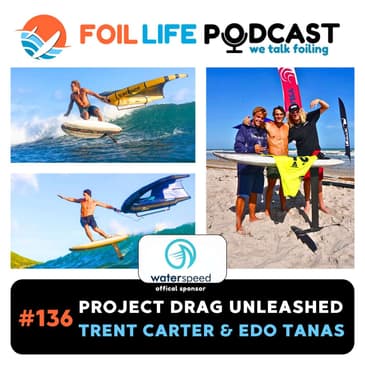
[00:00:00] Hey everyone, welcome back to the show. On this special episode, we sit down with Trent Carter and Edo Tanas of Slingshot to talk all about Project Drag. A top secret project that's been going on behind the scenes of Slingshot out of necessity to help improve the foiling game. We talk about their trip to Maui where all the magic happened and also what it felt like to collaborate with Bobby, Gabe, Ken, Kyle and Michael on this special project.
[00:00:28] So we do hope that you enjoy this episode. Next, we want to say a big thank you to Frank, Stefan and Pam. Thank you for your hard work behind the scenes for making this show possible. Next, WaterSpeed is the official app of the Foil Life community. It is the app that water sports athletes use to track their performance on the water. You can connect your Garmin, Coros, Apple Watch or Vaccaros and then it starts logging everything.
[00:00:55] From speed, tacks, jives, foiling time, live tracking, VMG and even polar charts. This is the kind of data that actually tells you whether you're getting better and faster or, you know, just feels like you are. It works across 30 plus water sports including downwind, wingfoil, sailing, windsurfing and it turns every session into something you can learn from.
[00:01:16] So before listening to this amazing episode, we ask you to go over and download WaterSpeed now. It's available on iOS and Android. And like we said, WaterSpeed, this is what performance tracking looks like when it's actually built for the water. Lastly, thank you very much to our sponsors for the 2026 season. A big shout out to North Foils Mystic and on kiteboarding.
[00:01:41] We also want to thank our title sponsor, WaterSpeed. We're loving the app so far, guys. Visit foillifepodcast.com forward slash sponsors to learn more. Now I hope you enjoy the show. Welcome to Foil Life. Whether you wing, kite, parowing, downwind, pump or e-foil, thanks for being here. Well, fellas, it's nice to have you guys both on the show.
[00:02:09] Trent, we talked last time, but Edo, this is our first time talking. So hey, man, welcome. Yeah. Thank you. Thanks for having us. Yeah, thanks for having us, Luc Moore. Yeah, you're welcome. We're excited to be talking about something that's very popular. Drag, right? Lots and lots of drag. Project drag? Is that what is what we're talking about today? Project drag. That's kind of the focus. We've been working on this for a while now. It kind of came out of a necessity, not a want.
[00:02:39] You look at everything of a foil system and you start... When you look outside of the front wings, you start to realize there's a lot of big areas where you're losing a lot of energy, creating a lot of drag. And this whole project was basically how do we minimize that from the second you get moving on the water all the way to the top end of your speed range. So from the board... And especially when we're foiling, we just want to be foiling, right? We don't want to care about what the board does when it's touching the water.
[00:03:10] Otherwise, we'd be surfing or kite surfing or windsurfing. But at this point, when we're foiling, we want to eliminate all the feeling of the board and its distractions to the foil. So the project drag is essentially eliminating the feel of the board and the distraction. So when you touch down, you don't feel the board tracking in a certain direction. You're just... It almost feels like it never does touch down because it's just like... The way it touches bounces right back in a very subtle way.
[00:03:39] And it's flowy as if you were always on foil. And I think what that allows, at least for me, the breakthrough was to be able to ride a way bigger board that gets you going. But then you don't feel it. You don't feel a big board. You're still foiling as if it was a smaller board. And I think Trent can explain a little bit about like what we were... We're using these... We're using these 62 liter boards, big mid-length boards for prone foiling. And they work great. Yeah.
[00:04:07] The last couple of days, I've had like some of the best prone foil sessions in my life in small, insignificant ways. Like the way these boards... The whole system, it's all working in synergy. And you can just jam it into these sections, just slam the board into the wave. And instead of having the board track or do something weird when it hits the water, it just continues that arc path and does something predictable just on the board side of things. So it's really...
[00:04:37] It's an amazing board. It's... If you're paddling in on it, you're like, okay, I'm on a 62 liter board. This is great. You're getting into waves easy. And then the second you get up, because of the way the foil is positioned and the things that we have going on on that front, you don't feel the board anymore. It doesn't feel like you're on a 62 liter big wing board. It's the kind of departure from everything I've ever felt. So it's pretty insane.
[00:05:06] Huh. How many... Because I know we're talking to Elliot and stuff. How many guys were working on this project? There's a lot of hands on this project for sure. I imagine. I think it originated from Ken and Kyle. Ken Adgett and Kyle Tui. Is it Tui? Last name? Yeah, right. Okay. Yeah. So they were the brains behind this whole operation.
[00:05:35] And we're fortunate enough that Slingshot was involved too. And all together with the designers and the entire team, we came to this baby right here. Oh! Yeah, right here. This is super sick. But I think where Trent and I came in was, it was mainly designed for wing foiling. That was the original intent. And then when we got onto it,
[00:06:02] we pretty much just used it prone foiling, downwind foiling, just using it in the surf. And they were pretty shocked to hear that we were loving it in the surf because who would ever think that a 62 liter board would be more fun than riding like a 4.5 and ripping turns on it. And the reason that is, is just because even though it is a lot more foam and volume than what we're used to, the connection that's created,
[00:06:30] like they focus a lot on having a really rigid connection between your foot and the foil and by using really stiff ways of construction. So you're really connected to the foil. You don't have the foam dampening, the way the foil reacts. And on top of that, like the coolest thing is it's balanced in the right place. It doesn't feel like a big board. You can swing around really well. And when you're hitting the whitewater, you're in like a critical section of the way where it's steep. Like I always thought a big board would probably,
[00:07:00] you know, hit the rail and purl or send me off the direction, but I'm fully like doing errors and whacking the whitewater. And then this board will like carry me out of it much better than a smaller board would. And it's, it's kind of like, we're definitely feeling a little bit of a breakthrough in the way we're riding. Cause having this extra length and, and foam also like has a little bit more swing weight. So it feels like we're surfing too,
[00:07:29] a lot more than, than on a smaller board where you're kind of leaning and kind of like snowboarding more instead of whipping it around. And so, I mean, I think they were all pretty shocked to hear how stoked we were on it prone foiling, but it also just, it also just like spread the word that this board isn't just good for winging, which was what it was originally designed for, but it works. The shape works for everything, but it's not just the board, right?
[00:07:58] Cause there was just the board. So we saw something at AWSI and, um, they were thinking it was going to be a couple of years out. Like I won't, there's one brand that put something like Apple had talked about it, but they were thinking it was a couple of years out, but then we hear rumors that something else is going on. And, and you guys have a little magical surprise to release. Yeah. So, um, Michael McKinley, um,
[00:08:26] designed a new adjustable tuttle box. So this tuttle box, you can basically move four and aft, uh, two inches. And so it's not as much as a super long track, but also you get the benefit of having a total mass, which the benefits, the benefits I didn't, I thought looking at total massive where I was like, Oh, that's cool. But they were doing that 10 years ago. Now, after writing it,
[00:08:55] it's absolutely mind boggling. Like having a tuttle in your board is most direct and like high performance thing. You can feel it is so connected. Every little, everything you push into the board, you get an immediate output. And then on the flip side of that, everything the foil feels, you feel instantaneously. There's no lag of going through the tracks, through the screws, through the foam, up through the deck, like all the energy, all the energy,
[00:09:24] both ways is just immediately getting converted to your feet, to your body or vice versa. So on that, that front, the mass and total thing, it is phenomenal to be able to get on that. Cause for me, this is the first time writing a title system. I don't know about for you at all, but it's, it's pretty mind altering when you get on it. And then once you hear the designer of the box, Michael talk about it, you're like, Oh,
[00:09:54] we've been, we've been missing out this entire time. Like what have we been doing? It's, it's pretty insane that performance advantages you get from a title. And I think as we're in the, in the thinking of project drag, right? Like where do you minimize drag? A big part of drag is the base plate. And you don't really know what you're missing out on until you get on a board with a title and you get up and going and you're like, Oh, why am I,
[00:10:23] why was that 10 times easier? It's, it's like a whole new world. I think for Edo and I both, it's the first time we got on it. We kind of realized, Oh, I can just sit on the wave, not on foil and use the board, like almost like a surfboard and sit on the wave, wait for a section. And then when it's, when the opportunity presents itself, actually go and use the board and its rail lines to make maneuvers, turns,
[00:10:51] and just adjust the timing. It's, I don't know. It's kind of game changing for us. How we, how we think about writing. So it makes that big of a difference. Yeah. Yeah, for sure. I think just looking at it and thinking, it's hot. All more connection. Cool. Like, is it even worth it? New mass, whatever, all these things. But when you're actually writing it, I think that's really when you can feel it. Cause the mass is going through the board and into your foot.
[00:11:20] It's like, it's almost like writing a little tray board in terms of how direct that feels. Like if you ever tow in or kite surf, like on a little tray, it's super twitchy and direct, but you're having that with a lot more foam and an actual like board that can catch and ride waves. But I, when we talked to Kyle, we did a trip to Maui and met, actually met Kyle in person and was able to pick his brain. And he's honestly a really smart guy. So I was just like challenging him. And I'm just speaking like my,
[00:11:51] my thoughts and seeing what the other side is. Like there's always trade-offs, right? It's not. True. With foiling, you can get more carved, but then you're losing out on speed or you get more speed and you're losing out. You know, it's, it's all trade-offs. So I was like, okay, this is super cool. But with the track, you get to adjust your mass wherever you want. And you have all this playroom. Like, how are you going to do that? I mean, yeah, we get one inch in the front, one inch in the back, but is that enough? And he specific,
[00:12:20] he was actually like, this is actually one of the strengths of having a tuttle. It just raises the bar for shapers to have to be very, very specific of where they put the box. Because part of the development of this tuttle was creating a formula for every single brand of foils to figure out where the balance point would be for the box relative to the board. And so now the strength is instead of guessing, you get on a new board,
[00:12:50] the tracks are super long and you can go all the way forward, all the way back. But most of the time, if you look around, everyone that's writing a brand is putting it in the same place on the tracks. So yeah, the idea is here instead of guessing, watch your, watch your hand on the desk there, buddy. Sorry. Am I being? Yeah, it's okay. Okay. Too excited. I'm too Italian. Yeah. I'm too Italian. I'm super, uh, no, it's all right. Put it away. Okay. Yeah. I always keep my,
[00:13:19] my foil nearly in the same place on my mass track. To be honest, it's always like an inch back or something. Cause I like it to be a little, whatever it is. That's where I put it. Um, they were teaching me in Maui last year when I was working with the guys at KT to like balance it properly. So you put it in a certain section where the board is level and everything works well, but you're saying that performance wise and, and pushing wise, it doesn't matter if it's slightly smaller because they have, they had to, they figured that out. Yeah. By specific.
[00:13:49] Yeah. Like they have to, they raise the buyer bar of shaping where they have to put the track so that not the, the rider doesn't have to figure out. They, they just have to work with very small details of what their writing preference is forward and back, but they don't have to go crazy and just like hop on a board and try all these different positions on the track. Cause it's, it's kind of useless to have a huge range. Think about it this way, Luke, if you had a surfboard,
[00:14:17] like imagine you had like your thruster surfboard and you could move your, your fins forward and backwards. Like you had long futures boxes or something like, yeah. Is that a benefit? Maybe, maybe like for people that are like, Oh, I want to adjust a lot. But at the end of the day, the shapers know exactly. And Kyle and Ken have built, I think over 150 boards collectively between the two of them trying to figure out this sweet spot, finding exactly based on the center of volume,
[00:14:47] the center of mass, um, where that board can stand on the water. So you could be sitting there. It doesn't feel weird. Like where if it's like a 62 liter that sinks that O and I a little bit, but because it's so balanced, exactly where it needs to be when your feet are in the perfect spot, you can be standing on it underwater and it doesn't feel like the nose is trying to shoot up from you or the tails going. Everything's just in perfect sync. So it's really, it kind of eliminates the board from under your feet.
[00:15:16] It's pretty incredible. You're saying because the title is actually in the board itself that you get a lot more direct feel than having it attached to the bottom of the board. Yeah. I think for, I think for advanced riders, they'd be thrilled for someone that's like intermediate beginner, the benefits of having a track or like just for the ease of use, breaking it down, setting it up again.
[00:15:46] Um, that's still there because like, you know, faster takeoffs. Yeah. It's, it's just a little easier. And also having, being so connected to the foil is it honestly at first, you're like, Whoa, this is, this feels insane. So I think it feels really great for the intermediate to advanced riders. I think the whole team that tried it, everyone's like, Holy crap. Then maybe for someone that's a beginner,
[00:16:15] like there's, there's, they can't feel the difference between anything yet. Exactly. But if you're going to start on something that gives you more opportunity to grow, then why wouldn't you? Right. I also think so. Like when you're, regardless of your level, when you're touching down on the board with a track, like with tracks, it's like hitting an e-brake. I mean, it just creates all this ventilation. The board sticks down and you really feel that point where it just breaks off and you're foiling.
[00:16:44] You know what I'm talking about? It's like a big breakthrough for when there's all that drag of the plates to like getting up. But then with the, with the mass of the project drag, it's just like, you don't feel that it's always super smooth. Now this Maui trip was pretty epic trip for everybody. Like how many of you guys were there? I know Bobby and Gabe were there. Kyle, Ken, Michael was there. You guys were there.
[00:17:13] Everybody kind of working together under one roof and putting all of that experience onto one project must've been pretty awesome. Yeah, it was really, really fun. There's, I think at 1.9 of us there in total working on this together. And we were going from everything from board design all the way to tail wing design, mass design, front wing design. So we,
[00:17:39] we really try to effectively use our time and just cover every single base we could in order to make sure. Okay. Now we have the board, like the board's great. Now we just start, have to hammer the details, get the mass all as good as we can get it to be. Think about the future. What, what improvements could be made on the front wing? What improvements could be made on the tail wing? The balance, right? Um, I think for those guys,
[00:18:06] I think the realization came that there's a whole different world, like in the open water conditions versus, you know, like hood river or, you know, any, I guess anywhere in the world, but the open water conditions where you're exposed to open ocean swell, it really changes the paradigm and you can feel every little bit of resistance and drag in the water. So for all of us to be having those same sensations,
[00:18:35] we were able to hone in and kind of just chop off little details here and there, how to make that, how to minimize things, all the drag that we can fitting the name like project drag. Yeah. Were you guys able to proto on Maui or how were you able to go through the different testing and building process? Yeah, there's a lot of prototypes. I think because the entire team was there,
[00:19:03] slingshot kind of went on all out and brought a bunch of prototype tails, fuses, front wings. I mean, and a lot of different versions of the mass with different layups. So like, it was a lot, a lot of testing. I think pretty much every single day for the three weeks that we were there, I was trying a different combination of something at some point. Which is super cool because we could also, since we're all there, I'll try it. Trent will try the exact same setup. Kyle will try it. And then we can all come back. What we would do is I try it, won't tell anyone anything.
[00:19:33] And then after everyone tries it, we like go at the same time, we would just say what we felt so that there's no, you know, you're not thinking of other people's opinions. You're just like giving your own. You guys do double blind controlled studies. Yeah. Yeah. Yeah. Yeah. Completely hiding it. That's exactly what we're doing. Poker face. Poker face. I was like, yeah, I'm not telling Trent my feedback. No, but the cool thing would, would be like when it overlapped and I'm like, Oh,
[00:20:03] I did feel the same thing that he felt. So then it's, it's consistent across. And I think that's the most important thing because a lot of people have different writing styles. And if you're just like listening to one person, then you're going to create a foil that's good for them, but not consistent for everyone. And I think that's what, I feel like that's actually what a lot of brands encounter at times is they have a specific group of writers that ride a certain way and you can see it in their writing.
[00:20:30] But the problem with that is it's only like for people that ride that way and not for, it's good to have a variety of, of different writers that ride and, and draw lines in, in different, different ways, I think. But it was also cool to have like the whole team there. Cause it's like a group of grown men shooting the shit at nighttime at like 10 PM. And we're like, Oh, we should design a board like this. What if we did this? I remember one night,
[00:21:00] it was like 11 PM after dinner. And all of a sudden Bobby, we're having like these ideas and Bobby, the foil designer, he decides to pull out one of the prototype front wings, which had a little bit too much of a, of a arch on the tips. And he boiled water to heat it up and was like, we all together using our brute force and step standing on it, ended up flattening out those tips to test it out the next day. And it was just like,
[00:21:30] yeah, it was just the fun that we would come up with, you know, putting all, all these people together and, and, uh, thinking of prototypes and how to make things better. So that was pretty cool. Well, it's a hell of a lot of experience, right? A lot of experience, a lot of education, like, um, from what, how many engineers would you have there working on this kind of thing? Plus combined with athletes and everything else. There was nine of us there in total, Bobby and Gabe and Kyle,
[00:21:59] I think are all engineers by training and trade. Um, and then you have Ken who's shaped hundreds of boards and done everything from, you know, boards for kite foil racing for the Olympics all the way to wing boards for everybody. So the wealth of knowledge there was pretty like when they have 10 people in a room and everyone just powwowing, bouncing ideas off each other,
[00:22:28] like things were happening really quick. And like pretty, pretty quickly it came to the point where we were like, we were just going way far out into the future of what we thought we could have done during that trip. So the progress made was really, really, really fun. And I was thrilled about it. And it was also fun to be there, like to, to try to soak in some of their knowledge. These guys all have so much experience. You're,
[00:22:57] you just try to be a sponge and listen to what they say and listen to what they, what they're feeling out in the water. And then just watching them too. Like they're doing things so differently than I would have ever done them. You kind of pick up on that. Mm hmm. And then shooting, obviously you guys have to shoot everything, get everything organized, which would be pretty sick as well. Yeah. The shooting was fun. Um, we had the jet ski for a couple of days and we were just, we were shooting nonstop. You'll,
[00:23:25] you might be able to see some of it soon. Um, you know, there's, we were with the ride engine designer, Julian. He's really good at jujitsu. And so we were also, we were getting trained on the beach at Kaa in jujitsu by Julian. So when you're sharing a bad with, with some of your friends for too long, it gets a little, yeah, physical at times. Yeah. Had enough of you, Trent. Let's go. Let's roll. Yeah, we can go. Yeah. Or like,
[00:23:55] give me that board. I want that board. No, I want that board. All right, fine. Let's fight for it. That's what's happening every day. That makes a good product. Can we talk a little bit about the creation of that title and what goes into holding that mast in there? Cause obviously you're not getting bolts from the top, like the old titles.
[00:24:19] So you guys devise a new system that would allow it to not move forward and backwards and then tie it in. Or is that coming soon? That is, that is coming soon. So all, I think all I can say about it or all we can say about it is that Michael McKinley has been working with Larry Tuttle on it. The guy who invented it. And basically it's, it's,
[00:24:49] it's the same, it's the same as the title system that you've seen. And it's just, it's extended and it's reinforced so it can meet all the needs of foiling. All right. Better, better than it was before this, the, how it's fixed to the board is still the same. So you still have the, you still have the screws from the top and that's pulling everything. Like, so if this is the board, it's pulling that title mass all the way up. So the idea and the principles still there.
[00:25:19] It's how can you do that on a thing that's adjustable? So the way they figured it out is you're using shims that are precisely made that you could either, you can kind of stack them. They're like Lego pieces almost. So you can either stack them for aft. Fascinating. Fascinating. Or put one on each side and then it's, then when you screw it in, everything sits snug and there's no gaps in anything. So like when you're looking at the bottom of the board, the shims,
[00:25:47] instead of having all that box where there's nothing there, it's all sitting perfectly flush. So. Like the windsurfing shims that you put if you're going from a quad to tri-fin or something. I think I would know better about that. Well, they fill the box. So in essence, you're filling the box. Yeah. Yeah. Yeah. Well, that's cool actually. So it's much different than, than the apple tree design where they had screws and it would kind of turn these two lock washers and sit within a track. Yeah.
[00:26:16] Completely different. Going all the way through it, which you're finding would be a lot more stable. There'd be less chances of it buckling. Yeah. So less issues and then longevity and all that. Plus more direct feel. Yeah. The box goes all the way up to your feet. Okay. That's what they were hoping for this whole time. Exactly. When can we expect some of this stuff coming out? I'm not sure on the release date.
[00:26:46] I think Elliot's on those and the rest of the team. Oh yeah. Okay. That's fair. But at first, this board's coming out as a track system board after we just spent 25 minutes talking about how great titles are. But I think people are still going to feel that same advantage of just the board. Like all that, that wealth of knowledge that Kyle and Ken have packed into this board. Even with the track system, you're going to be, you'll be laughing. Like, you were talking about the different,
[00:27:16] the way the rails are fabricated, the way the bottom was and all the different kinds of nuances that you guys put into it. So when it does touch down, it doesn't kick, it doesn't jump. It kind of, so that, that's what we're, we're going to try it with the regular foils and then you're going to release the tunnel after. Yeah. I think that's the main thing that you'll feel with the regular foils is I had never experienced where you do a turn and usually you do a turn, touch rail, and somehow it, it tracks a little bit.
[00:27:46] You'll feel like a, like an oh shit moment. I might fall. But instead of that, it continues the turn. It, it doesn't feel like it's, it doesn't have a mind of its own. You're completely eliminating the board taking over, but you're just focusing on the foil and the way the foil rides. And the board is just a platform for you to foil and with its volume and everything being packed in there. But the cool thing is you're just focusing on foiling and the board is no
[00:28:13] longer a component that you have to think about. Like a, what if I drop it on this wave? Am I, am I going to nose dive? Am I going to dive? If those, those parts are eliminated as much as possible, it's all about how, like, where do I want to position the foil? What lines do I want to draw? Completely eliminating the, the board factor. And even with the track system, you can 100% feel that just because of the contour of the board.
[00:28:42] And it is actually a pretty, like if you look at the board, doesn't look that intricate from afar, but when you get close and you feel with your hand, you'll feel a lot of very small, minute, like edges and sections, which are put at specific angles of attack. So when the board touches down at this angle or this angle and this angle, there's always a surface, a surface that's made for that and shape for that occasion.
[00:29:10] And we'll just bounce right back as if nothing ever happened. Yeah. I think the eye opener for both of us when we were on these boards is we were doing the leco laps and we were testing out a bunch of different foils, tails, mass variants. And Edo and I would just be like, instead of like just trying to jam straight downwind and race, we were just surfing for eight, nine miles going way out on the pair wing. And then this surfing side by side for miles.
[00:29:39] And what we were both doing is we'd mess up on a turn. So we'd go full bore, bank the board over, and then we just smash the rail into the water. And typically if you're doing that on a downwinder going 20, you're falling off and going straight over the handlebars. But with these boards, we were just burying the rail, smashing it into the wave. And instead of flying off, we were just continuing to turn and then just going right through it.
[00:30:07] So at least for me personally, it was like, oh, this is, this is like a cheat code. Like if you're, it just opens the door for you to be able to go make mistakes or even use the board as a flotation device throughout your time. Turn and be able to keep going, not stall. And shout out to Trent's YouTube video that he made and posted on YouTube. I don't know if you saw it,
[00:30:33] but we did a full pair of wing prone downwind run together with these boards. And you'll, if you watch it, you'll get a feel for what's going on. It's super sick. Yeah. Nice. Nice. Well, so we got that come. What's our, go ahead, Trent. But to the point, um, like on that situation, maybe the title didn't make that much of a difference because we weren't touching down flat. Right. Every time Edo and I would touch down,
[00:31:00] we would be going up into the lip of a wind swell and then just bearing it as hard as we could. So if you had a track there, you wouldn't, it would have the same exact effect where you hit the water and instead of shooting or bouncing any which way, you just go right through it and keep going on boil. So it's, it's an awesome feeling. Like I, it's hard to explain what it allows the comfort of riding. It gives you like,
[00:31:28] you don't feel weird about touching the water anymore, falling off. Like just feels like it's going to come right back. It's confidence inspiring. Well, I'm looking forward to trying it. I'll be in the hood this summer. So I'm sure there'll be some stuff floating around. HQs would be kind of sick to try some of that. And the tunnel makes sense. Cause that just talking to how big that mass plate is and how much work had to go in just to make sure the stiffness stayed. This just makes so much more sense. I'm stoked to try that as well. And,
[00:31:58] uh, and see where that's going. How long has that been in development? Like the idea must've been here for a while if it's almost ready to come to market. Um, well, Ken and Calvin, this is like the pinnacle or this is, they've been shaping boards for years and years and years since the beginning of winging and even before that. So right now it's awesome. Cause they're, we're positioned to take advantage of their years and years of hard work.
[00:32:29] So it's like, how'd that collab come to be? I think Fred and, Fred and, uh, Jeff Legos and the whole crew are, yeah, they all get to talking and plotting and with Ken and Kyle and they get all excited. And I think they've made something happen. I can't, I don't know about the details of that. Okay. That's fair. And you guys are going to be using the new tunnels for race season coming up in Hawaii this summer. I think so. Yeah,
[00:32:59] for sure. I mean, the performance is so much better. It is coming up. So, um, we're like in the prototyping stages of creating a board, a downwind board with the tunnel. And we still need a, I mean, we have our theory of how it should work because production takes a long time though. And we only have, um, what is it? Yeah. A few months left. We hope that we can, maybe the first board that we ordered is going to be the perfect one. Who knows?
[00:33:28] But yeah, we only have like two or three rounds before the race season. So hopefully we'll nail it. In the meantime, you guys get to play around with it and continuously refine or, or see what you like or what could be tweaked along the process. Yeah, exactly. I think we never, that's our, our job is to pretty much pinpoint all of the, the details that could be improved. I mean, there, you can always get better and better and better. And there's always an area to improve on.
[00:33:58] And I think that's pretty much literally Trent and I's job is to ride foils and figure out what their weaknesses are and brainstorm with the designers of how we can improve those. And it's an ongoing process. It's just about priorities, right? Like what, what's the first thing that we can do? And then from there, go to the next thing. And it's just never ending. It's yeah. Never ending.
[00:34:25] Do you see this project jumping ahead of some of the other competition, let's say, cause it's all friendly competition within the brands. Like, do you see other brands looking at this and like, Oh shit, we, we got to hop on this too. This makes sense. For sure. It's just a big commitment for a brand to go in and experiment with a new mask with a title and then a board and getting ahold of the track and
[00:34:52] figuring out where to put the title track and the construction involved in creating a board with the title is completely different. So it's not only a lot of money and R and D that a brand needs to do and also a lot of time and effort that they're going to have to put towards it. So I think I honestly am very, very, very certain that maybe in the next three years, we'll see every single brand switching to the title or the adjustable title,
[00:35:20] just because we're chasing high performance, at least for downwind foiling or racing in any discipline. And it's why wouldn't you want to have the best performing connection and you don't want to be limited by, by tracks. Like you could have a super stiff mast, but it could be this much stiffer if you had a tight connection with the board. So that's, that's going to be an area where you can maximize everything, but then if you do want to take it to the next level, you'll have to go there too. So, uh, yeah, we're just,
[00:35:49] we're stoked that we're hopping on that first and, and putting in the work now. So hopefully we don't have to do it late. I mean, we don't have to do it later and then everyone will have to catch up and then, yeah, hopefully that's how it goes. We'll just have the best equipment. Any advances in fuse tech or anything like that? Or is it front tail wing and mast? Uh, Oh, go ahead. I don't go ahead. No, no, you got it.
[00:36:19] You got it. I think, well, with the mass itself, the whole mass has been redesigned. There's some little, some, some new things in there. The mass itself is super, super fast. I think it's going to be the thinnest or if not one of the thinnest on the market when it comes out. Um, and it's all because we get this advantage of having the tunnel. So you don't need to have all that extra carbon bending to make that base plate, right?
[00:36:48] Like everything is in the straight line. It's all super stiff. So it allows you to go to the extreme of the base of the mass and the design of that, making it as efficient as possible through the water. Um, as far as the fuse and everything, there's some little changes, but overall it's just, it's still the same one lock system. We just made some little alterations to it to minimize the drag. So I'll, I'll leave it up to you to think about how the,
[00:37:17] if you look at a one lock system, think about, okay, where can we eliminate the drag? And that's kind of been accounted for in the new mass designs. Well, looking at the mass, right? Because it's just straight, you have a lot less forces and different vectors and stuff working to maintain stiffness or give stiffness where you want. Correct? Cause you're not dealing with these different shapes and figuring it out thickness and how much, like if it's just one straight line, you could,
[00:37:47] would you not be able to make it a little bit more performance because you're not having to play with all these different things? Exactly. Yeah. Yeah. That's, there's the, that's the total advantage right there. Yeah. You're using less material. You're, you're going, everything's in a straight line all the way down. The connection's perfect. Like, so yeah, that's, that is the advantage of the total, at least on the mass side of things away from the board, just on the mass. It makes it all, makes it all come together so much, so much easier.
[00:38:17] Sick. Well, boys, I'm looking forward to trying this. Um, I think it's going to be a pretty, I'll be in hood river for at least a couple of weeks in July. So I think it'd be perfect time to hop on this stuff and see how she goes. Yeah. I think there'll be plenty of gear up. I think the board's going to come in like 62, 72, 82, one 12. So there's going to be a huge range of sizes. So maybe like a 72 for pair of wing, just so you can get up in the light wind or not be a sink in the whole time. Um,
[00:38:48] there's a range of sizes, so you got to get it on it for everything because pair of wing wing foiling, and even maybe getting on that one 12 for sub foil downwind or in hood river. That could be fun for sure. Yeah, that would be fun. It's pretty, it's pretty remarkable. You'll be, I can't wait to hear what you think about it. Yeah, that's what I was talking to a few other teammates there as well. That's my shot. And they were looking forward for us trying it and see what we thought compared to the stuff that we're riding now. So yeah, that'd be pretty sick. So yeah.
[00:39:18] Well, what do you guys have planned for the rest of your day? A little friendly chess match or tennis match or something? Cause you guys are a couple of houses apart or what? Like I said, if Trent stops hanging out with his girlfriend all the time and gives me a call, I'd love to play tennis with him, but I don't know. I'll probably have to make some other plans. We're going to run the tennis today. I'm going to show it. Oh, it's going to be kind of, it'll, it'll, it'll be like Alcaraz versus center. That's the vibe. Waving at the fake crowd,
[00:39:47] waving at the fake crowd. Bring a champagne bottle for my victory. Yeah. Yeah. All right, boys. Thanks for coming on. Thanks for introducing this like revolutionary product. Congratulations, by the way, for being first to market on something like this, that's going to be coming out. I'm really looking forward to trying it. And that must've been a blast with everybody just designing and testing and that would have been so cool. Yeah.
[00:40:17] Thank you. And all the thanks goes to those guys. They put in all that. They put in all that legwork. We're just the beneficiaries. You guys are supposed to break stuff. Yeah. Break stuff and test stuff. Critique. Just. How smart you both are. Just. Yeah. We're just coming. Thanks for having us, Luke. Yeah, man, for sure. Looking forward to chatting with you guys again soon. Thanks, Luke. All right, guys. Take care. We'll chat soon. Hey guys, thank you so much for listening to this episode. We really do hope you enjoyed it. Now to help our show grow,
[00:40:47] if you can hop over to our channel. So we got our YouTube at Foilife Podcast. We've got our Instagram at Foilife Podcast. And we're even on TikTok at Foilife Podcast. If you can give us a follow, like, subscribe, all that good stuff, it'll help our show grow. And thanks a lot for doing that. And we'll see you in the next one.