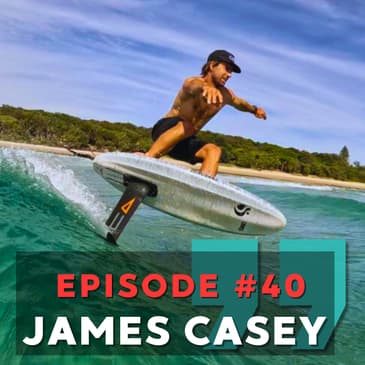

James Casey is the co-owner of Code Foils, the current foil world record holder and 2 x molokai 2 Oahu Champion. He joins us from his home in Australia to chat about:
- His intro into water sports
- How he started racing SUP’s
- His Molokai 2 Oahu races
- His World Record Holding Foil
- The story behind Code Foils
- His Coach Casey Programs
- Code Foil product overview
Watch Episode on Youtube or visit the Episode Page
Like what we do? ★ Support this podcast ★
Learn more about us & follow us on Instagram
This episode is brought to you by the Fit for Surfing Program. Use the Coupon Code WINGLIFEPODCAST50.
https://langepersonaltraining.de/fit-for-surfing
[00:00:00] Welcome to the Wing Life Podcast, where we talk about wing foiling and the lifestyles
[00:00:12] of those who enjoy this great sport.
[00:00:14] All right.
[00:00:15] Hey, James.
[00:00:16] It's great to meet you.
[00:00:18] Looking forward to seeing where our conversation goes today.
[00:00:20] Yeah.
[00:00:21] Thanks for having me, Luke.
[00:00:22] It's good to learn it a lot.
[00:00:25] And yeah, so I had to get into it.
[00:00:27] Oh, yeah.
[00:00:28] Absolutely. the variability. We've got a north east Libre today, so it's like our standard sea breeze, nice weather, normally north-easters, and then we get southerly france that'll come through every I'll try to say exactly, but normally once a week there'll be a southerly from the come through. Cool temperature down, wind direction changes, and then as this front goes past, the wind swings
[00:01:42] back around to the north east to the north east, and another from a come through, so it's been
[00:02:49] up my, both my mum and my dad both surfed. And like, I guess any, some of the mum and dad who surfs, they guess we have the water as well. I'm doing that with my son too. So
[00:02:53] you guess exposed the tomb and my parents really pushed it upon me. They sort of showed
[00:02:58] me what was there. And then it was just like one of those family activities we did. So,
[00:03:03] you know, surf school as a kid and then we, like people who live in warm countries, because we're in the cold and snow here most of the time. So we escaped to the warm. So I already thought that people from the warm
[00:04:21] would escape to the cold for some different,
[00:04:23] but you normally don't.
[00:04:26] So I was like, huh, back when you led the kite you generally learn in footsteps and I was mucking around and this was a super fun day and I was trying to get barreled on the kite and I thought it just got it wrong instead of went up and over and one of my feet came out with straps and I was stayed in this strap and I sprayed in my ankle so the next few days there wasn't
[00:05:41] much wind and I couldn't I could walk I catch waves and not hurt my ankle again, but even better it was, we were surfing these spots that you wouldn't be comfortable enough to paddle out in your shortboard because it's like, you know, five, six, 700 meters out of reefs. So answer was surfing by ourselves in awesome waves and no one else around.
[00:07:05] So we're like, maybe there's waves all the time, but there aren't really good waves that often. That's a city, so it's kind of crowded. So with a centre parable, you could go to outer reefs, you know, around waves that aren't as good, but you could get them to yourselves. And so more waves, less crowds, it just makes sense.
[00:08:20] Easier in a note.
[00:08:21] Oh, that's cool.
[00:08:23] Yeah.
[00:08:24] When did you think about starting to compete?
[00:09:22] It wasn't a good thing to do. But it's just like, I feel like we're up surfing.
[00:09:23] It was just surfing a big board.
[00:09:25] And I was kind of, it seemed to work.
[00:09:28] OK, whereas I was competing against,
[00:09:30] I've had a lot of standard paddleboarders out in surfers
[00:09:32] first, basically.
[00:09:33] So because I surfed and it was a decent surfer,
[00:09:40] I was competing against guys who were just
[00:09:42] standing paddleboarders and didn't necessarily surf.
[00:09:44] So the guys that were winning were good surfers as well. like a career choice, I guess. It wasn't a something you're doing, it paid for. It was just something that you did. And then growing up, I was like, the dream was like the pro surfer, but I just wasn't, I was a good surfer, but I was never the best surfer. You know, it was like, that'd be cool, but it's so competitive here in Australia
[00:11:00] and around the world now.
[00:11:01] And so I think I definitely made a good choice
[00:11:05] with the alternative ocean sports.
[00:12:01] you know, whatever it is. So it's funny looking at that.
[00:12:02] Yeah, that was the first time where I sort of understood
[00:12:05] that there was like this sort of competition,
[00:12:09] I guess, to the standard paddleboarding.
[00:12:11] And then I still wasn't interested.
[00:12:14] And then I basically went to my first standard paddleboard
[00:12:20] event, which was the Marine Vealer Classic,
[00:12:21] which is a pretty famous wind surfing event.
[00:12:24] You know, all the pros back in the first round, but it like, the base of the, the, the organizer Tristan was like, okay, we've qualified for the rest of the tour of the, you want to come do it. And then the next event was in Brazil. And then there was a couple in like, um, France and Abu Dhabi and the Wavebull and that was the beginning of all that. So I wasn't. That stage I was just like, just to pay your way.
[00:13:41] Oh, kind of thing.
[00:13:42] Yeah.
[00:13:42] Yeah.
[00:13:43] Exactly.
[00:13:43] Okay.
[00:13:44] Oh, nice.
[00:13:45] A bit startable.
[00:14:41] and dad run a four-in footer. And my brother thought he kind of stitched me up,
[00:14:43] put him on the shoulder board,
[00:14:44] but because the board was shorter,
[00:14:45] it was a little bit easier to paddle into the wind.
[00:14:47] Like it was kind of easier to go.
[00:14:49] So, so I beat them.
[00:14:52] I've been my brother and my dad in that practice
[00:14:54] on the shoulder board.
[00:14:55] And I was like, let's, yeah.
[00:14:57] Actually, we didn't race again for like another,
[00:14:59] I didn't do another one of those for like two years,
[00:15:01] as you can imagine, like a hail storm headwinds.
[00:15:04] It's not really what was I.
[00:15:04] It's not useful.
[00:15:06] No.
[00:15:06] Yeah. that I can, so I thought I was gonna go around the distance as well, but the distance was like an upwind leg and the inside of it was just like, you know, bouncing and flexing. And so I mean, I was the first of the non pros in the distance, but like it was, like I was in the second or third pack, you know, so it was fun. That was cool, I was the beginning of it, I guess,
[00:16:21] the racing, oh, maybe I should do this more.
[00:16:23] And then you won 2019, you skip ahead a few years.
[00:17:23] long road to one of those things that just sort of, that was my goal every year and to sort of work hard for that.
[00:17:25] And yeah, it was a cool,
[00:17:29] yeah, there's a lot more to that, like board design and brands.
[00:17:31] And, you know, it was starting with,
[00:17:33] it was part of a JP originally because of the surfs ups.
[00:17:36] So good.
[00:17:37] Then I was trying to help them with the race board design
[00:17:39] and saw what I wanted to do, like unlimited racing
[00:17:43] and who I didn't, didn't, the breadth,
[00:17:45] I guess our ideas didn't align. and no mix. So it's like Honeycomb, sort of carbon stuff. He built that and basically sent himself a break. He wanted to build himself on, he built me one as well. And I won Molotai on that board, which was, I think, made it. Sort of half worth while for him. Because he, as I said,
[00:19:01] he went broke doing it.
[00:19:02] And then, yeah, now, it seems like this is a distant memory
[00:19:06] that's doing the paddle stuff. it was pretty cool to we on stuff that we had created. Yeah, for sure. Definitely. For the honest, it was. It was a I didn't expect it. Like I, uh, my goal was to get on the podium. That was like the ultimate goal of I can get in the podium. I'm pretty stoked because there's just so many variables and so many unknowns.
[00:20:21] You know, my wife, I had to run for four years, since 2019
[00:20:27] because of COVID.
[00:21:24] I was very, I sort of still peaching myself and Marcus, Ben and Dan, like on the front of the aisle, like,
[00:21:27] holy shit.
[00:21:28] That was really good.
[00:21:30] Anything you're going to win that I liked.
[00:21:31] It was just like this, you know, it was a bit of shock.
[00:21:35] The show.
[00:21:36] Oh yeah, I don't doubt.
[00:21:37] So back to back.
[00:21:39] Yeah.
[00:21:40] In essence.
[00:21:41] Yeah.
[00:21:42] Yeah.
[00:21:42] Yeah.
[00:21:43] Holy man.
[00:21:44] When did you guys think about like starting code? and said, look, we're thinking about it. And maybe even 8 to 22 is that we're looking at doing our own foil brand. Would you be interested on my car? I am, but everything's going pretty well with my current sponsor. There's no need to change that. I feel like everything's going pretty well here. Like, all right, well, when we get something, we'll send it to you. We'll come down and we'll get you to try it.
[00:23:00] And maybe we can change your mind.
[00:23:02] I was like, yeah, sure.
[00:23:03] And I was like, in my head, we'd have a bunch of prototypes.
[00:23:06] There's other brand. pretty good deal with the brand I was with and it was going to be a big call to exit that deal. I guess the contract had ended but it was just like a shame that I was going to continue. And yeah, I sort of started chatting to him and how it could work and talked about
[00:24:21] the numbers and whatnot and how it could potentially to their credit, they were super stoked and we just like getting, yeah, that. I didn't know how happy that it wasn't another brand, but also, you know, kind of happy that because Marcus was actually a sponsor of his brand as well in the past and he was
[00:25:40] like, okay, if you got to do it, I'm stoked that it's with those people.
[00:25:43] So good luck to you and it will see you real.
[00:25:46] So it's luck, but like Marcus did a lot of work. Marcus and Ben did a lot of work get really draggy after that, it's not really worthwhile. So Oh, yeah, fair enough. Yeah, it's good play. Yeah, so we Yeah, the hard work paid off, I guess and I was out training pretty hard on the now for a few years to this You know the world record foil. I did you know two hundred and thirteen Ks in like eleven hours was
[00:28:25] You know trading towards more life you can if you can fall for eleven hours
[00:29:23] You know, the swells are big, the West leaves are blowing, you just go around. It would be cool to do that.
[00:29:24] I said, why don't we start something shorter?
[00:29:25] He was like, what about, why don't you go from Western Australia to Victoria, which is,
[00:29:31] you know, around along the bottom of Australia.
[00:29:34] And I was like, what about like Bastraid?
[00:29:36] Like start with something small, which is like Bastraids are pretty notorious channel.
[00:29:40] I think it was about two other guys.
[00:29:42] Every sort of, so okay, a lot of each other. with boats and whatnot and finding time with a family now is a little tricky. Oh yeah, with your little guys starting out into the world that you were in, which is going to be pretty fun, I think. Yeah. How does that feel with the little one kind of just looking and learning at everything that you're doing? Yeah. Does it bring another dimension?
[00:31:00] Yeah, for sure.
[00:31:02] It puts a bit of different perspective on everything and everyone's like, when I was and I grew up too fast. Yeah, I hear you. Yeah. So going back to your foils and here is I'm just on your website now, just looking to see how everything connects. You want to do maybe a high level, because we could always talk to a designer more later, but maybe just give everybody a home kind of a walkthrough of how
[00:32:20] and why you guys decided to design it the way you did.
[00:32:23] Yeah.
[00:33:25] board, basically to your feet. So if we can give the baseplate more surface area, we can give the baseplate to the mast more strength, then it's going to create more stiffness,
[00:33:30] and it's going to be able to, it's going to work better for everyone, because a more
[00:33:35] connected setup is a better setup.
[00:33:37] Yeah, exactly.
[00:33:38] So that was the first year. And then even like, it was just like, how do we make this easy and how do we make it, you know, idiot-proof and what's the best way to make this, you know, efficient and, you know, basically. And so, and strong and all that sort of stuff. So, you know,
[00:35:00] then the fuse to frat wing, it's got that sort of overlap and then the tail onto the
[00:35:04] fuse. It's really clean. So we're getting extra, so we're just your system, you can't change it. So we don't know how high aspect foils are going to get. We want our future proof this. So let's make everything solid and bigger so that when the stuff changes, we don't have to change our system. So that was the idea behind it. Yeah, 100%. That makes sense. And then so we've got your S series wings, your R series,
[00:36:22] and then you've got your tails.
[00:36:24] How many mass sizes are we going with? And what we're saying with a bunch of sort of beginner downwind followings is, so it's easy to paddle up. Isn't always that easy to turn. And if it's, if you can't control it once you're up, you're ready to do a really short runs. So it's a bit of compromise. You're gonna be able to paddle up. You're still gonna be able to turn it. Some people can paddle up super easy, but you can't turn it. So this is kind of like,
[00:37:40] it's the fall that we feel is,
[00:37:44] it's just the next time we're releasing.
[00:37:45] It's a bigger one and it's,
[00:38:42] Yeah, and you guys have like, the fetch is plenty, you know, depending on the wind direction
[00:38:43] which side of the lake you're on,
[00:38:44] but I was chatting to,
[00:38:46] it was a client who's in like,
[00:38:50] he's in Michigan.
[00:38:51] But anyway, he's, so,
[00:38:53] I think he was on the southern end of that lake.
[00:38:56] So he's right,
[00:38:57] and the winds blow straight to the finish,
[00:39:00] and I might do.
[00:39:01] This is, this is the spot.
[00:39:02] It's gonna be cold, but you know,
[00:39:04] the conditions, like basically,
[00:39:07] the fetch is there. So a foil that's perfect for learning to down and foil, it has a low stall speed, so it lifts at a slow speed. So if you can paddle and pump your board to around 10 to 15 k's an hour, again, that's
[00:40:23] sort of ballpark, you're going to be hard to get up because you need to go fast as well as slow as well as fast. So it's just this combination of a few different things. And yeah, we're still working on what I'm saying right now that this is our fall to date. And for us, learning for the same tail and it's all about leverage. So if this is my tail and I was moving up and down this much with the long fuse and so you're moving up and down this much and the short fuse it's just it's it's something I've never really found out in the last sort of two years but the fuse like makes a big difference on this how small or large
[00:43:00] the tail feels. Likewise if I use a too small a tail or too small a fuse, you're actually going to be going faster than the bumps are. Therefore, your foil never gets to the speed that it wants to sit at. So you actually feel like you're just stalling out
[00:44:22] to the tail, some of the straws. So you can how to downwind foil. So, a lot of people learn to wing foil and they'll use the wing to get themselves up and going. And then once they're going, they'll just sort of hold the wing, like free wing or something like that.
[00:45:40] I've got some people got witching, whatever you're going to call it, but they hold the
[00:45:41] front handle on that, put it wherever they want to put winging that wanna learn to downwind foil is use gear that you gotta be using when you learn to downwind with a paddle, I guess. And I've done a few different things with a wing and it kinda revolves around trying to get rid of it. And that's either holding it in the backhand, so I'm natural foot, so left it forward, right foot back.
[00:47:03] I always try to downwind with the wing in my right hand,
[00:47:05] I try to get up down Wind will get up and into the waves and so the the anchor man from cloud nine that does some pretty a critical little anchor You should just throw the wing away at it. This doesn't blow away And then there's the D flight down window. I was just deflated and hold on my arm
[00:48:20] And then I'll pump it back up when I get to the end there are to go back to the start and
[00:49:21] I did the back foot on it, ran and I landed, we in the bounce stuff into a rock and got stitches in the eye,
[00:49:25] you know, next to the eye.
[00:49:26] So I'm scared from that.
[00:49:28] Just the aerial stuff has never been my deal.
[00:49:32] And the speed stuff hasn't really, like I grew up surfing.
[00:49:34] So to me, wings are awesome because it's like having a jet ski.
[00:49:38] But you can get rid of the jet ski.
[00:49:39] Yeah.
[00:49:40] Definitely.
[00:49:41] So for somebody brand new or they're looking to get into foiling, what would
[00:49:45] make code a bit different, for example, from other brands? what we use, we've got what we've released so far as the middle and we've got bigger and smaller to come. But it's just the beginning and I'm very excited. I'd like to see you guys grow and see what year number two brings because my buddy was all about you guys and he said, man, you have to talk to James and have to see how this stuff is made and set up and where it's going.
[00:51:01] It's a good all-around foil so it no tricks. But he's doing tricks. He's doing tricks. He's doing tricks. Like just the solid feeling and then obviously if you want to do like downward winging or
[00:52:21] pumping, working on your pumping with surfing or speed, but you still have that stability. So I can't pump between waves on the 720 with the long fuse on the 108 tail. I can on the 720 with the medium fuse on the 150 or the 142 tail, which is strange, right? Like you wouldn't think that would be a thing. You'd think a bigger tail would make it easier to pump.
[00:53:40] Yeah.
[00:53:41] It doesn't all the time.
[00:53:42] Depends how big.
[00:53:43] It's like, like I said, full as a range and you go too big and it makes it no good.
[00:53:46] You go too small and makes leg up.
[00:53:47] There's a little 70 or whatever. He's charging big time. So like, I'm always curious as to what everybody thinks about this, because it seems to be that
[00:56:24] it's going to push that way slowly to bigger, why would you want to go surf a big slab like that? Surfboard definitely designed for that either, but it's just the challenge. And so the reason I think, and I think it's going to become not a problem that we're going to see, I guess things happen. Like surf is run into surfers. It just happens. Foilers run into foilers and surfers run into foals and foals are going to run into surfers. And it's just like, the problem with foiling is we're using a surface, so it's, you know, basically we have to navigate, I think as foil is being the newer thing, we've got to sort of take a bit of common sense and like, we don't need as good a ways as much as you'd like a better ways to foil them. Surfers have been doing it for longer and they go, oh, then us, I think I see someone
[00:57:40] speak to me the other day, the best way to sort of police, like that sort of stuff is
[00:57:44] whoever's going slower has right of way. and most of them, I'm catching the waves you don't even want. So just so you know, I'm gonna be in minutes. And just communication, I think is really important. Okay. Yeah, I found that because I sent to Fino, like on Vancouver on this year, and I was wing foiling that, like Long Beach, and there was five or six surfers there. It was the same premise, they were looking over, and then I was just lapping stuff,
[00:59:00] catching the shoulder, kicking out,
[00:59:02] not getting into any sections.
[00:59:03] I was just kind of learning in the waves.
[00:59:05] And they were pretty decent about it. So are you going to travel? Yeah, but I want to foil. It's a different sort of, we're looking for different things. Whereas downwind foiling, when it's super windy and you're out to see, there's literally bulbs everywhere. And I'll be going out with, but out of 10 people the other day, once I go going, I only saw two people. Like, so there's 10 of us launching and starting at the exact same location.
[01:00:21] Once we're going, there's one person, two other meters that way, and there's another
[01:00:26] person, two other meters that way. pretty much and we get to share and we get to try out all this cool gear and all this brand new gear coming out. I'm pretty stoked to see this and I'm looking forward to getting to be able to try it. Are you guys going to head down to, I know it's a pretty far journey, are you heading down to AWS sign-up next year? We're talking about it. We kind of, I'm really making this issue.
[01:01:40] We actually prioritized the Wood River, the Gorge Paddle Challenge. And I'll be there next year. So even if your foils are there, I'll definitely take them out for a rep and see what they feel like. I think that place is, like it was my first time foiling there. It is insane. It is so good. Yeah, I've been there for a while. And the foils have gotten a lot better since I've been there,
[01:03:02] but even when I was there in,
[01:03:05] well, honestly, I think last time I was there,
[01:03:06] it was like, ah, well, probably a Coach Casey club membership, because like no, like people try to buy their way to being better at something and look, you did need the right equipment to a certain extent. And, um, but the best sort of benefit, like from 50 to 525. So you got 50 monthly, 150 for three months, 285 for six, or you can go annual. And then you got your premium, just that big step up. Do you wanna walk us through what premium would sound like for people?
[01:05:42] Yeah.
[01:05:43] Well, previous pretty much exactly the same.
[01:05:44] So the weekly sort of coaching calls
[01:05:46] are open to everyone, all members. which actually get a few people that like that holiday to Sydney now, like know that I live here and they'll be like, Oh, James, you're around in Sydney for a week. You're going to do a lesson. So if anyone's ever in Sydney, Australia, and I happen to be out at the time, we can definitely catch up for a, for a one on one, which is always a bit of fun. But there's also the camps and the clinics and, um, yeah, looking at around in a few
[01:07:02] this year, actually, I, I'll end up outtolls of the water runs out, the winds going along, it's epic bumps for winging and downwind foiling and dokstouting off the boat into the bumps. There's a few different ways to have fun over there with a little board boat and a dinghy and we have a jet ski as well.
[01:08:24] So it's going to be some Yeah, that's an amount of Island Resort. Whoa.
[01:09:40] All right.
[01:09:40] For folks at home that aren't on YouTube, you might want to hop on YouTube to
[01:09:44] watch this.
[01:09:44] This place is phenomenal.
[01:09:46] Whoa, that would be pretty sweet.
[01:10:44] I'm going to tell George we had the time to chat and I'm really looking forward to trying these puppies out.
[01:10:45] Yeah, no, it's really exciting and yeah, thanks everyone for who's gotten behind us so far.
[01:10:50] It's been a not even quite not even a year yet since we launched this for about nine
[01:10:55] months about or maybe even less sort of eight at seven, eight months since we launched and
[01:11:00] it's been a journey and everyone that's been a part of it just asking questions interested