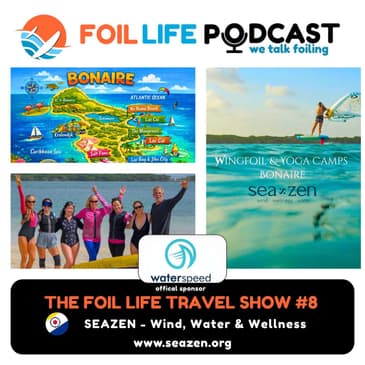

The conversation covers everything from Bonaire’s legendary flat water at Lac Bay — with its unique mix of steady 15–25 knot winds, protected deep-water sections, and safe learning conditions — to the incredible variety of activities both on and off the water.
Dasher and Ladina discuss what makes Bonaire special for families and non-watersports partners: world-class snorkeling and scuba right from the beach, rugged desert landscapes with wild donkeys, flamingos and parakeets, Klein Bonaire drift snorkel trips, sunset cruises, and more.
On the water, they break down their teaching philosophy across all levels — from complete beginners getting on foil to advanced riders polishing jibes, tacks, backwind 360s, and flag-out foil riding — plus exciting new additions like boat-assisted wake winging and para-winging sessions.
The duo also highlights their collaboration with Duotone at Franz Paradise, video analysis on a solar-powered beach TV, Bluetooth coaching headsets, custom private group camps, and the powerful wellness component that helps students stay injury-free, focused, and progressing faster. Plus, a sneak peek at their special August camp with acro-yoga, slacklining, kiting, and SUP options from their Puerto Rico partners.
Episode Highlights:
Why Lac Bay offers some of the flattest, safest learning water in the Caribbean for wing foiling
Seazen’s signature blend of wing lessons + targeted yoga, mobility, breathwork & mental training
Island activities for families and non-riders: snorkeling, wildlife, tours & more
Teaching styles, gear rentals through Duotone, safety boat support, and custom group experiences
Upcoming camps, including the unique all-inclusive August wellness & watersports package
Real student transformations — going from zero to confident upwind foil riding in one week
Whether you’re dreaming of your first wing foil session, looking to level up your transitions in perfect conditions, or planning a wellness-focused watersports getaway with your partner or family, this episode is packed with practical info, inspiration, and Bonaire stoke.
🎧 Tune in for all the details on Seazen and why so many riders are calling Bonaire their favorite wing foiling destination.
Brought to you by Seazen Wind, Water & Wellness — combining world-class wing foiling with mindful movement on the island of Bonaire.
Visit www.seazen.org to book your camp or private lessons and join the journey! 🌊🪁✨
[00:00:00] Hey everyone, welcome back to the show. On our 8th episode of the Foil Life Travel Show, we jet set to the beautiful island of Bonaire to meet Charles Dasher and Ladina Vonsual, the owners of Seazen Wind, Wellness and Water. The dynamic duo offer private lessons and they run a spectacular camp. I can personally vouch for them as I attended the Wing Foil Camp. I helped coach with them last year and it was great.
[00:00:27] We were able to help some beginners get off the water and it was an absolute amazing time. So we do hope that you enjoy this episode as we get to know them a little bit more. Next, I'd like to say a big thank you to our team. We have Frank, Stefan and Pam. Thank you guys for your continued work in the 2026. Next, we want to introduce WaterSpeed as the official app of the Foil Life community.
[00:00:51] It is the app that water sports athletes use to track their performance on the water. Connect your Garmin, Coros, Apple Watch and Vaccaros and it starts logging everything. Speed, tax, jives, foiling time, live tracking, VMG and polar charts. This is the kind of data that actually tells you whether you're getting faster or just feeling like you are.
[00:01:15] It works across 30 plus water sports including downwind, wing foiling, sailing, windsurfing and more and it turns every session into something that you can learn from. So before you listen any further, make sure to go download WaterSpeed now. It's available on iOS and Android. Lastly, thank you very much to our sponsors for the 2026 season. We obviously have WaterSpeed. Next, we have North Foil's Mystic on kiteboarding.
[00:01:41] Make sure to visit foilifepodcast.com forward slash sponsors to learn more about all of them. Now I hope you enjoy the show. Welcome to Foil Life. Whether you wing, kite, parowing, downwind, pump or e-foil, thanks for being here. Hello my friends, it's nice to see you both. Hey Luke, nice to see you. Yeah, what is new with the two of you?
[00:02:04] Oh my God, we survived another high season in Bonaire. So we're a little tired but really stoked on how the season's gone here. But yeah, I mean it is a long, busy season and we're just starting to feel it mellow out a little bit. But yeah, so we had another really fun season. Yeah, with a lot of wind, right? It was very windy the whole season actually. Really? Not many light wind days, yeah.
[00:02:34] So yeah, we've had more. We probably had more days where people were like, oh, it could be a little less windy than any days where people were like, oh, it's not windy enough. Yeah, yeah, yeah. So that's been pretty good. How's the overall though? Weather was good? Everything was good? Yeah. Yeah, that's awesome. That's awesome. Yeah. Because last year I think it was you had just launched CZN, right? So is this your first official year with it, a full calendar year? Pretty much?
[00:03:01] Yeah. CZN, yeah. I mean we still got two more camps coming up in May and one in August. But as far as like launching a full high season with CZN, yeah, this was the first one under that name versus just Dasher and Irie Sports and Wellbeing, which was Ladina's former entity. So now we are CZN and it's gone really well.
[00:03:27] So that's officially the name of your school for tonight's school episode, right? CZN, wind and wellness too, right? CZN, wind and wellness? Okay. Wellness, yes. Yeah. Located on the beautiful island of Bonaire. Yes. About nine months out of the year.
[00:03:53] Nine months. Cool. Well, for a lot of people obviously that are tuning in, you've either been to Bonaire or you want to go to Bonaire. Now the both of you have been there for quite a long time. Can we give a little bit of a highlight of the island? And obviously it's great for learning because it's super flat water, but what else is there to do on the island if you're bringing your family and perhaps they don't hop on the water kind of thing?
[00:04:22] Yeah. So there's the option to snorkel or scuba dive. The reefs are beautiful. You even can walk in from the beach. You don't have to take a boat and go drive out to the reef. So beautiful reefs. That's for sure something.
[00:04:39] Yeah. And, you know, I think one of the coolest things is, you know, just touring because it's such a unique landscape where you have this beautiful turquoise water set against this very kind of rough, rugged, almost desert-like island scope.
[00:04:58] And then you've got all the wild donkeys and goats and flamingos everywhere you go and parakeets flying wild. So just, you know, I think a lot of people when they come here, they start first at, you know, full on, I want to wing, wing, wing, wing, wing, but then they settle down and like, okay, we're going to take an afternoon off and they go tour around and that's always awesome.
[00:05:21] And, you know, you have the full gamut of, you know, you can do a sunset cruise, you can do a ride out to Klein-Bonaire, which is a little island off the coast and go do a snorkel, kind of a drift snorkel out there. So there's just endless things to do, all pretty much outdoor oriented. It's not like we're going to go shopping for the afternoon at the mall. It's definitely an outdoor island experience.
[00:05:48] It was the best snorkeling I've ever done in my life. It was phenomenal at Bachelor Beach. I'd just go out for a quick swim in between our first camp that we ran last year and the ocean made me feel alive. It was crazy. I know that the reefs are not what they used to be, but it was still compared to other places I've been to. Absolutely phenomenal. So where are your lessons located?
[00:06:14] So everything, you know, wing-wise is 90% of everything wing-wise happens on Lock Bay, which is on the windward side of the island. And it's a pretty expansive, clear, beautiful blue water bay with onshore wind.
[00:06:32] And so what's unique about Lock Bay is you have onshore wind with some of the flattest water known because of the outside reef and the shallow sandbar upwind. And then where we're launching on kind of the downwind side of the bay, you would expect there to be chop, but it's actually the flattest section of the bay because everything gets stopped at the outside reef and then the shallow sandbar. And then you have our deep water section.
[00:06:59] And it's just a nice combination of steady wind and, you know, but strong steady wind with flat water. And that's a very unique thing to have for learning to wing. That's one thing that people think about Bonaire, that it's only the shallow windsurfing section, but there's actually a large area that you can foil in when it's crazy deep.
[00:07:27] So that's one thing that I didn't know because I assumed everything was shallow, but that wasn't the case. Well, and I answer that question, you know, when I'm going on and looking at different, you know, wing threads and stuff like that. It's like, can I use my 85 mast if I bring it down? And I'm like, it, Lock Bay was founded on windsurfing back in the day. And it's very famous because it has have a large section that's, you know, thigh to chest deep water.
[00:07:56] But that's only a third of the bay. Two thirds of the bay is actually, you know, at least six to eight feet deep. And a lot of it is unridden. The kind of some of the upwind sections is actually unridden. And so, so yeah, that is, that is something that people are usually not aware of is how, because it was founded on the shallow water. Two thirds of the bay is actually quite deep.
[00:08:23] But because the wind is coming over that shallow, you're not getting a lot of chop. So learning is immensely easy given the fact that you're not bouncing around. Like even Mexico, La Ventana is a lot harder than here for that, for that reason. You know, we've had a lot of word went out the last couple of seasons through a few key people that kind of came over after a gorge summer.
[00:08:49] And then they were, they, they, they still, they still go to La Ventana, but they do a couple of weeks here first or after. And, you know, I hear it. It's like, oh my goodness, this is such an easier, easier spot. Much easier. Like to, you know, and then they go back and they go back to La Ventana again. And they're like, you know, they've progressed to where they can enjoy that even more. So it's pretty cool. Yeah. And it's safe, right?
[00:09:16] You don't, there's no chance to end up somewhere in the Caribbean Sea. It's like you go down the wind and there's a border where you got, yeah, you got land again. So it's very safe. What are the average wind speeds, air temperature? Air temperature. Um, air temperature.
[00:09:40] And I'll do the, uh, Fahrenheit is typically between mid seventies to, to in the winter time, the winter months, you know, upper eighties to low eighties. And then in the, when you get into the, the, uh, late summer, early fall, that's when the wind can be a little quieter. Then it can get quite hot. Then it goes up into like low eighties as the low and then into the low nineties for the high.
[00:10:08] And wind speed is, you know, on average 15 to 25. All right. Okay. What foiling disciplines do you both teach? So right now wing foiling is what we're both teaching. I am making it my goal for this summer to become a pair of winger.
[00:10:35] So I got a little bit of practice last year and just had a humbling experience, a humbling overpowered experience a couple of days ago. But, uh, uh, I'm pretty determined that, yeah, that we'll, uh, we'll get that dialed, uh, in.
[00:10:53] And, um, one thing that also that I'm going to focus on for next season, because we have a lot of people coming, um, that are now like, you know, they love coming back or they have a partner that's still kind of in the learning to jive, learning to tack, learning transitions, but they want some kind of wave action. So we do have, uh, uh, one, two places with swell.
[00:11:19] And then the other thing is I want to start doing some, um, wake winging, which is we, we have a boat that we use to create quite a good wake. And it's very flat water, but not in lock Bay. It's on the, the downwind side, but you can actually take the boat. Like wait for him? He's going to drive at the perfect angle. He's going to drive at the perfect angle and you can wing in, get on the wake, flag out.
[00:11:45] Or if you've got pair of wing skills, well, you know, so it's kind of a unique situation to use a boat wake to teach pair winging and, um, you know, flagging out and riding, uh, riding a wake. Oh, that's kind of cool. That'll be fun. Yeah. Yeah. So, so that's about that. That's about it. I mean, we're primarily, uh, wingers.
[00:12:07] I am going to also, um, get a, uh, an, a foil assist, a duotone foil assist and start working with that to kind of get into that aspect of the, of the sport. What levels are you both catering to? All levels? Beginners from, from my side. So Ladina's pretty comfortable. You taught me how to backwind. You taught me how to backwind. I wouldn't have been able to do that otherwise. So I guess all levels. Yeah.
[00:12:35] And then, you know, I'm teaching, um, um, you know, really comfortable teaching, uh, you know, like Carl Spice from, uh, launch was down here recently and we went out and did a morning session where we got him doing both, uh, backwinded 360s and one handed 360.
[00:12:52] So variations on, you know, variations on turns, twists, uh, you know, I, I really push teaching people how to learn how to flag out and ride just the foil so that they, they're, they're better in their transitions. But then when they do get in a swell situation, you know, they've already had the practice of how to flag out and ride more just the foil.
[00:13:17] But we really don't have, like, we don't have conditions for paddle downwinding here unless you take a boat and you go out in the middle of the ocean. So we really haven't been keen in. I mean, we, I think, you know, 98% of the people that are coming here are coming here to learn to foil, learn transitions, get dialed in on tacks and jibes.
[00:13:39] Um, you know, if somebody's here and, and, uh, wants to learn to jump, then we're going to turn them right over to, uh, Nigel at the Friends Paradise, who's, you know, probably one of the, the best instructors teaching high performance stuff down here. So we can cater to pretty much all levels of winging. Do you guys do, uh, gear rentals and sales for anybody that does not want to bring their gear to the island?
[00:14:07] Um, we work, uh, with, um, the Friends Paradise, Tati Franz's place. And we were really stoked this year because they became the official duotone center for Bonaire. Oh, really? So. Oh, that's cool. Um, so yeah, I mean, they really, they really stepped up. So we let those guys do the rental operation at work hand in hand with them. And then we just focus on teaching. Okay. What are you focusing on? Privates, groups?
[00:14:37] Obviously you did, you're doing camps as well. Right. So we're doing camps. I do a lot of private lessons, but we started this season. It's kind of happened organically where people are returning and they're bringing the family or they're bringing friends. So we're doing a lot of custom, what I'll call a custom trip where it's not like we organize a camp and open it to the public. But we have a group that comes down that may have, they may bring two or three beginners.
[00:15:06] They have some people that are just learning to get on foil. And then they have some guys that are trying to polish off jibes or learn tacks. And that's all in one group. So we'll cater a week of lessons and photos and videos for them, however they want to do it. You know, so with that, I think we had five different groups that we did this year. So it's pretty cool. You know, we'll usually do a dinner or two with them and stuff like that.
[00:15:36] So it's a private group camp, basically. So besides setting up our organized camp that anybody's open to, we do, basically it's a private week for a group, kind of a VIP group. Well, last year's camp went very well. People were extremely happy. They're still chatting in the group chat. Yeah, it's a pretty cool. Which doesn't happen all that often.
[00:16:02] So I have a personal experience of going to one of your camps and just seeing how, like, what is it that you can do there? What kind of nice restaurants and what it is that you can do on the water and off the water. But learning how to parowang, that would be a beautiful little bay because you're not worried about falling off. And that would be a pretty nice place. Now, overpowered, I had to body drag in and 30 knots and la ventana.
[00:16:28] So I know I had to body drag holding onto my leash, I think, or something in the water. So I can understand how that taught me a lesson for sure. But it would be a good place for it, wouldn't it? Well, I will just be clear that we're not parowinging on lock. No, you're not on lock? It's going to be on the other side, boat assisted. Oh.
[00:16:50] You know, years ago when kiting started, the park decided that that was going to be too dangerous for the flamingo population that flies over. So they stopped kiting and wrote it in their rules that anything that's attached with lines is not allowed.
[00:17:15] So a parowing looking, obviously looking more like a trainer kite than a sail or an inflatable wing has put it in a gray area where it would probably be looked upon as not allowed. So we do focus on doing any parowinging over on the downwind side of the island. Okay.
[00:17:38] Well, season wellness, what's the wellness component, Ladina, that you're adding to a lot of these lessons and camps and retreats? So the camps, most of them, they contain one hour of yoga or mobility in the program, which is really aimed to wing foiling.
[00:18:04] And otherwise, besides the camps, people, of course, have the possibility to join regular classes, which are going on right at the bay on a beautiful platform where you see the whole action going on on the water.
[00:18:23] So, yeah, I think that's also our speciality that we do combine the mobility, the yoga, the mental work also with the water action. So that's, I think, what makes the word wellness in our season camps. It's pretty amazing. I think that makes it very unique, yeah, compared to a lot of other schools who are not offering that.
[00:18:52] If you go windsurfing, you go winging four or five days, or if you're there for a week, the mobility is going to play a big part in you being able to continue and actually stay sharp and not sore every day from personal experience. Yeah. Well, I tell you what, you know, and that's one hour a day when it's a camp setting. It's not just one hour in that week. And what you find is like, and we cater it. Sometimes we'll do an evening yoga session.
[00:19:21] But there was a couple of days where I'm like, do you guys want to get started on the water a little earlier? And they're all like, no, no, no, give us the yoga first. Because by the third day, you know, they're like, they really, really enjoy getting their body warmed up and getting dialed in. And then there's also the aspect of, you know, Ladina has done a great job of really creating a program that isn't just yoga,
[00:19:48] but it's stretching to help your mobility for like, you know, extended riding toe side, but also, you know, for beginners who are learning to trim the board with their feet, you know, that during that yoga practice, you know, they're sitting there maybe with their eyes closed, focusing on where the pressure is on their feet. And it's, you know, and then when we get out there and coach them on the water, they have this awareness about how they're trimming the board.
[00:20:16] Or sometimes, you know, we get people that struggle just to get their knee starts. So they're learning how to use their body to make that lifting up on the board easier so they don't have to rely so much on wing power. And we've had great feedback from that. So it's been really cool. Yeah, also a lot, right, a lot of people do switch stance or toe side, like we also call it toe side riding.
[00:20:43] You got that twist in your spine, how to adjust everything with your core muscles and really keep your lower spine safe. Because, yeah, I see people which stand often switch day more or less after one week, they got a back problem, right? Because it is shooting into the lower back.
[00:21:06] So also an aspect to think about, it's not only, yeah, the actual action on the water, which connects with the yoga, the yoga, with the action on the water, but also the health point. We do really try to keep the body healthy and keep it nice and aligned.
[00:21:31] And also the mind, it's a little bit also a thing which helps if we do in the morning a meditation five or ten minutes before we go underwater. Helps a lot. People are more focused. They're more focused on themselves. And don't start trying to be somebody else or, yeah. True. Compare themselves with others. Enjoy your own journey. Exactly. Yeah.
[00:21:58] And I found really, as we've coached this more, you know, we do get a lot of people that are getting on foil for their, you know, the first time. And teaching them right from the start how to work with the wing with more finesse. And then, you know, as they start to do that acceleration and feeling the foil start to take off, you know, it's pretty interesting.
[00:22:26] You can see someone's body as they're starting to pick up speed and they start to tense up on the wing and the board starts to get erratic. And if you can say, okay, let's breathe and relax that grip. And all of a sudden everything settles down. So I think the relaxation part of it and the breathing part of it really play a lot into foiling because it is such a finesse sport.
[00:22:52] And if there's less fight and more relaxation, they do so much better. Yeah. Yeah. Yeah. A lot of breath work also. So that's why we for sure also practice with them. What's your teaching style like? Are you following people in a boat? Are you riding with them? What's the setup like over there?
[00:23:13] So it's pretty unique in that with that flat water, I'd say 80% of the time we're riding with them. And there's a stopping point. So if you've got a small group, there's a little spot that I call base camp. It's about, you know, 200 meters away from the beach. And we get lined up there.
[00:23:37] So I might take one person, follow them back towards the beach for a run and come back with them while they – because people get tired. So – but I'd say, you know, we're using with the small groups, maybe talking Bluetooth headsets. So that makes it – that makes it a much easier process to begin with. I got the van rigged with a big TV screen this year so we could do video analysis at the beach. No way.
[00:24:07] So, yeah, yeah. And it's all solar. So, you know, we're doing video analysis at the beach. So some sessions were about sending people out. We do a little bit of on-land training theory. Send them out for an hour and then bring them back in. And then they can have a break and we just sit back. And, you know, that – so we've got the writing with people. We've got the communication with Bluetooth.
[00:24:35] And then the video feedback is often one of the favorite things that people – because they can relax. They're watching themselves. They're watching others. And it's a very easy way for them to learn. That was the first time I had seen it and I thought video analysis was immensely technical, meaning that the clients probably wouldn't get a lot out of it. But a lot of these points are fairly obvious, especially for somebody starting.
[00:25:04] And you can pinpoint this stuff and it really helps. So it would be kind of cool to have it so close to the beach where I could still have my stuff on, come in, look at it, and then go and get that visual and go back out and practice. Another thing is fairly unique. That's cool. Yeah. I mean, from way back in my teaching windsurfing days, you know, I used to always do video jibe clinics, you know. And it really is – you know, people learn by feeling, seeing, and hearing.
[00:25:34] And that ability – you know, you may – everybody sits and watches everybody else, but until they see themselves, you know, they might not have that visual cue of what they're doing. So I really feel it's a great tool for teaching people. Yeah, for sure. Anything else about the school that you would want to put out to people? We've covered quite a bit. Oh, affiliation.
[00:25:58] So you do work with Duotone and whatever other equipment that Tati and them have? BB Talking USA, the headsets, we work really closely with them. The Franz Paradise, you know, they have really stepped up. I mean, people come back this season and went, wow, you guys really stepped it up. So having the Duotone gear to work with is really fabulous. You know, and there's always a boat.
[00:26:26] So, you know, when you get blown downwind, which happens at some point in everybody's career, whether you might have a wing problem or, you know, you're learning. What's really nice is there's, you know, worst-case scenario, you get blown downwind to the other shore. You're not getting blown offshore or so. But there's a boat that comes and gets you and brings you back, which makes everything feel nice and safe. That much safer.
[00:26:56] Yeah. Yeah, that's kind of nice to have that peace of mind and you can explore a little bit more and not have to worry about it. So that's cool. Well, anything else you want to put out there to the world about the school? You know, it's just I can tell you that I love this sport. I mean, I've done windsurfing, kiting and sup foiling.
[00:27:21] But the wing foiling and foiling in general is just, if you haven't tried it, it's worth the journey. And, you know, I had two guys last week that came down, had never done it before. And these weren't. These guys were both, let's say, 50 years old, had windsurfing experience. But, you know, they were on foil, not necessarily gracefully by the end of the sixth day.
[00:27:49] They were back and forth on foil, staying upwind. So, you know, both what they said from where they ride back in Canada, they were like, this would have been two summers. Big time. Of, you know, by the time they can get to the water and then, you know, to be able to have start with beginner gear and end the week on something, you know, be able to switch your gear out as your journey goes.
[00:28:15] They figured they saved a summer of learning by just coming down here for a week. So it is quite a unique situation that you have the consistent wind, you have the gear, and, you know, you have people that have been teaching and have a lot of experience teaching winging and foiling. So I think that makes it a very cool combination. How long have you been teaching now, Dasher?
[00:28:43] Well, windsurfing since, oh my gosh. Let's not date us. Think back. 1990 or, you know, like 1990. So I actually have a lot of people that I taught windsurfing in Aruba in the 90s that are coming down and going, hey, I'm ready for this next part. It's kind of cool. It was an investment in my future teaching there, windsurfing, because now they want to learn how to wing.
[00:29:10] Well, anybody who I've talked to about both of your teaching styles have loved them. I just want to mention that, especially Carl. He called me and he was so stoked of what he learned. Anyway, side note, but go ahead, Ladina. Yeah. That's sweet, yeah. Now, I wanted to mention our August camp, which is a combination with a couple from Puerto Rico, which is joining us.
[00:29:37] And they're focusing on acro yoga, on slacklining. So they're quite famous in that circle. And in that camp, we also offer accommodation. So it's a whole package.
[00:29:53] Really something for couples, for example, where one side want to wingfoil and maybe the other side rather would do like all kind of different yoga styles or slacklining or stand-up pedaling. Or you, of course, can try both. You can wingfoiling. You really can pick out what you want to do for the day from that offer.
[00:30:18] So it's like I mentioned, wingfoiling, acro yoga, slacklining, different yoga styles, stand-up pedaling, snorkeling, big range of what you could do. And also kiting. And kiting because they're into kiting. They're learning to wing, but they're also teaching kiting. So it's kind of like an all-encompassing, all-inclusive trip. And they're very unique. They do trips all over the world.
[00:30:48] So they came down last year and watched our house. And we talked about this and saw what they were. They loved Bonaire, so they're coming back again. And so let's join forces and do something that's unique that offers quite a variety. And you can kind of pick and choose what you like to do while we're here. Exactly, yeah. Because there's four of us. So we can take two people. We can go over to take winging. You can do slacklining. You can go kiting. Any of the stuff. It's end of August. Yeah.
[00:31:19] Yeah, that's true. End of August? Yeah. Where would people go to learn more about you online? That is at czen.org. Dot org. Yeah. Or social media. Website. There's a website. Oh, let's go over and check that out real quick, shall we? All right. So I'm just going to check out czen.org really quickly. Oh, very nice little site you got going on. When did this thing go live?
[00:31:48] Oh, I think it's like maybe in half a year. Something like that. Yeah. Here it is. I'm just going to give a quick look for those on audio. Czen.org. So you can book. You can find all the information about your camps all on the website. Yeah. Yeah. Dates. All right. So that's their special camp. That's the price for the camp? Wow. Very well priced. That's the price. No? Yeah, that's the one for the four-day camp. Four-day camp.
[00:32:17] No, that's not the all-inclusive price. Okay. I was thinking $7.45. Count me in. So that's the special camp. All right. Well, guys, thanks for taking the time to come and introduce CZN to us officially. Yeah. And congratulations so far on your first season. It's really nice to see that you were busy and that everything went well. So that's amazing. Super stoked.
[00:32:47] Thank you, Luke. Thanks. You're welcome. All right, everybody. See you in the next one. All right. Bye-bye. Bye-bye.