

Episode Highlights:
- Growing up in Mauritius and the local kite scene that produced top riders
- The Olympic journey — training, mindset, opening/closing ceremonies, and representing a small island nation
- Why Jean built WingGlide school and his passion for teaching all levels
- The unique Pointe d'Esny lagoon: safe, flat water, reef-protected, ideal for wing foiling, free riding, and instruction
- Downwind adventures, family-friendly vibes, and combining watersports with island exploration (hikes, boat trips, culture)
- Teaching philosophy and progression tips for wing foiling success
- Future clinics, the mix of kiting vs. wing foiling, and why Mauritius is a “safe bet” destination no matter the conditions
A relaxed, insightful, and inspiring conversation packed with real-world advice for anyone dreaming of foiling or kiting in Mauritius, progressing their skills, or planning an island watersports getaway.
Check out Jean’s riding and school on Instagram & Facebook: @we_glide or visit https://www.we-glide.com.
Brought to you by Waterspeed App — the ultimate app for tracking, analyzing, and competing in wing, wind, kite, and foiling. Download now and join the community!
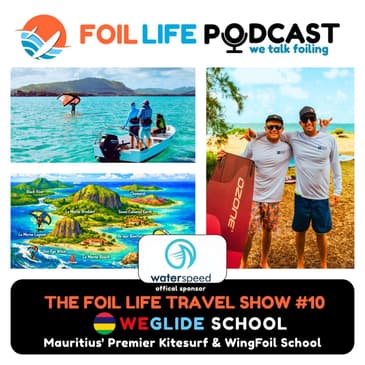
[00:00:00] Hey everyone, welcome back to the show. On this episode we sit down with Benoit Carpentier, Mauritian kite surfing pioneer, Olympic athlete and founder of the We Glide School at Pointe dEsny on the beautiful island of Mauritius. Jean shares his journey growing up in paradise, kiting since the age of eight alongside talents like Willow River Tonkin and his path to the Olympics, the four year preparation that became the real highlight and the magic of representing Mauritius
[00:00:30] on the world stage. So we do hope that you enjoy this Foil Life Travel Episode. Next we want to give a big thank you to our team, we have Frank, Stefan and Pam. Thank you for your hard work behind the scenes that allows this show to keep going year after year. Next as you know, WaterSpeed is the official app of the Foil Life community. It is the app that water sports athletes use to track their performance on the water.
[00:00:56] You can connect your Garmin, Coros, Apple Watch or Vaccaros and the app starts logging everything instantly. Speed, tack, jibes, foiling time, live tracking, VMG, even polar charts. This is the kind of data that actually tells you whether you're getting faster or you're getting better or you know, just feels like you are. It works across 30 water sports including downwind, wing foiling, sailing, windsurfing and it turns every session into something you can learn from.
[00:01:26] This is what performance tracking actually looks like when it's built for the water. So before you listen to this amazing episode with Jean, we ask that you go download WaterSpeed now. It's available on iOS and Android. Lastly, we want to give a big thank you to our sponsors for the 2026 season. We have North Foils, Mystic, and on kiteboarding and water speed. Visit FoilLifePodcast.com to learn more about them. And you never know, you might be able to find your next foil through our sponsors.
[00:01:56] Now I hope you enjoy the show. Welcome to Foil Life. Whether you wing, kite, parowing, downwind, pump or e-foil, thanks for being here. All right, Jean. Thanks for joining me on the show. Thank you. It's nice to see you. We've been chatting a little bit about Mauritius in general. So it's going to be fun to geek out about this island. Everybody's heard about Maui and what Maui sells.
[00:02:23] But Mauritius is a little gem, isn't it, as well for all of our water sports? It is. It's really known for the waves we have at Le Mans. I think that's what everyone sees and everyone hears about. It is a little piece of paradise in the Indian Ocean, which isn't quite well known for water sports in general. When I say that, I mean the Indian Ocean. But Mauritius here, it does deliver.
[00:02:51] And there's a really cool place for anyone that wants to come on and have a good place. You have really cool water sports and a good mix of doing other stuff. That's what's really special about Mauritius, is you can come and have a great time on the water. But off the water, you can also have a really cool time discovering mountains, doing awesome hikes and amazing boat trips. Hmm.
[00:03:21] Would you say it's like Hawaii-esque then? I've never been. I can't tell. For sure, we don't have a crazy wave that Hawaii has. It looks it. It's a bit more chilled than Hawaii. Okay, that's good to know, though. How long have you lived there? I've lived here since I'm seven years old. So all my life, basically. Okay. What was your favorite part about growing up there? It's kind of this little paradise in the middle of the ocean. So I guess you got into water stuff pretty soon, didn't you? Yeah, exactly.
[00:03:51] I kite since I'm eight. And since then, I've always just kite surfed. It's quite simple. But yeah, if you want to have a good time here, you have to be into the water sports. It delivers. And yeah, it will be a shame not to. Do you ever kite with Willow and some of the other pros that have gotten out of there? We used to. Willow doesn't live here anymore. Unfortunately, he spends a lot of time in South Africa.
[00:04:21] And I think at the moment, he's actually sailing around the world. Or he is sailing for sure. But we grew up kiting together. It was Willow, Luca Pito, really good freestyler from here. And some few other guys that actually were doing really well. When did you start to think that the Olympics were going to be a possibility for you? Because that's not every kiter's journey.
[00:04:47] No, I don't think most of us actually thought about the Olympics when we started kiting. Because it's really new. And it was quite funny, the whole training when we were on events with other sailors. Because we're not sailors. We're kiders. And the guys that came from the saline, since they're super young, they have these Olympic games in their minds.
[00:05:15] And for us, we just kind of fell into it. It was super different. And the whole process of training for the Olympics was a bit more laid back for us, I guess. And there was always this debate of if we were sailing or if we were still kiting. And it was quite funny. There was a lot of joking around. So we just kind of fell into it because we were doing the sport since early stages.
[00:05:44] And it became Olympic. And just at the right time, I guess. How did that experience go for you? We talked to Annelies and Maurice about their experience as a couple going to those games. And it was such a special time for them to be able to experience that. Yeah. For me, the whole experience was the training. The four-year preparation. I've kited all my life.
[00:06:11] And from a country like Mauritius, it was super hard to actually make it professionally. Because we are small means. And it's actually in every sport, it's super hard to become professional in a country like Mauritius. A lot of people, a lot of young athletes struggle. So for me, the whole preparation, the whole four years of training was really the whole experience. That's what I really enjoyed.
[00:06:39] The fact that you know, okay, for the next four years, this is going to be your job. You can finally do it at 100% without having to worry about anything else. It was super cool. Then comes the games, which is a bit of the cherry on the cake. The whole cake was the preparation. And obviously, you want to make it to the games. And if you do, that's awesome. And it's like a massive bonus. How were the games? The opening ceremonies and representing your country in front of so many people? It was cool.
[00:07:08] It's definitely quite special, the games, because you really feel like you're competing for your country. Versus all the other events I've done were much more for myself. And I just wanted to do well for myself. And now when you're at the games and you can really feel this energy from your country, all the people following, it makes it super special. And then, yeah, at the opening, you can see all these athletes that are with you, all these big names you see on TV.
[00:07:39] It's quite crazy. It's hard to describe. I mean, you'll have to go there to kind of experience it. But, yeah, it's big. It's big. That's the word. It's super big. When did, because today is a school episode, when did you decide to put all this passion and knowledge into opening a school there to help people learn?
[00:08:05] I would say it was maybe one or two years before the games. I kind of knew that if the games was going to come, I don't know, I'll need something else. I knew I was not going to go for the next games. That was for sure. Not because I didn't like the sport, but for me, I had to do something a bit more serious. I wanted also to be back in Mauritius. That's where I really enjoyed living and spending my time, which I didn't for the four years of preparation. So I missed home,
[00:08:33] and I wanted to have a plan to be back home, basically. Before training for the games, I had been instructing freelance for another kite school that was here in Mauritius at my hometown. So I have always kind of been instructing somehow, on and off, and I really enjoyed the job. It is quite special giving the opportunity to someone
[00:09:00] to kite surf or wing forward or do any water sports. And I mean, for us, it's not that much of a hard job because we've done it so much. And it's, yeah, it's kind of easy for us. Well, it's been part of your, it's in your DNA. Yeah. It's when, yeah, when you've done it all your life and something is so natural for you, it doesn't feel like you're doing a job.
[00:09:29] It just feels so natural, pain of the kites, handing this to the people. And I guess it will be much harder for someone to become an instructor from zero. So there will be much more effort to put in just from the ability to fly a kite, basically, and understand how it works with a boat or rescuing people and all those, you know, things around it, which for us was quite natural. And it just makes the job enjoyable. Yeah.
[00:09:58] I've had the fortunate opportunity to study under Alan Cadiz and Charles Dasher, which in Maui and in Bonaire, some of the legends in the wing foil, windsurf kind of instruction and how they break down a skill and how they help you learn that skill and transfer that passion is something that not everybody can do. Like Alan, both of them, to be honest, they're both at the same level, but how they're able to just look at you and know exactly what you're doing
[00:10:27] and how to help elevate your skills so quickly is phenomenal. So I think you can only do that if you're passionate. Plus, you've had so much time on the water. Exactly. There's so many small details. Like when you're coaching someone, you can just tell him the most simplest thing, but you have to know what he's feeling and where he's struggling and you'll be something so simple. Push your arm out, for example, where he might be thinking about 10 other things
[00:10:56] that are not going right and whereas it's just, or maybe lift your head up and yeah, there's small details and when you break it down step by step, it's actually quite easy. Where is your school located? I've heard of Le Monde before, but I hadn't heard of Point Destiny. What's different about that location, particularly on the island? Our location is not as windy. So that's maybe why this didn't become a famous kite surfing spot.
[00:11:26] Le Monde pumps. In winter, you've got 20, 25 knots plus, 2 meter waves and it's full on and that's why it's so popular because people travel there for the waves. All they used to for the windsurfing, it was big than the kite surfing. Our spot is much more quiet. We've got a lagoon. We are sheltered by a reef. It's onshore winds so the waves, we can't actually ride the waves all year round and we have this lagoon
[00:11:56] which is quite shallow but it still gives us a little chop which I think isn't so nice for people who want to really go hard in their kite surfing. But on the other hand, it makes it great for everything that's wingfoiling or free riding or instructing because it's super safe. The onshore winds, the fact that there's a reef all around the lagoon. The reef is really far out so you don't have any effect of current or any danger. Basically,
[00:12:26] we are on the southeast coast and Le Monde is on the southwest so it's opposite side of the island. Okay. So that does sound pretty nice. Could you, Bonaire, so it's pretty flat water then so it makes learning a lot easier than if you're in some swell or some bigger conditions, right? Exactly. There is a small chop. It's not glass but it's flat. I mean, it's not like it's not like an open sea in the Mediterranean that has a huge chop. So I'd say it's flat water maybe
[00:12:56] 1.5 to 2 meters deep. So it's quite deep. Obviously, we have some coral. So if you go with a coral, you'll be dry at some tides but at the high tide you can basically go everywhere you want. What's kind of special about that area? I know you mentioned that you were doing some pretty spectacular downwinders. Yeah. So our area is the biggest lagoon of Mauritius.
[00:13:26] we got maybe on a straight line 20 to 30 kilometers of lagoon and with five islands on the whole stretch of the lagoon. one super cool thing that we like to do when we have a good group of kite surfers or wing foilers is to do a downwind. It's just you're not going to ride crazy waves or you're not going to have the big air session but just the scenery of riding through these
[00:13:55] different islands down the reef with the background of the mountains like Mauritius is actually really beautiful and us as instructors it's the days we enjoy the most because well you get to share the spot you get to share the session with the clients and it's it's quite cool it's maybe it'll take two or three hours to do the downwind. Hmm wow that's a pretty decent downwinder yeah that would be phenomenal as well to kind of be in that environment
[00:14:25] for it it doesn't always have to be gnarly sometimes it's nice to relax and just cruise and look around. Exactly and that's that's how our position our spot people like people would come for more like free riding as a family maybe the kids are getting into the water sports learn how to wing forward do their tags their jibes all that kind of vibe is our spot is really good for them which can kind of tie into what levels
[00:14:54] do you cater to at the school all levels so beginner complete beginners and obviously with my experience in the foiling I'm quite comfortable to take anyone that wants to progress in their foiling or in the kite surfing so yeah a huge range of level I mean obviously the pros I won't be coaching them but yeah anyone that comes to do basic tricks and tricks and bigger or
[00:15:24] anything quite technical in the foils we can take them but we focus mainly on beginners that's what makes the business work the sports that you're teaching the most is it winging taking over or is kiting still pretty popular it's half half for sure and I can't tell which one is taking over I'll tell you a bit more in a few weeks when I have the stats some days we only have wing foiling which is quite surprising
[00:15:53] some days only kiting and sometimes a really good mix I would comfortably say we're somewhere around 50% that's cool and ages ages the kiting remains quite young and wing foiling is very often with older people this week I've actually got my first really young student which is 8 years old who wants to learn how to wing for it it's the first time I've had someone so young
[00:16:23] and it's going to I had 2 or 3 young kids in La Ventana last winter or the winter before one of them picked up land training really quickly it was just so intuitive and the other one may have been 10 you just couldn't connect and it took a lot longer and eventually they started to get it and in the water we just did this body dragging kind of
[00:16:53] thing where they were kneeling or winging and I would just hold on to the leash and they had a blast so it was a great introduction to it and very safe environment for them but they learned so bloody fast and they're going to have so much fun like imagine starting kiting at 8 that would have been for all of us who started later we found it 29 or 28 or something we were just like why couldn't I found this at 10 yeah yeah no the wing for
[00:17:23] for me it seems like some people get it it clicks intuitive and some people just don't get it and it's it can be quite challenging sometimes compared to a kite whereas a kite it flies itself you can let the bar go it flies and you just have to go left right no matter what you do the kite is going to be in a good position what's hard what I feel it
[00:17:53] just won't work and that's quite challenging to manage to make the student understand this is the right position you can have all these other positions they won't be good but this one works and sometimes it takes a bit of time there yeah that definitely does take some time can you walk us through what a kind of typical session is at your school so obviously it depends what's your level but let's say we'll take a complete beginner
[00:18:23] someone that's never winged before we'll do an introduction on the beach to obviously the gear the wing the board the board we'll be using for the first lesson is an inflatable board with fins on it it's a 235 litre board that's the gear we have for the first session so we pump up the wing we demonstrate to you how you hold the wing how we should flip the wing on the beach
[00:18:53] on the water and then obviously how you should hold it so now before we hold the wing we have a certain method to how they're actually gonna grab their handles so what we instruct is we we do it we do it we do it on the beach at first is you hold the wing in the neutral position which is on the main ladder by bringing the wing backwards just in that position you can turn the board into the wind so now it's quite hard for them to picture it because we're
[00:19:23] still on the beach but we want those reflexes to come before we actually send them on the board or each time they're gonna grab the wing so we we try and get that really early so we demonstrate how you should bring the wing over your head by bringing it over your head your front handle is in reach without you having to like reach over all the front handles so it keeps you stable we grab the back wing and we immediately ask them to be in
[00:19:52] this position where you can kind of see over your front arm and that kind of brings them in a safe position on their knees at this stage they're still on their knees and now we'll first ask them to do a little run on their knees on the board okay but whilst we're in the introduction we'll say okay this is yeah on your knees when you want to stand up front leg first then your back leg they often ask which one is the front leg so we'll just say well if it's your right hand forward it's gonna be your
[00:20:22] right leg forward that's true somebody has to think about that stand up and then we kind of ask them to find this relaxed position where the wing actually flies itself where it's not you that's holding the wing the wing has to fly so I would always demonstrate just with my two fingers like you can see the wings flying and I'm not actually holding it there are always put a huge accent on the fact that they have to keep their backhand straight like they're almost like you're pushing
[00:20:52] your backhand and you're extending your front arm and you kind of have to feel the wing that inflates and you're not coming to pull all the time they're doing that I'm also making sure they can see that I have my I can look over my front arm that for me is critical in the wing forwarding progression you always want them to be able to look over your front arm so that immediately from day one they can learn how to go upwind
[00:21:21] and the upwind that slight little upwind angle they have will keep them stable on their first few tries on the board I guess yeah so I explained them the whole process that that's still me that's demonstrating on the beach I haven't let them hold the wing yet I'm just like I run through a quick introduction to how they're gonna eventually stand up on the board I show them how they should hold it this is the position you have and then I'm
[00:21:51] quickly I'll quickly show them like I'll tell them what very often it's gonna happen you're gonna have the wing that's gonna go in the water and then I'm just gonna explain to them that if it happens I'll tell them you can try and lift as hard as you want this I'm gonna work you just have to push your back hand forward make sure you have your back hand extended push it forward flip it back up so I'll show them a few all this introduction all these all these do's and don'ts and then I'll
[00:22:21] just let them have the wing have a feel for it five minutes just grab it have a quick feel play around and then I'll put them on their knees on the beach and say okay now more seriously we're gonna run through different steps of how you're gonna grab the wing when you're on your knees on the board I make them go through all those little steps stand up and then once they're up start walking up and down the beach holding the wing and making sure that it's not like diving in the sand they're stable they're not over sheeting the
[00:22:50] wing they're like nicely they fly once we've got there then we're gonna go on the board and then they'll do their first few trials of getting up on the board the ability of turning up wind is so critical and it'll save a lot of time than just heading because people just ended up heading straight downwind right away but are you using jet ski or boat support with your clients are you riding alongside with them what's the most popular method so all our
[00:23:20] lessons are given with the boat support so we take them as soon as they're gonna start doing exercises on the board we're helping the boats I have fiberglass boats 17 foot boats with 30 horsepower so they're quite easy to maneuver they're empty they've got space they put the boards on the wing so we're helping the board I will literally drive maybe 500 meters upwind from the beach so we stay quite close and then I follow them with the boat and I coach them from
[00:23:50] the boat I can get really close I don't use any walkie walkies or whatever because I'm always very close and you must remember that we don't have a very strong wind it's always between 12 to 22 knots so it's quite manageable considering that the water's flat we can get super close and have a nice conversation you're not like getting rocked in the boat or there's no crazy gusts and stuff yeah they do their first few trials and I make sure that like as soon as they grab that wing
[00:24:20] they're already heading upwind and the whole process of getting up on their knees getting up and riding they have an angle upwind because then it's also going to help them if maybe we've done only two lessons and they get into a good session and they're going to go back home one friend's going to give them equipment to try they know they can ride upwind what makes your school unique on the island because there's quite a few different centers there's quite a
[00:24:49] few I think what makes us unique is the spot we have and the fact that we're the only ones on the spot it's super cool we go out on the water there is no one else instructing there's only our school and the spot's empty I mean obviously on a Sunday on a really good day you have maybe 10 other locals riding at a time and that's it so it's quite exclusive in that way where we have the whole spot for ourselves
[00:25:20] there's that there's the wing foiling conditions that are great even at the lowest low tide we can still use foils we can still instruct we can work I know that other spots around Mauritius they do have to wait for like a nice tide to go out on the water are you hosting clinics as well or camps this year we'll host our first kite surfing clinic cool it's gonna be end of July beginning of August
[00:25:49] now for people wanting to get let's say intermediate level who are wanting to tap into waves are you able to take them to a spot where it's friendly or how would that work kind of thing we can the thing is that it's not very casual we can't just go from our beach and go for a wave session we have to take a boat with us I need to take a skipper I would obviously
[00:26:18] be riding with the clients so that they know which is like you know on a waves you can have different peaks and I can be them with them and all that what I want to say it comes at a cost so if clients are really keen and they're willing to pay for like half a day of me a skipper on my boat no problem we can go and do it but it's not something that I advertise because I know that Le Monde is much better for it and you do have guides there for
[00:26:48] that okay so this is a perfect flat water spot to come and learn and what's the lifestyle like what's the town like it's super relaxed it's it's actually like postcard Mauritius it's true it's a very nice white sandy beach you have apartments on the beach so some of my clients most of them actually have accommodation within 200 meters 50 meters of my high
[00:27:18] school so they're there on the spot and overlooking the La Vue and the Chocras border so that's super cool it's like the setup for accommodation is nice and one kilometer from where this nice beach of Kondesny is you have a local fisherman village so it's super nice for the people that come and discover Mauritius it's quite authentic that's what I want to say by then is you can go into the village do your groceries
[00:27:48] and it's very authentic and very local so you have a really cool experience of what Mauritius is just by staying in this area whereas on other spots of the island it can get very busy it's gotten very touristic it's building up below traffic and it's not the same experience oh it's good to
[00:28:22] and it's super rare it's like to see them in two meters of water like super shallow is quite nice it doesn't happen often I haven't seen it
[00:28:52] hear any noise yeah they were everywhere in Maui and if you got too close I think I hit a couple shells by accident but they get so used to seeing people and they dive super fast but sometimes it's you can't avoid them when you're foiling is there anything else that you feel people should know or should convince them to finally book their trip to Mauritius I mean yeah so what I've heard from people that travel a lot is
[00:29:21] a lot would go to these destinations like Morocco or Egypt and stuff which actually pumps when the wind is there but on the downside if there's no wind they're just sitting there waiting for the wind and there's not much to do Mauritius for me is a super safe place to come for a trip because no matter the conditions obviously you want wind still going to have an awesome time you're going to go snorkeling
[00:29:51] you can go surfing it's very accessible you're going to have super boat trips discover different cultures the island has so all that makes that it's like a super safe call you just know you're going to have a good time because there's nothing worse than planning a trip going somewhere conditions don't deliver and you're just there you don't know what you're going to do with yourself so that for me is
[00:30:32] eat food that's what you have to eat when you're here you go out there's a very nice Indian culture in Mauritius so you have very nice curries all those kind of Indian style foods are super tasty and I mean if anyone who comes to Mauritius has to somehow link up with a local and where is a good spot because you won't necessarily know you have to be local
[00:31:02] and what I also like chili yeah they will enjoy their meal with chili but you have to be careful what about land based activities is there like rock climbing or indoor rock climbing or mountain biking or any of those other kind of sports you can do on land yeah yeah for sure you can do mountain biking the only thing it's super hard to access good bikes if people are really into it they'll have to bring their bike there's super
[00:31:32] nice hikes Le Monde is known for its spot but it's actually Le Monde is a big mountain a big rock that's super nice to hike off and views is incredible so there's a few hikes that are nice a few trails yeah I mean there's there's a bunch of activities you won't get bored and the clinic we're doing this year is actually going to be a mix of come and
[00:32:02] kite to Mauritius come and get a better kiter and we're also going to discover Mauritius with the clients through that clinic like we're going to take them on different activities that are on the land so they actually get to see the place oh that's cool like a lifestyle clinic yeah for sure we have that it's going to
[00:32:45] be to countries or spots and I've only been in the water only kites have jumped back in the plane came back home and then I thought back I was like man I've been to this place but I actually I did I don't know where I've been I did not visit I did not enter at all yeah and so I think it's
[00:33:15] I I guess through the website they usually find me on whatsapp or send an email awesome well hey man thanks for taking the time to introduce your beautiful island to us and I think it's time that we finally get over there Tom Hartman is over there Jorgen from the SFT is over there and we've had Willow on a
[00:33:46] cool thanks Jan we'll talk to you soon thank you everyone thank you so much for tuning into this episode we really do hope you enjoyed it we'd love it if you could subscribe to our Instagram YouTube and TikTok channels to help our show grow we are constantly putting out some really cool content there so that would be awesome if you could do that for us if you have any
[00:34:21] enjoy your day and we'll catch you in the next one