

Episode Highlights:
- Leading the DEFI 20 km Water Speed Challenge and chasing the Golden Jersey
- Gear breakdown: sail, prototype wing, and board choices for speed + endurance
- Balancing top speed vs. sustainable average speed over distance
- The insane 561.6 km / 24h challenge — logistics, pain, mental game, and the 800 km goal
- Night foiling creativity (broken boom + flashlights), safety, and community tracking
- Why Waterspeed’s live tracking, leaderboards, and performance analytics are perfect for DeFi prep
Whether you’re training for DeFi Wind, dreaming of ultra-distance foiling missions, or just love hearing from riders who push the limits, this episode is packed with real talk, motivation, and practical insights from one of the most dedicated watermen in the game.
🎧 Tune in for stories of speed, endurance, and the pure joy of foiling in Gruissan’s perfect conditions.
Brought to you by Waterspeed — the ultimate app for tracking, analyzing, and competing in wind, wing, kite, and foiling.
Download now and join the next DeFi Challenge! 🌊⚡
Visit: https://defiwind.fr/en/
[00:00:00] Welcome to Foil Life. Whether you wing, kite, parrowing, downwind, pump or e-foil, thanks for being here. All right, hey Jean, thanks for joining us from the beach for this little short leaderboard update of the water speed challenges preparing for Defi. How are you my friend? Yeah, I'm very good. I'm now on the IFCA World Championship and no win for the moment but I'm still in the beach.
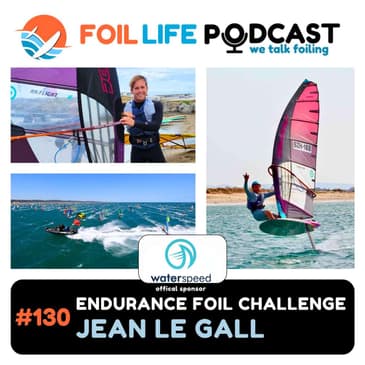
[00:00:29] So I'm quite good. Nice, and you hit a top speed of 37.20 knots and a time of 23 minutes and 54 seconds .99. How does that feel to be at the top of the leaderboard? Yeah, that's weird because it's the first time I'm in the first place during a competition so it's quite good.
[00:00:54] I appreciate a lot and I hope I have 10 more days to wait but I cross the finger to stay in the first position. Hey, congratulations so far. That's pretty exciting. Are you looking forward to the potential of wearing the golden jersey at Defi?
[00:01:16] Yeah, I'd like to. I hope I can wear this light bra, this t-shirt. It will be an honor to have it. What kind of gear or how are you able to maintain your speed to be at the top?
[00:01:35] I think to reach the 25 minutes or 24 minutes, I reached 27 knots during 20 kilometers. I think it's that speed. And I used my 4.9 sail, an Elpride sail from 2024 I think.
[00:02:05] I don't know if I can turn my phone. No, I can't. But I used this. Nice, okay. Beauty. Yeah, and I used this one. I have a prototype of front wing, 350 centimeters square. And I have a GP board, 80 wide.
[00:02:36] And with this I reached 37 knots on the top speed. And I did this on the, on the La Plage du Rouet in Grissant. Oh, so you're a speed spot. Windsurf foiling. Yeah. Windsurf, holy shit, that must be fast foiling. That's like 68 kilometers an hour. Yeah. Yeah, almost. Previously I did, I did 38 knots.
[00:03:04] It's my top speed, but it wasn't during this day. Yeah, that's crazy. How do you balance between like pushing for top speed or maintaining a good average speed for such a distance? Because maybe some riders will go really fast and get tired or fall and slow down. What do you think the best approach is? Compared to the fin in the jibe on the foil, it's more easy to, to not lose speed. Okay.
[00:03:32] So, thanks to Grissant, the sand is the wind, sorry, the direction of the wind is quite good to make long distance. And I can, I can stay close to the beach and I don't have so much, so much waves and I can go fast during a long time. And I don't need to, to jibe every 13 seconds.
[00:04:01] So I can, I can do like a Duffy training, one side, the other side, one side, and it's, it's over. So, it's quite, it's quite fast to, to do 20 kilometers. I said, I said to myself, go fast as you can. And, and you will see after in the, in the app. Fair enough.
[00:04:28] What do you like the most about using water speed to track and to connect with the community like this? Cause this is a pretty fun little contest before the Duffy wind. Yeah. You can, you can compare the, you can compare with the, the other guys and you can see the track. And the one thing is very good. Also it's the, you can follow the people in the, in the real time.
[00:04:55] I can, I can send a link and they can see me in the water and they can follow me during the Duffy or. Or, or, or other Duffy's. But yeah, that, that's quite good to, to use the app during the, during the Duffy. Like beyond just tracking speed, what do you think about the foiling efficiency, tax and jibes? Do you think that's going to help you stay competitive and, and use those kinds of metrics? Yeah, that's quite good.
[00:05:23] We can see, we can see the difference and the evolution of the, of the, of the, the performance. I don't know. So yeah, that's quite good. Okay. Where did you record this session? Ah, this session was in Grissons. In the, the, the same place as Duffy. Yeah. So for people who have never been there, it gets pretty gusty, right? You get some offshore, pretty strong wind. Uh, yeah, but it's, uh, the water still, still flat. Okay.
[00:05:53] Because the wind come from the, the, the, the land. The land, yeah. Yeah. Yeah. But on the foil, we can't go too close from the beach because there are sand bank. So we have to be a bit, uh, a bit further, but, uh, that's quite, uh, that's quite the same, um, the water. Okay. So it's flat. Yeah. That's still flat. Now there's, even though it's offshore coming from land, going out to sea, it's not too scary
[00:06:22] to be able to in, in that kind of wind, given the fact that if anything happens, you'll get blown out or is it not? Yeah. That's quite, uh, a bit dangerous, but, um, um, I'm not alone in the water. Uh, there are always people, uh, with me, uh, looking, uh, looking sometimes, uh, if, uh, if I'm good and, uh, I have the, um, the water, I have my phone in my backpack so I can,
[00:06:47] uh, uh, uh, every people who have the link, uh, can see where, where I am. Um, they can see where I am. So you like that, that feature. Yeah. Another little point that would be super cool to talk about is, um, is you had a 24 hour challenge. That's how many kilometers did you hit with that? Uh, 561.6, uh, kilometers in, uh, in, uh, 24 hours. Yeah.
[00:07:16] So you sailed midday from to midday, so you sailed all the way through the night or how did that work? Yeah. Uh, we have some, some problem because the, the nightfall and, uh, there were, um, um, there, there were a fire, uh, next to Grisson and they blocked the, the light from the moon. So we need to stop during the night. So I, I, I start at 12, uh, AM, uh, I finished the first part in, uh, in 9 PM. Okay.
[00:07:47] And, uh, um, I stopped during the night and I, and I restart, uh, at, uh, at 6 AM to, uh, 12 PM to 12 AM. Oh yeah. Yeah. That's, uh, that's, uh, that's, that's 15 hours. So, um, uh, I want to, to, um, to, um, to, um, to restart, to do, to do it again, to, to reach, uh, uh, I, I want almost, um, uh, 800 kilometers. Yeah.
[00:08:17] Oh, yeah. How do you make, how do you maintain that for that length of time? Do you stop for food or drinks or how does that work? Uh, um, I make, uh, only one, one, uh, one break, uh, to refuel the, uh, the backpack with a water and something to drink and, uh, something to eat. So I, um, uh, I have some, um, some energy bars in my, uh, in my backpack and, uh, three
[00:08:45] liters of water, uh, behind me. So that's, that's kind of enough. And, uh, when I stopped during the night, I, uh, I eat a lot. Yeah. Some cheese, some jam, so everything, uh, close to me. How do you, how do you stay mentally focused for, for that length of time? That was difficult because we have, uh, some, uh, mental fatigue. I don't know. Yes. Yes. Yeah. Yeah.
[00:09:15] That was exhausting and, uh, physically also. Yeah. Yeah. How do you, do your legs go numb or how does your body? No, that wasn't the, no, no, the body was good. The, the only thing was, uh, painful was the, the end of the, the grip to, to hold the, the wish to the boom. Yeah. It was, uh, because when you drive, you need to change the position of your, your, your hand. And it was kind of difficult, uh, during a long time. Yeah.
[00:09:43] Uh, because, uh, uh, it's hurt when you, you, you, you, uh, you pull the boom, uh, all the time. Yeah. So how was it taking a break, eating and starting over with your body sore and you must've been tired as well. Yeah. Yeah. That was good to make a break. Yeah. Yeah. I can imagine. So your next one, you said you want to hit how many kilometers? 800. 800. Yeah.
[00:10:11] Like, uh, we, we want to do it during the night this time. So, um, I need, uh, three hours to do a hundred kilometers to be, uh, to be able to, to reach that, um, that, um, that distance. But yeah, nine hours during the night, it's, uh, it's enough to do 300 more. So I think it's, uh, it's going to be good, but, uh, I don't have, um, a time to do it again.
[00:10:38] Uh, I think, uh, during the summer, that's when the time is, uh, it's the best because, uh, the, the sun, uh, rise, uh, soon and, um, and the sunset, uh, late. Yeah. That's why, uh, it's a, it's a good time during June, June, July. So, uh, maybe, uh, I will, uh, I will try again. Um, and how do you, how do you see at night?
[00:11:06] Is it, is it moonlight or is it headlamps? Yeah. Um, um, I don't know if you know Fred, uh, Frederick Oudier. Um, he did, he did this in the, in the film and he tried, uh, with, with the foil. So he beat me, uh, to 10 kilometers. So he did, uh, 571 just to, to, to say, uh, I beat you. But, uh, that's, that's why I want also to, to do it again.
[00:11:34] Cause I don't want to say, uh, I don't want to let him, uh, in the first place. Yeah. That's cool, man. Yeah. Well, Hey, let us know when this is going to happen. It would be super cool. Yeah. But I will use the water speed app to record this. So I will, you, you can see, uh, when I did this during, yeah, during the night I used, um, uh, during the first time I broke, uh, uh, my, uh, my boom, uh, cause I hit the fish. Yeah. Yeah.
[00:12:04] 32 kilometers, 32 knots. And, uh, yeah, it broke, uh, in three parts. I can send you the picture also. Sure. And, uh, and thanks to this, I, uh, I cut the, the head of the boom and I, I keep the, the attach to fix, uh, two screws and, uh, attach the two, um, flashlights. So, uh, I will send you again the, this picture and, uh, and, uh, um,
[00:12:32] thanks to this, I hope I can, uh, uh, I can, um, I can, uh, I can see in the dark. Do the 800. Yeah, exactly. Oh, sick. Nice, man. That's really creative. We need also, uh, some people to, to have, uh, to, uh, to safety, to, uh, to light in the, in the, in the sand, in the, in the reef. So yeah, we, it's, uh, it's not easy to do, but we need some people to help us to, to reach this.
[00:13:02] Okay. Yeah, no, that sounds exciting, man. Okay. Thanks a lot for joining me and, uh, good luck, my friend. We'll chat with you soon. Thanks. Bye. Okay. Bye. Bye.